Ipley Cross in England’s New Forest is notorious for being the UK’s most dangerous crossing for cyclists. The particular angle of the intersection gives rise to a phenomenon known as “constant bearing, decreasing range.”
In essence a the angle will have the car just out of the cyclists’ visual range, up until the point where they crash. At the same time, the car driver will not see the cyclist because they will constantly be inside the visual shadow of the car’s A-pillar (the pillar next to the windshield.
Both motorist and cyclist won’t see each other until the final moment where they crash, with deadly consequences for the cyclist.
Both people may be absolutely alert and focussed on the road ahead, but neither will see death approach directly down their path.
Focus or Flounder
I find this analogy particularly interesting against the backdrop of years of business consulting advice that claims “focus” to be the highest good in strategy.
We fear that a diffused perspective will scatter energy and reduce our ability to achieve results. Like a magnifying glass concentrating the energy of the sun, only a strategy with clear focus can consolidate the organisation’s energy to catch fire.
Thus the mainstay of McKinsey style consulting has been consolidation, rationalisation, and divesting anything with a whiff of distraction. I’ve personally been involved in a few outsourcing and reorganisation processes where we were encouraged to “cut the fat.”.
The logic usually states that a company that focuses on doing just one thing will be more cost-effective than your internal department, trying to juggle multiple roles.
The core mantra of Western economics: division and specialisation of labour.
Objective = lens/filter
And there is some evidence that providing focus to a team works. One study, in particular, gave the same coding task to different teams with different top priorities. In other words, one team might have been told that on-time delivery was their top priority. The other was told that usability was key.
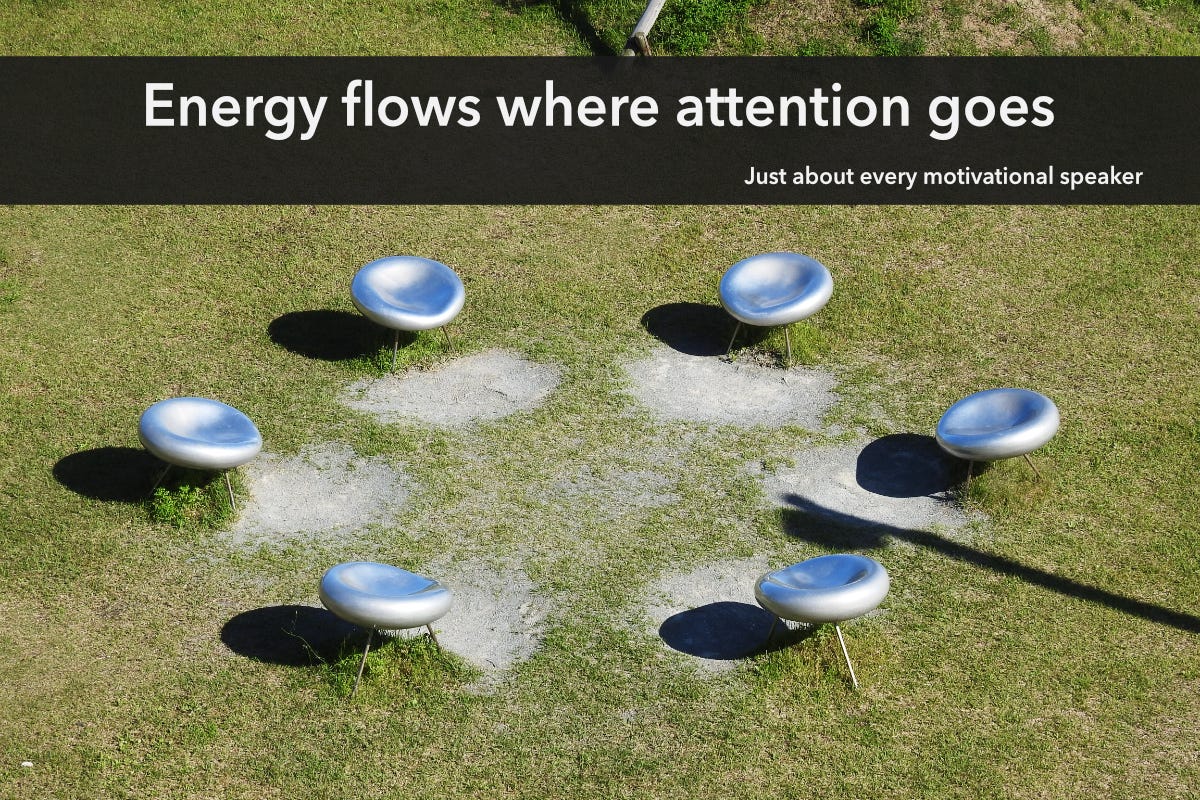
Surprise surprise, teams performed according to their top priorities. The old saying: “What gets measured gets done” serving as the business-friendly version of “Energy flows where attention goes.”
The flipside of the learning however was that such a focus came at a cost. There were always unintended consequences as teams simply did not have a holistic perspective when their objective was to prioritise.
In addition, the selective perception associated with this focus also constrained and narrowed the learning path of the team. Missing out on new or relevant trends because they were focused on the established objectives.
Okonomiyaki
It’s interesting then to see how Asian firms and the Korean Chaebol’s, in particular, stand out in contrast against this obsession with reductionistic “focus.”. LG does everything from communication satellites to trains and dishwashers. Samsung provides your phone, industrial chemicals, and much much more.
I’ve always wondered if it was an engineer from the train engine department who provided the spark of inspiration to do away with the belt drive in the washing machines.
When we look at the cost and consequences of focus nature provides an interesting analogy.
I always say that diversity is the intelligence of a system. But diversity also provides the capacity for sustainability. Look at how expensive it becomes to maintain a monoculture.
The model of date palm or soy (or any industrially farmed commodity for that matter) sees diversity as a cost. You need to buy herbicides to kill the encroaching plants and the congestion will make it harder to harvest and sort the money paying crop.
But as the soil gets depleted (due to lack of microbiome) the farmer gets caught in a trap of having to buy fertiliser and other expensive supplements to sustain the productivity of his crop.
In the same way, a team or company that has become hyper specialised, will pay dearly for the lack of exchange and exposure to other ways of thinking and approaches to solving problems.
In AI Superpowers, Kai-Fu Lee describes how Chinese companies grow. The Chinese business ecosystem is extremely competitive, just purely due to the low cost of entry and the sheer number of people ready to take your place. Launch an app and within twelve hours you’ll have clones operating.
This makes one-trick pony companies very easy to supplant. To counter this challenge, the companies will quickly vertically integrate to own as much of the customer interface as possible.
The amount of innovation that has come from companies like Alibaba and Tencent has been astounding, but in retrospect quite understandable given their pressure to survive.
They have to offer an integrated and diversified offering to own the interface.
When a food delivery app launched they quickly had to build a fleet of drivers and even kitchens to out-compete the clones who were simply passing on orders to the restaurants and relying on their delivery services.
A western VC would have praised the second approach for making smart use of existing infrastructure = Focus on core competency.
A real-world competitor would praise this vertical integration as a way to secure customer satisfaction.
Fuzzy, furry and incomplete
So perhaps the issue isn’t focus so much as where and on what you focus?
As we begin to understand the working of our brain better, we also understand that conscious focus comes at a high price. We burn a lot of calories on our attention span.
That is why the biggest majority of our processing happens below our conscious attention. We do not “focus” on the way we walk, chew, or sense slight changes in wind direction and flavours.
The biology of our body is however finely tuned to translate these signals into emotional cues to shift our focus towards relevant “focus” areas.
Blending focussed and unfocused learning has been shown to increase creativity and results. We bring in a far bigger and more ancient wisdom when we dive below focussed attention.
Our mind however relies on the trick of verbal communication to translate these thoughts and experiences into ideas that can be communicated. And that is the true bottleneck
In the same way that when soy or palm oil are seen as the only valuable species because they earn money, the thoughts in our range of focus receive a premium because they can be communicated.
The fuzzy, non-verbal hunches and ideas get played down and rationalised away, even though they may be far more important, decisive and urgent than the things that can be formulated as a target or objective.
I hope our society is at a point now where we can evolve our concept of focus to include the fuzzy awareness and depth of our full wisdom. Let’s harness our full potential and engage others more deeply in building a diversified and vital perspective.
Let’s take that leap.
P.S. The audio text contains a lot of information not covered in the text. Please feel free to listen to the podcast for more background information and perspective.
Three key take-outs:
1. Depth of fieldHow might we broaden our field of view? Include a broader set of senses and feelings to inform your focus.
2. Finding rangeHow do we test and calibrate our focus to ensure we are not blinded by it? What are your control/sounding board/contrast and compare protocols?
3. Multiple lensesCan you define objectives in a way that encourages learning and adaptation? Can your harness the power of focus at the right time and in the right domains, yet be expansive and inclusive?
Side Note:
This week we launched cooko.co
Cooko is a new venture which aims to improve the situation for cacao farmers. The industry is currently one of the world’s biggest contributors to human slavery and environmental degradation.
Please reach out if you’d like to know more and invest.