Empathy has become a very charged term in these days of integration and identity. Through mindfulness and non-violent communication, we seek ways to engage and anticipate the emotional realities of our counterparts.
Surprisingly, the word empathy is relatively new. It traces its roots back to 1858 when the German philosopher Rudolf Lotze started using the concept of “empatheia.” It was the Greek expression of the German “Einfühlung” – literally to feel within. To be inside the emotion.
The directionality of the term opens a very revealing challenge and shortcoming in the way we use it in modern discourse. If we attempt to be “in the emotion,”
…are we using empathy as a mirror or a window?
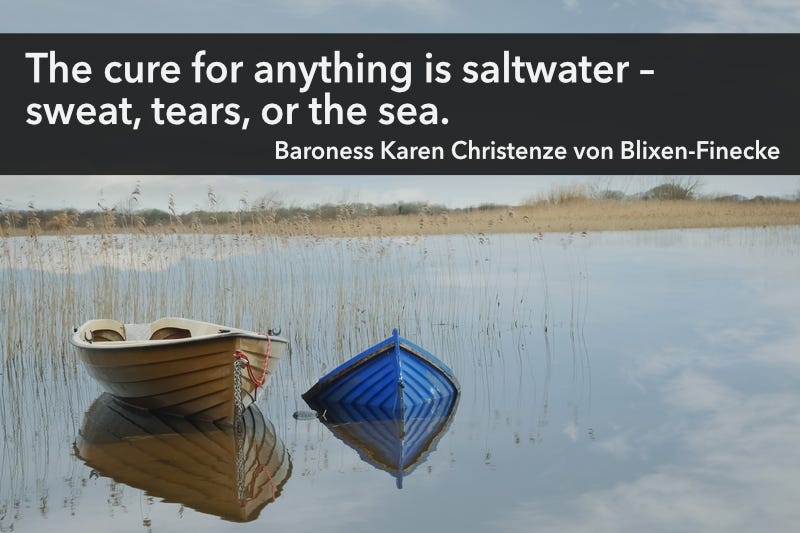
Sweating the details
Ovetta Sampson’s powerful article on Medium at the end of 2020 titled “Stop Bastardizing Design with False Empathy,” is a great place to start the discussion.
Ovetta walks through Goleman’s three levels of empathy to describe how we fool ourselves into believing that we are deeply connected to the reality of another person. The 3 levels are:
* Cognitive: you understand what the other person is feeling
* Emotional: feeling along with the other person
* Compassionate: beyond the first two we are compelled to help when needed
The design thinking hype has led many people into a space where they believe they are applying empathy, because they understand the predicament of the person they are designing for. As Ovetta points out, quite often companies will even substitute “the person they are designing for” with a so-called (fictitious) “persona.”
This persona more often than not reflects the bias of the designers. It is a static model of their imagined user.
In other words, this “empathy” is mirror.
Going to the next level often requires dedicated “empathy exercises.” These are activities designed to elicit the same or similar emotional state that the target user is experiencing. Quite often you need to create a totally different scenario to bring people into the same space.
For example, if you want people to experience what it feels like to be blind, the first reaction is to cover people’s eyes. This won’t create the same emotional state though because for the “designer” it will be a novel state. For someone who is blind, this is their default state and they have adapted to being operational in this.
It might be more useful to paint everything a monotone colour to hide the descriptions or visual information we rely on. This will more closely resemble the frustration experienced by a blind person navigating their way in a world designed for the seeing.
So the calibration of the emotion has to be adapted for the person who is seeking empathy. We need to understand what reference inside them will trigger the same emotions being experienced by the other person.
There is a massive danger in this too.
As I point out in the audio section, this can be a lot of fun and very useful. It is also very very dangerous as I found out. In one exercise we wanted nurses to experience the helplessness and disorientation felt by women going through labour, when they are left alone by staff or the staff do not respond to their calls.
We sent them on a treasure hunt, communicating only via SMS. Whenever they asked for instructions or wanted to know what to do next our response was: “just hold on a minute, we just have to sort something out and we’ll be right with you.” We had taken this line from a response they were providing on a regular basis.
Needless to say, when the group returned to the design session, they were ready to explode. The exercise had worked perfectly but unfortunately, the overwhelming nature of the emotions completely blinded their ability to design from it. They were in a rage.
You can see the limits of applying empathy when you need to for instance design for people who have experienced trauma or are in a debilitating psychological condition like schizophrenia.
The fact is that we can become so blinded by our own emotional response that we substitute the actual feelings of the other person, for the intensity of our own awe, disgust, hopelessness or whatever feeling has been triggered by the exposure.
So the second level is also at risk of being a mirror rather than a window.
Tasting the tears
Goleman’s third level I find problematic as well.
When we were launching ReDI in 2015, it was at the height of the Syrian refugee crisis. In the presentations we held to build support for the cause, we noticed something that we ended up calling “refugee porn.”
Often, we’d run into people who were listening to our story with the expectation of some kind of sensationalized insight. In essence, there was a group of people who were listening to the story for their own gratification. In a weird way, they wanted us to excite their emotions through sensationalism in order to motivate them to act.
To be clear, Outrage ≠ Empathy
We found this dynamic to be fundamentally unethical too. You cannot use people’s strife, disposition, or stroke of fate as a marketing line. Emotional clickbait to fool people into thinking that feeling outraged is the same as doing something about the core issue.
The so-called “white saviour complex” is another version of this. The core flaw in this approach is the way it places the experiences on different levels. The “other” is reduced to an “object” that must be pitied, protected, patronized with guilt and apology.
This is the opposite of empathy. By doing this, one does not enter into the emotion, one is simply projecting emotion onto an individual. The intensity of our emotional experience is not the same as accuracy in the emotions we experience.
So is it possible for empathy to function as a window instead of a mirror? Can we break out of the hold of our emotional experience to calibrate towards a bigger and inclusive under-standing?
I would suggest that the foundation of empathy should be respect. Our motivation to act has to be driven by a basic respect for the humanity in which we share.
Respecting that what our counterpart experiences as “being helpful,” may not be our help. We need to calibrate at a deeper level.
The Sea-change
On a course I attended many years ago, the instructor made an interesting analogy. The challenge of navigating the experience of empathy is like two ships on one ocean. Both are moved by the same waves, both feel the same currents but their response will be very different.
We have to understand that our ship is not their ship. That we own our emotions and should not confuse the two.
But we can go deeper into the ocean to understand the common connection we share. Acknowledge the currents and feel the ripples. Through this, we can see that each individual is a manifestation of a different experience of the same humanity.
In this, we can find true empathy. Understanding that my experience is not higher or lower than yours. That the completion of our “oneness” comes from the respect for our difference.
Let’s take that Leap.
Three key take-outs:
* Sweat Are you doing the work to deeply connect with the reality of the person you seek to establish empathy with? Are you walking in their shoes, in a way that is truthful and honest to their experience?
* Tears Have you progressed beyond the point of simply understanding with your mind, to a point that you can connect with your heart? Are you feeling tears driven by your emotional needs or their emotional reality?
* The Sea Can you respect the other person as a complete being, not damaged, defunct or in any way diminished? Can you find respect in your common humanity?
This week’s inspiration: The weight of the world
For Joachim. Born 28/6/21, Died 28/6/21