That took a lot longer than expected! But the journey has been a rewarding one.
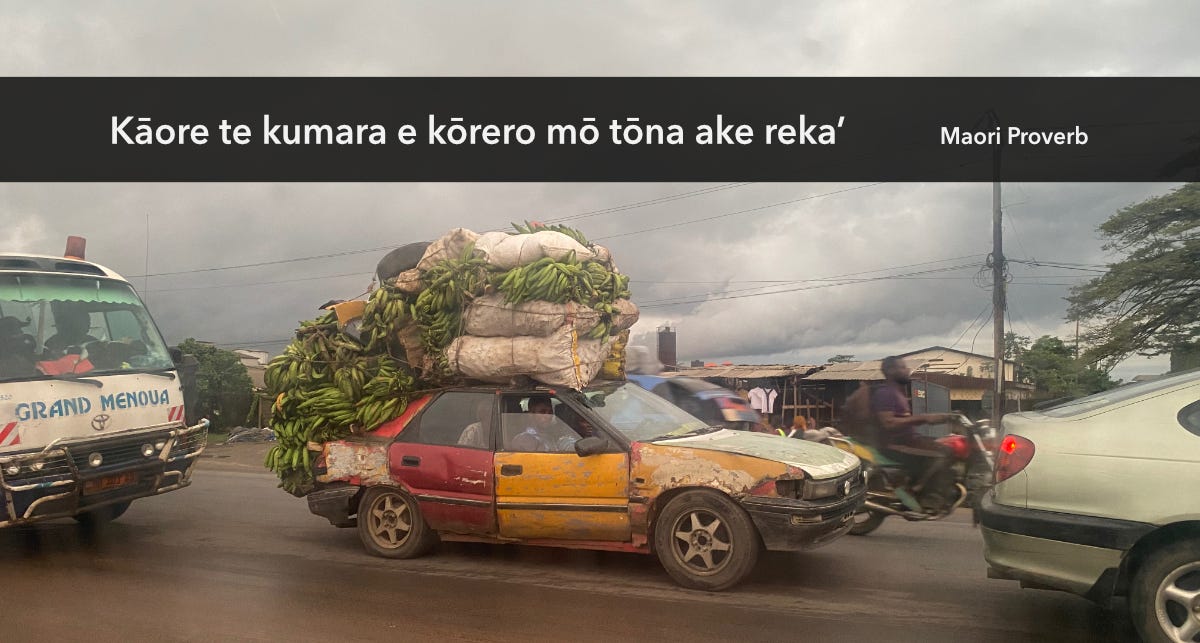
Between edition 49 and this week's newsletter, I've been to Cameroon, getting my feet and hands dirty with the raw challenges of launching COOKO.
In a sense, it also provided me with first-hand lived experiences of the type of tribal and traditional hierarchies that John referred to in our interview.
As he put it: “The Niuean word for respect is “Lilifu” and depending on the context “lilifu” is also honour, status, and humility. The act of respect is “Fakalilifu," which means to give or receive respect. In the Pacific world view, respect is based on our collective mindset and values, and sustained by cultural norms.”
This complements the perspective we took last time, where the focus was on the reflexive nature of respect. The "RE" part of the word. This time we look at the second part.
"SPECT" deals with the perspective or point of vantage we take on the situation, person or conversation. Quite often, where you stand or sit determines what you see.
Embedded
John: Respect is a value that some Pacific Islands cultures practise to maintain social structures and systems. These values in the context of community life including-
* Ancestors and the knowledge transfer,
* cultural and genealogical ties,
* family, church and village,
* the natural environment - the land, sky and sea,
* spiritual, cultural, social systems and structures,
In conversations with John, the image of respect evolved into a twofold entity in my mind:
1. Form/vessel/symbol: This is the overt structure of power hierarchies that confers respect upon the holders of a space or position in the system. Status is based on where you sit in this hierarchy.
2. Energy/spirit/meaning: The inherent nature, behaviour, meaning or what we would call the character of an individual, action or movement.
There is a symbiotic relationship between these two levels. The form cannot function without the spirit, and the spirit cannot manifest without form. For "respect" to transform a situation, it needs both levels, and this is where the friction starts.
John: “Personally, I find the way leadership is approached by the different communities is intriguing - where respect is based on a person's title and status, regardless of ability.
I grew up in a culture which doesn't look to social structures and titles as a birth-right, respect is based on one's experience, knowledge, community work and character. You respect your elders because of their knowledge and experience (expressions of character).
I see respect in its purest form in communities with simple and basic living conditions, with limited or no assets. They are happy and content with their lives.”
Duality
Growing up, John could experience first-hand how the duality of "respect" could deliver confusing and contradictory outcomes.
His mother was the first woman to enter the seminary and become a Minister in the church, previously an all-male domain.
John: “Watching the resistance to change from some parts of the church and the community was frustratingly fascinating, it brought out the best and worst in people.”
When our expectations of form and spirit do not match, it becomes confusing and disorienting. We smell a rat when people cling to the overt, external symbols of power to overcompensate for lack of the true spirit of respect.
At a deeper level, we all understand that respect is a two-way street. The respect you get and give needs to be in balance, and this works up and down the hierarchy.
One particular aspect that brings this into relief is mutual respect's role in making communities sustainable. The older generation needs to have respect for the younger generation's energy, challenges and ideas.
The younger generation has to have respect for the older generation's context, understanding and framing.
Only when both have a mutual and balanced respect can they transcend their individual expectations. If a community don't adopt new ideas, they will stagnate and become their own worst enemy as younger generations reject old ways.
On the other hand, if a community jumps onto every new idea without profoundly reflecting on the impacts and costs of adaptation, they may lose their unifying identity, value and values.
Mutual respect plays the pivotal role in balancing permanence and transience to manifest potential.
As I was travelling through Cameroon the structures and signs of respect were all-pervasive. Looking back, the one symbol from the trip that sticks most firmly in my mind is the leather sofa.
In all formal contexts, the person's status, and hence the respect afforded by the position, were measurable by the size and value of the sofas.
The outlier village chief had a small set with velour. The senior minister had two separate waiting rooms. The first had three large leather sofas, the second was an enormous living room with 6 ornate leather sofas. The sofa says who you are.
These overt symbols of status are implicit cues that signal the respect required. They become guide ropes to set out the protocols and flow of the dialogue.
The irony of a sofa being the ultimate status symbol is its role in stagnating and ossifying systems. The sofa is not a dynamic symbol.
You will slumber into seated sedateness.
The ossification of such power dynamics means that a disproportionate effort is placed on making people feel comfortable about how things were, rather than engaging people in how things could be.
As John put it: "When respect is used to keep people focused on and living in the past, when we should use the learnings of the past to anchor and light the way for the future.
When respect is used to keep people from moving forward is when we see significant disparities in income and wealth."
The officials, business leaders and authorities who mask and cloak their intentions in the finery of respect, demand the formal rewards of power without the spirit of respect. This asymmetry cannot support a sustainable, evolving community because it doesn't serve adaptation.
Deceptive deference
The COVID pandemic has highlighted this coercion of respect in clouding sensemaking. In dealing with a radically new situation pundits of all designs have clung to cultural and societal symbols of respect to reinforce their messages.
Hiding behind the masks that projected certainty when in fact there was none.
In many ways, both the scientists and the fear mongers were inviting us to their sofas. The bigger and grander the sofa, the less likely we would be to contradict, question or guide the conversation to uncertainty. The sofas looked solid, even though the science, theories and political slogans were not.
Respect requires engagement. We cannot ignore or falsify the spirit inherent in mutual honour and shared power. Any attempt at short term gains at the expense of the other, will be felt in the keen cutting anger of disrespect.
Let's create dynamic structures that learn from the fringe AND honour the core. Let's get out of the sofa and onto the dance floor.
Let's take that Leap
Three key take-outs:
1. in-SPECTWhat are your biases and unspoken expectations regarding respect? What are the lenses that might distort the way this is interpreted and understood?
2. retro-SPECTAre you looking forward or backwards when you interpret respect? Do you place a disproportionate value on the past or do you aim to build a forward looking framework for mutual respect?
3. su-SPECTAre you navigating by the overt symbols of respect or the inherent spirit of respect? How does the situation change if you suspect the motives to be respectful?