[Note: Don’t forget that you can forward these e-mails to friends who you think would like my quirky samplers of unusual music for the holiday season and my background information. I’ve gained about 50 subscribers already so far this year.]
Playlist
* A taste of the Grandshire peal Victoria Guild of Bellringers 1:00
* Ring Out Wild Bells Emily Brown & Alyssa Pyper 3:12
* Russian Orthodox Christmas bell peal Novo-Diveevo Convent bellringers 1:01
* Sweet Chiming Bells Nowell Sing We Clear 4:03
Music notes
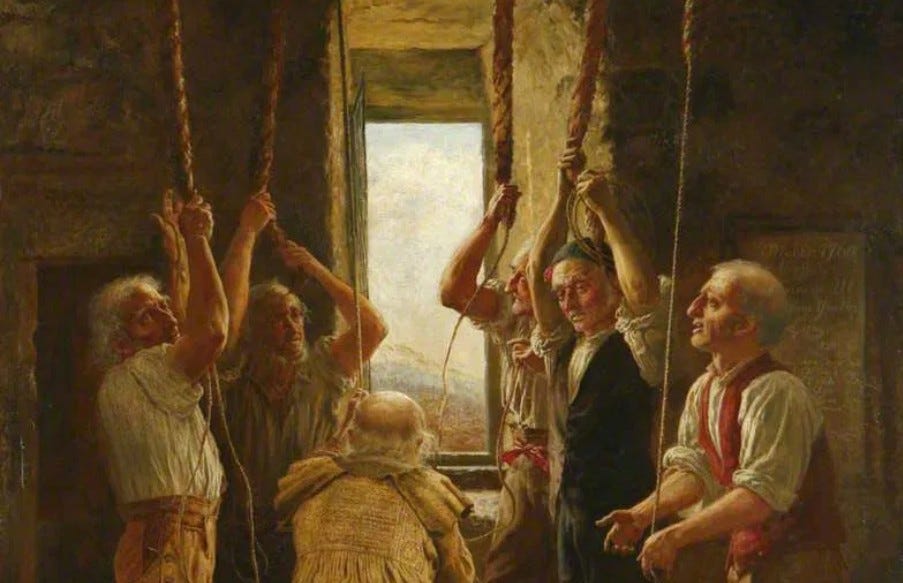
A taste of the Grandshire pealThe 17th century English playwright and diarist Ben Jonson said that the change-ringing of church bells was “the poetry of the steeples”. Another way of thinking about it is that they are the loudest and most public form of folk music.
According to this article:
Bells [have] long been part of the English aural landscape. In the eighth century, Bede wrote that a bell sounded the call to prayer at the monastic house at Hackness, near Scarborough. But by the end of the 16th century bell ringing had become a secular pastime and pleasure. A German traveler in 1602 noted that: ‘On arriving in London we heard a great ringing of bells in almost all the churches, going on very late into the evening. We were informed that the young people do that for the sake of exercise and amusements.’ And for gambling too, he was told.
It is out of this milieu that change ringing developed. The first-known secular bell-ringing society, the ‘Schollers of Cheapeside’, was founded on 2 February 1603 . . .
In 1628, the parishioners of Ashby-de-la-Zouch felt compelled to crack down on bell ringers. ‘None shall be allowed to ring for pleasure above twice in the week’, they decreed, ‘and that above the space for an hour at a time.’ No doubt they felt, to use a ringing term, over-belled.
I live about three blocks from Victoria’s Anglican Christ Church Cathedral which has a bell tower with large bells suitable for doing the full circle change-ringing known as peals. Christ Church’s ten bells range from 250 to 1450 kilos (550 to 3200 lbs.) with diameters ranging from 66 cm (2 feet 3 inches) to 137 cm (4 feet 6 inches). They are all tuned to harmonize with the largest bell which is tuned to the note of D. They are the same size, weight and have the same tuning as the change-ringing bells of Westminster Abbey.
I have a nice view of the back of the cathedral from my balcony, and hear them ringing frequently. The ringers practice most Tuesday evenings, and do a short “method” (a short duration of change-ringing) before two masses on most Sunday mornings. That makes it easy to take for granted what a rare privilege it is for me to hear this glorious “joyful noise”.
Here is the Cathedral’s Guild of Bellringers’ explanation of change-ringing, from their notes about this recording:
We are one of seven churches in Canada (three in BC) equipped for traditional “change-ringing” in the style that emerged mostly in England in the 16th Century. The bells are mounted on wheels which are turned by means of a rope passing round the rim of the wheel and controlled by the ringer on a lower floor, who cannot see the bell he or she is ringing. Each bell turns through nearly a full circle and is struck at the end of its swing by the clapper suspended inside the bell from its crown. [There is therefore a time delay between when the rope is pulled and the bell is rung.]
This method of ringing makes the playing of tunes impracticable, so the aim of change-ringing is to produce a changing pattern of sound through a set of mathematical permutations which are both rhythmic and musical. The bells begin by ringing down the scale and, at a signal from the conductor, proceed to ring in a different order each time the bell-ropes are pulled.
There are fixed rules governing the position of each bell in these changing sequences. The bells eventually return to ringing down the scale, without any one change being repeated. Since one person can ring only one bell, change-ringing is very much a team enterprise and requires great concentration on the part of all the ringers. Eight ringers were involved in the performances on this recording.
Here is an interesting four minute video about Christ Church Cathedral’s bells and bellringers.
This track is only a small one-minute sample from the beginning of a plain peal where it is just starting to get into the more abstract-sounding parts of the progression. A full change-ringing peal takes over 5000 rings from each of 8 bell, with the progression continuing non-stop for about three hours and 25 minutes, but those are only accomplished very, very rarely. (As far as I know, the Victoria Guild has not done one.) More common but still very challenging is a 45 minute quarter-peal, but even that length of change-ringing is challenging and uncommon.
The ringers adjust the place of their bell in a cycle through a brief pause of the appropriate length in their rope-pulling. Proper ringing takes and incredible amount of both memory and concentration by the ringers, and even one bell rung out of its proper sequence means that the peal, quarter peal, or shorter change-ringing sequence is not considered to have been successful.
Actually, there are a variety of peal progressions of different lengths, based on different mathematical sequences of changes. This recording is excerpted from the Grandshire Triples progression composed by Robert Roan around 1650. I got the recording from this YouTube video. These are the same bells that I get to hear every week.
Ring Out Wild Bells The lyrics for this song are a poem by Alfred Lord Tennyson that was first published in 1850, the same year that he was appointed Britain’s Poet Laureate.
According to a local legend, the poem was inspired by the ringing of a midnight New Year’s Eve peal by the bellringers of Waltham Abbey in Essex, north of London. They don’t do it that late here, but there is an old English custom for some churches to “ring out the old year and ring in the new one” at midnight. Sometimes the bells are first rung half-muffled for the death of the old year, then the muffles are removed to ring proudly, marking the birth of the New Year.
For most churches, the midnight ritual would just be ringing the church bell enthusiastically, but like Victoria, the bell tower of Waltham Abbey is equipped for ringing the changes. Lord Tennyson happened to be staying nearby to the Abbey in High Beech and apparently a heard he midnight peal for the first time.
This recording is by Emily Brown & Alyssa Pyper, and is from an out-of-print 2015 charitable fund-raising sampler album called Merry Christmas Provo Vol. 2 (from Provo City, Utah.) This music setting for the poem is by Crawford Gates and is published in the Hymnal of the Church of Jesus Christ Latter-day Saints.
Below is the whole Alfred Lord Tennyson poem, and here is allpoetry.com’s analysis of its uncommonly optimistic message from that Victorian poet:
Ring out, wild bells, to the wild sky,The flying cloud, the frosty light:The year is dying in the night;Ring out, wild bells, and let him die.
Ring out the old, ring in the new,Ring, happy bells, across the snow:The year is going, let him go;Ring out the false, ring in the true.
Ring out the grief that saps the mindFor those that here we see no more;Ring out the feud of rich and poor,Ring in redress to all mankind.
Ring out a slowly dying cause,And ancient forms of party strife;Ring in the nobler modes of life,With sweeter manners, purer laws.
Ring out the want, the care, the sin,The faithless coldness of the times;Ring out, ring out my mournful rhymesBut ring the fuller minstrel in.
Ring out false pride in place and blood,The civic slander and the spite;Ring in the love of truth and right,Ring in the common love of good.
Ring out old shapes of foul disease;Ring out the narrowing lust of gold;Ring out the thousand wars of old,Ring in the thousand years of peace.
Ring in the valiant man and free,The larger heart, the kindlier hand;Ring out the darkness of the land,Ring in the Christ that is to be.
Russian Orthodox Christmas bell pealThis is another abridged ringing from a YouTube video, but this one was posted by the Novo-Diveevo Russian Orthodox Convent in Nanuet, New York. You can see the bell-ringers in action in that four-minute video.
Not only are the size of these bells smaller and higher in pitch than I am used to, but the Russian Orthodox style of change-ringing is very different. There is an interesting Wikipedia entry about the history and spiritual meaning of bells for the Orthodox church where they are described as “singing icons” that are as important for the Orthodox church as its painted ones.
According to that Wikipedia entry:
The foundation of Orthodox bell ringing lies not in melody but in rhythm, with its intrinsic dynamic, and in the interaction of the timbres of the various bells. These sequences have a very special harmony, since Russian bells (unlike Western European ones) are not tuned to a single note. Western bells usually have an octave between the loudest upper tone (”ring”) and the loudest lower tone (”hum”). Russian bells have a seventh between these sounds. Generally, a good Russian bell is tuned to produce a whole scale of sounds (up to several dozen of them). . . .
The Russian Orthodox [liturgical instruction manual] provides for different types of bell ringing. Different ringing is used on different days (on working days, on Sunday, on holy days, during fasts, Lent, Easter etc.) Different ringing is required for different services (for morning service, service for the dead, liturgy, etc.). These differences are accomplished by ringing particular bells in particular ways.
Sweet Chiming Bellsis derived from a Salvation Army song called The Bells Ring Out at Christmas Time, which is of unknown origin. Its Salvation Army lyrics were:
The bells ring out at Christmas time Their message loud and clear. Our hearts are stirred as on the air The joyful sound we hear.
Chorus: Sweet chiming Christmas bells Sweet chiming Christmas bells They cheer us on our heavenward way Sweet chiming bells. They cheer us on our heavenward way Sweet chiming bells.
Thanks be to God since all may learn The bells’ exultant theme. The babe of Bethlehem was born This lost world to redeem Chorus
Glad message of the Christmas bells Of God Whose name is love. Oh may this music all our days Our hope and comfort prove Chorus
Those verse lyrics would have fit perfectly for my set today about bells, but I can’t find a recording of it being song sung that way. They are certainly appropriate for the Salvation Army, whose red kettles and bell ringers (where permitted) have become a ubiquitous feature of the Christmas season.
[Digression about the Salvation Army kettles and bells: According to the Salvation Army, their use of kettles to solicit donations for Christmas charity was begun in San Francisco by a Canadian-born ex-sailing captain named Joseph McFee:
When his corps (local church) wanted to host a Christmas Day dinner for 1,000 of San Francisco’s poor, Joseph accepted the task of raising money to pay for the meals. He then remembered the “Simpson’s pot” he saw in Liverpool, England, during his years as a sailor. The pot was a cooking kettle that a man named Simpson placed near the wharf to collect donations for the poor.
Joseph decided to use this same technique and, on either December 14 or 15, 1891, he placed an iron cooking pot on San Francisco’s wharf near the ferry depot entrance. He hung a sign above the iron pot that read: ‘Fill the pot for the poor. Free dinner on Christmas Day to 1,000 poor women, children, and unemployed men.” A Salvation Army Soldier (local church member) stood guard next to the pot. A second pot, this one a brass urn, was placed in the ferry waiting room, and a third near the ferry exit.
The donation pots were an immediate success and this pre-Christmas charitable fund-raising technique soon spread to other Salvation Army corps across the US and Canada, and has since gone world-wide. The use of bell-ringing to draw attention to the donation kettles was invented in 1900 by 16 year-old Salvation Army cadet named Amelia Kunkle (1884-1984). According to her:
When I first stood by the kettle to ‘keep the pot a-boiling,’ it was a bleak, cold, damp day. Girl-cadets wore long, black cotton stockings and rubbers over regular shoes; rubbers resembled slippers but were unlined and not high-topped like modern galoshes or boots.
Standing on newspapers helped block the dampness and penetrating cold. I was in The Battery, near Wall Street. Our kettle was by the entrance, or exit, to the ‘El’ which brought droves of businessmen to and from the financial district. Some contributed to The Salvation Army kettle; most passed by.
In those days, the average donation was a nickel or a dime; sometimes a quarter; occasionally, a dollar. One afternoon, donations totaled $18; very good for a four-hour stint! Most days, I was disappointed that people ignored me and my kettle.
Someone suggested that she bang a stick on the kettle to draw attention but she considered that to be too unladylike. But when she was in a nearby Woolworths she saw a small handbell that made a tinkling sound. It cost only 10 cents and she bought it. On her next day of kettle duty she rang her bell and more people stopped and donated. Raising more money to feed the poor was obviously much more satisfying when more money got raised. When she told the other cadets about the success she was having with her new technique, it spread like wildfire.
The Salvation Army’s kettles and bell ringing has become an iconic symbol of Christmas charity. That is the type of bells referred to in the traditional Christmas song Silver Bells, but I’ll leave that song and story for another time. End of digression.]
Back to this song, Sweet Chiming Bells. The Salvation Army song The Bells Ring Out at Christmas Time apparently soon faded away but it did not die. In northern England it was transformed by folk-processing into this popular Christmas pub-singing song.
Like many hymns, and many other songs too, its verses are in a commonly-used poetic rhythm – in fact, it is so commonly used that it is called common meter (CM). CM has four stanzas, and the number of syllables in each stanza is 8,6,8,6 with the accents on the even-numbered syllables. That makes it easy to the swap melodies between any songs with lyrics are written in CM.
Playing around with songs by matching different lyrics to melodies used to be much more common than it is today. The most popular pub-singing way to sing the verses of this song became using the familiar words of While Shepherds Watched Their Flocks by Night, but with a variant of the original song’s jolly Sweet Chiming Bells chorus, even though that has nothing to do with shepherds and angels.
During England’s folk music revival in the 1960s the song sung in that format spread out from Northern England’s pubs across the land, to become a popular mainstream Christmas song throughout the country. And that is the form in which the song came across the pond to the New England seasonal recording and touring folk group Nowell Sing We Clear (active 1977 to 2019).
NSWC already had plenty of versions of WSWTFBN in their repertoire, so they changed the verses again but now they were from a CM poem called A Song for Christmas Eve. In the chorus they changed a single word, swapping “heav’nly” to “merry”.
The poem had come from a small, stapled 95 page paperback book called Kriss Kringle Recitations, Dialogs and Songs for Christmas, compiled by Hal. J. Weigle and published in Chicago in 1914. The group says “this little book of poems and stories yielded pure gold.” They recorded this version of Sweet Chiming Bells on their 1995 album Hail Smiling Morn! and with its light-hearted, highly sing-along-able chorus it became a fan favourite.
Here are the song’s lyrics the way Nowell Sing We Clear sings it here:
O blessed night! A star shines brightThough seen through falling snow:The star of love lit from aboveTo set the world aglow.
CHORUS Sweet bells, sweet chiming Christmas bells, Sweet bells, sweet chiming Christmas bells, They cheer us on our merry way, sweet chiming bells. They cheer us on our merry way, sweet chiming bells.
Child voices sweet once more repeatThe angels’ glorious strain,Our grey old earth in holy mirthBecomes a child again. [Chorus]
Chime sweetly on, ye Christmas bells,While happy voices sing.Shine out, O star, from Heaven afarAnd guide us to our king. [Chorus]
To hail the little new-born kingA few poor shepherds came,Although with wonder, joy and loveThe heavens were aflame. [Chorus]
The wise men came upon their wayLed by that heavenly light,O star of love, shine from above,And make our pathway bright. [Chorus]
The loving heart, the prayer of faith,Are sweeter gifts to bring,Shine out, O star, from heaven afar,And guide us to our king. [Chorus]
For more information about Sweet Chiming Bells, and to hear another rendition of it, go to my Dec 10, 2025 post.