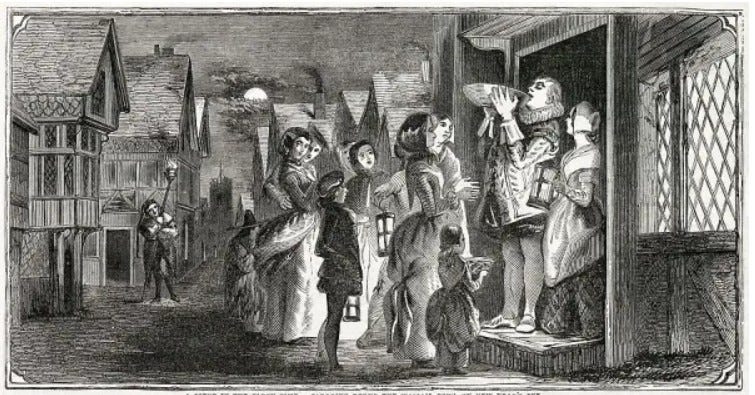
The wassailing tradition, a forerunner to the Victorian-invented Christmas caroling, is a custom that almost certainly pre-dates Christianity. I wrote an essay about that attached to my Dec 21, 2022 posting, as well as one about how other pagan customs survived medieval times in my Dec 18, 2021 posting. I won’t repeat all of that for you now (you’re thinking “thank goodness!”) but after the Music Notes below is an essay (about 1600 words) with some follow-up thoughts about the possible history of the custom and its songs.
Playlist
* Here We Come a-Wassailing The Watersons 1:28
* Jacobstowe Wassail Waterson:Carthy 2:51
* Here We Come a-Wassailing Kate Rusby 3:12
Music notes
Here We Come a-Wassailing is the name that the then-newly-formed British folk-revival group The Watersons used for this song when they recorded it in 1965 as the opening song on their very first album, Frost and Fire. After considerable research, the origins of this particular wassail song are still a mystery to me. Its first and fourth verses are very familiar with only minor variances from those found in many wassails, but its melody is unusual and the charming second and third verses seem to be unique:
Here we come a-wassailing among the leaves so green,Here we come a-wandering so fairly to be seen,Now is winter-time strangers travel far and near,And we wish you, send you, a happy New Year.
Bud and blossom, bud and blossom, bud and bloom and bear,So we may have plenty of cider all next year;Hatfuls and in capfuls and in bushel bags and all,And there’s cider running out of every gutter hole.
Down here in the muddy lane there sits an old red fox,Starving and a-shivering and licking his old chops;Bring us out your table and spread it if you please,And give us hungry wassailers a bit of bread and cheese.
I’ve got a little purse and it’s made of leather skin,A little silver sixpence it would line it well within;Now is winter-time; strangers travel far and near,And we wish you, send you a happy New Year.
The Frost and Fire album’s original sleeve notes did not give any information about this particular wassail’s origins, and I have been unable to find any source in which the Watersons identify it. Since this was the first song on their first album, and the Watersons had been raised in Yorkshire, I thought it might have been a version of The Yorkshire Wassail (Roud no. 209). That is often called Here We Come a-Wassailing. Taking that a step further, since the Watersons had been raised in Kingston upon Hull, it might be a variant from near that city and perhaps even the version that the Watersons themselves had sung as children.
But Yorkshire has a carefully researched database of the region’s folk music curated by The Yorkshire Garland Group, and the notes for their entries about The Yorkshire Wassail, which is what they call Here We Come a-Wassailing, say:
. . . no Yorkshire song collection could possibly avoid including at least one version of The Yorkshire Wassail. Practically every village in Yorkshire has its own version and, though the words show little variation, there can be almost any permutation of the eight or so standard stanzas, and the chorus and tune can vary considerably.
Though nearly every county of England and Wales has its own distinct Wassail song, some more than one, it is The Yorkshire Wassailwhich is the most widely known across the whole country, probably the world, due to its early publication and its subsequent inclusion in all of the standard national carol anthologies.
In some parts of England this led to the strange paradox of the local wassail song being sung in the villages, and middle classes in nearby towns singing The Yorkshire Wassail. Fortunately the Yorkshire family group The Watersons have more than redressed this imbalance by recording the main varieties of Wassail songs from other parts of the country.
That last part is certainly true. On the 6 albums that the Watersons and Martin Carthy recorded as a group, and many more that they and their descendants have recorded as duos or singly, they have indeed recorded wassails from all over England. But the two middle verses of this one are not among the “eight or so standard stanzas” with words that “show little variation” that the Garland Group describes as characteristic of The Yorkshire Wassail. If those delightful and rare middle verses appeared in a wassail that had been collected in Yorkshire, I would expect that the Group would take great pride in identifying their region as having been their location of origin.
As far as I know, throughout their career the Watersons only sang traditional English folk songs, albeit in their own idiosyncratic style of harmony singing. I think it unlikely that those middle verses were either their own composition or that they patched them from another source into a variant of The Yorkshire Wassail, and that is despite the fact that doing so would have been very much in the authentic spirit of true wassailing.
If anyone knows the origin of this wassail song variant, please let me know.
Jacobstowe Wassail (aka Robin Redbreast Wassail)was recorded in 2006 by Waterson:Carthy, the next-generation version of the original Watersons group. They were then comprised of Norma Waterson and Martin Carthy from the original group, Eliza Carthy (Martin and Norma’s daughter), and Tim van Eyken. It is from their album Holy Heathens and the Old Green Man.
It was easier to find the origin of this one, and it does have an interesting story. The song was gathered by the Anglican priest, antiquarian, hymn-writer and folk song collector Rev. Sabine Baring-Gould (1834-1924). Baring-Gould collected, documented and published many books on the folk music of Devon and Cornwall, often working in collaboration with another important folk music collector, Cecil Sharp. He also sometimes even collaborated with the American folklorist Francis Child who collected and analyzed variants of English and Scottish ballads and published the eight volume work now known as the Child Ballads.
Rev. Baring-Gould’s contribution to traditional music did not end when he died. He had donated his note books and working drafts to the Plymouth Public Library Archives in 1914 and folklore scholars have been mining information from them ever since. Then in 1998, a previously unknown trove of 30 boxes full of Baring-Gould manuscripts, notebooks and correspondence was discovered at Killerton, a house-museum operated by the National Trust. That has provided a whole new source of previously unknown folk songs, including this one.
One way that Baring-Gould would gather old songs, besides his own field collecting, was to encourage people from Cornwall and Devon to send him transcriptions of old songs and tunes together with information about where and from whomy they collected them. In the Killington trove was correspondence from Mrs. Batchellor who lived in Jacobstowe on the Cornish Penninsula which included the lyrics to this song. She had written them down from the singing of an unnamed wassailer. Since she had not sent him the music, Baring-Gould tentatively matched it with this tune that had been sent to him independently by G. Lewis Maitland.
Baring-Gould never completed that project and published it, which is why it was not with the documents he donated to the Archives in 1914. Baring-Gould hadn’t given a name to his mash-up of lyrics from one source with a tune from another a name in his private manuscript. They also do not say if the tune had been collected in Jacobstowe or from elsewhere. It has gone by various titles since it was discovered.
This rendition by Waterson:Carty was the first to be recorded and they chose to call it Sugar Wassail on their 2006 album. When an amateur group called the Wren Chorus, which is affiliated with the researchers who found it in Baring-Gould’s papers, recorded their version of it in 2008 they chose to call it just Robin Redbreast.
More recently, the name has become standardized by general consensus as Jacobstowe Wassail, since wassails are generally named after the places from which they were collected. Topic Records, the label that published the Waterson:Carthy album, has now posted this same 2006 recording on YouTube and even they are now calling it Jacobstowe Wassail. (This confusion in assigning a name to this newly-found old wassail explains how I accidentally repeated this version of the song after having previously included it in my Dec 8, 2022 set.)
Hopefully, more old songs (including wassails) are still out there to be discovered.
Wassail, wassail,Good master and mistress, sitting down by the fire,While we poor wassailers be dabbling in the mire,With a jolly wassail.Oh, little Robin Redbreast he has a fine wing,Give us of your cider and we’ll begin to sing,With a jolly wassail.
Wassail, wassail,Good master and mistress, our wassail begin,Please open your door and let us come in,With a jolly wassail.Oh, little Robin Redbreast he has a fine song,Give us of your cider, we won’t keep you long,With a jolly wassail.
Wassail, wassail,Your ale cup is white and your ale it is brown,Your beer is the best that e’er can be found,With a jolly wassail.Oh, little Robin Redbreast he has a fine leg,Give us of your cider, and we’ll begin to beg,With a jolly wassail.
Wassail, wassail,Your gin it is brew’d from the juniper tree,Your gin is the best that ever can be,With a jolly wassail.Oh, little Robin Redbreast he has a fine toe,Give us of your cider, and we’ll begin to go,With a jolly wassail.
Wassail, wassail,With a jolly wassail.
Here We Come a-Wassailing Kate Rusby, from Penistone in the West Riding of Yorkshire, is one of England’s best-known contemporary folksingers. She doesn’t seem to have gotten the message that the folk music revival is long past. She records traditional English songs acoustically but in a way turns them into pop music hit songs in Britain.
Rusby appears to have a special affinity for Christmas music. Of the 20 albums that she has recorded, seven have been Christmas albums, and as far as I can tell they have all become mainstream Christmas best-sellers. This is the opening track from Sweet Bells, her first Christmas album released in 2009,
After having done all that research trying to find the roots of the Waterson’s version of Here We Come a-Wassailing and thinking (probably incorrectly) that those roots would be in Yorkshire, this one was easy even though her liner notes only attribute it to “Trad & Kate Rusby”. It ticks all of the boxes for being a variant of The Yorkshire Wassail; even the melody and refrain are the very familiar ones from that region.
The oldest documentation of this generic version of The Yorkshire Wassail seems to be in the 1871 edition of Henry Ramsden Bramley and John Stainer’s Christmas Carols New and Old. That was the Christmas songbook that fueled the Victorian era’s taste for Christmas carols that related to the Nativity story, many of which are very familiar today.
Perhaps as influential in making this particular wassail song so well-known is that it was also in the 1928 edition of The Oxford Book of Carols which Martin Shaw co-authored with Percy Dearmer and R. Vaughan Williams. In it they included this version, which Shaw had learned as a boy from his father, who had often heard it in the streets of Leeds in the 1850s.
Rusby’s version abbreviates the wassail down to five of the standard Yorkshire verses, which is the common length. Her three-line verses (with a repeat of the usual second line) may or may not have ever been sung that way by actual wassailers. She employs her own creativity to make England’s old Christmas songs popular for present and future generations rather than preserving them intact as they had been sung in the past. I can’t recall having ever heard a wassail sung quite this way by anyone else.
Here we come a-wassailing among the leaves so greenHere we come a-wandering so fairly to be seenHere we come a-wandering so fairly to be seen
[Chorus; sing after each verse] Love and joy come to you And to you our wassail too God bless you and send you a Happy New Year God send you a Happy New YearWe are not daily beggars that beg from door to doorBut we’re the neighbour’s children that you’ve seen beforeWe’re thе neighbour’s children that you’ve seen bеforeI have a little purse, it’s made of leather skinI need a silver sixpence to line it well withinI need a silver sixpence to line it well within
God bless the master of the house and then the mistress tooAnd all the little children that ‘round the table growAll the little children that ‘round this table grewAnd here we come a-wassailing among the leaves so greenAnd here we come a-wandering so fairly to be seenHere we come a-wandering so fairly to be seen
Essay: Further thoughts about wassail songs (about 1500 words)
During the Middle Ages throughout most of Christianized Europe, the people kept old pagan traditions alive either by endowing them with Christian symbolic meaning or by purely secular observation. That was the only way those old customs could survive to this day, if they did at all.
But the English wassailing custom and the now largely-extinct-but-not-forgotten Yule Log tradition made no pretense of having Christian meaning. Their probable ancient meaning as a religious rite had likely been long forgotten, but they appear to have been continued as purely secular traditions. Not very many of the wassailing songs that we consider to be traditional today even mention the occasion of Christmas at all, let alone God or the Nativity. Their only connection to the Christian holiday is that the days on which the wassailing takes place locally are often identified by their Christian holy day names.
But how could that happen? How could a tradition with pagan origins survive through adamantly Christian times without at least taking on a veneer of Christian meaning? And why should England be an exception to the medieval Christianization of ancient pagan luck-visit traditions that took place in almost all other places in Europe?
I do have a theory, but it is pure speculation. Perhaps in England the old wassailing custom did take on a Christian symbolic meaning during the Middle Ages, with the songs adapted to reflect being part of celebration of the Christmastide season rather than a continuation of pagan observation of Yuletide.
That was what the early- and mid-Victorian song-collectors thought when they went looking for extant medieval “Christmas carols” from rural communities in isolated locations. The problem was that they couldn’t find very many old songs about the Nativity in the common people’s luck visiting singing repertoire. What they found was that the singing that was being done door-to-door at Christmastime was wassails like these, with no mention of Christmas or the Nativity. For the most part, they didn’t bother to collect those because they were clearly not the medieval Christmas carols they were looking for.
Folklorists have tended to draw the conclusion that medieval caroling as a door-to-door singing of Nativity-oriented songs did not exist: They concluded that it was an imagined Christmastime tradition that Victorian era medievalists were hoping to revive in support of the “keep Christmas” movement. The medievalist’s perspective was that if there had been such a Christian practice in medieval times it would have been discontinued and then forgotten after the celebration of Christmas and its associated Christmastide season had been banned by the Puritan Parliament and Church of England in the latter half of the 17th century.
That ban and its unintended consequences is another topic that I have previously written about in some detail – you can read about it in the essay in my Dec 3, 2021 posting (which is mostly about the modern history of celebrating Hanukkah but I needed to tell about the “Keep Christmas” movement to give context for that story.)
So here’s my theory – perhaps wassailing really had changed into a Christianized custom, with songs related to the Nativity, but then in the mid 17th century when celebration of Christmas was banned by both law and the church the people just adapted to the times again: They removed the Christian symbolism from the occasion and Nativity words from their songs. By doing so they could not only continue to celebrate the season legally and theologically acceptably as a secular occasion in the traditional way, but also revel in their successful resistance to authority by imposing an unintended consequence upon the Puritans in authority who sought to deprive them of the year’s most beloved holidays.
If that had happened, wassail would likely have become what it is now – a secular tradition with no pretense of Christian or Pagan meaning that people participated in simply because it was what you do at this time of year. It is unlikely that the people at that time even knew about wassailing’s pagan roots, and if they did, they certainly would not have revived the pagan aspect of the tradition during a time when witches were being burnt at the stake. In other words, the songs would have ended up being exactly the kinds of solicitations that are in the traditional wassail songs today, with good wishes replacing words like blessings as what the wassailers offer in return.
We know that kind of adaptation is how people might have responded back then, because that is how they did respond when Rumania’s atheist government under Nicolae Ceaușescu banned the celebration of Christmas in the 1980s. I told about that in a post three years ago as background information for two songs from the Rumanian equivalent to wassailing, but to save you from having to find that, here is what I said back then:
This recording was made at a time when the caroling custom, and Christmas itself, was prohibited in Romania. Like the Puritans had done in England in the 17th century, the Communist government under Nicolae Ceaușescu banned celebration of the holiday! But his reasons for doing so couldn’t have been more different from the English Puritans. Ceaușescu saw Christian leadership as posing a threat to his one-party rule and decided to impose Communist Atheism as the state religion. (Or is that a state non-religion?) He had the Orthodox priests arrested and executed, and prohibited all forms of religious observance including colinde [the Rumanian luck-visit equivalent to wassailing] and the singing of Christmas carols. . . .
How did the people react to this prohibition? Pretty much as you would expect (and the same as what had happened in England 300 years earlier.) In the cities, public acknowledgement of Christmas did not take place in public but its celebration continued in the privacy of people’s homes (even though they no longer got the day off work.) In the rural areas the custom of colinde pretty much continued as usual, but with some discretion.
It still began on December 24, but that was nominally done only to keep up tradition: The people said that their new focus of the custom was to celebrate the coming of a new year under the Communist regime. What they sang during the visits depended upon the reputation of who was being visited. For trusty old friends it would be the old carols. But if they were visiting the home of the local party official they would sing the national anthem or another patriotic song. That person could then report what he saw: The people of his village were conforming to both the letter and spirit of the law.
In some cases they would write new secular lyrics to sing to the traditional Nativity carols’ melodies.
But again, the idea that this may have been what happened in England in the 17th century is just speculation, and I’ll have to think more about it. There are some problems with the theory, such as: Why would Christian themes remain so thoroughly removed from wassailing through the 18th and 19th centuries, when England was still a fervently Christian country?
My idea is based on the fact that the wassail songs are an ever-changing type of folk music. As far as we know, wassail songs have always been improvised and tailored specifically for whichever household was being visited, or whoever opened the door. That is another reasons why they escaped attention from folklore collectors until the custom was on the verge of dying out in the late 19th and early 20th centuries. The earlier collectors knew that the verses in the wassails they heard were not necessarily old songs; at least some of the verses they heard had just been made up on the spot.
Once folklorists did begin collecting wassails from the living tradition it was to document the current state of the folklore. They would cherry-pick the most clever or most representative verses from the singing. And if they documented the melody at all – most didn’t before the days of recording technology – it would have been by giving the name of the tune they heard if they recognized it. Remember, the 19th century was a time when, unlike our current approach to singing, swapping out melodies between songs was commonly done and a common skill.
As with collecting other types of folk music and songs, such as sea shanties and children’s play songs, the process of documenting these moment-in-time bits and pieces of performances given at various households has created a rather artificial and frozen single “authentic” version of what had been a community’s living and evolving tradition.
Because of similarities in the lyrics of wassail songs collected from far-flung places, often with the exact same couplets being used for the verses collected from places far from each other, I suspect that they were often not collected before the local variants had been influenced by exposure to clever wassail verses from other communities and regions. Also, it seems apparent that some wassail songs were not collected until wassailing that in previous decades had been done by whole families survived only as a remnant children’s activity (as is evidenced by the third song in today’s set.)
So take these “authentic” wassail variants with a grain of salt. Although their melodies and lyrics sometimes vary, what English wassail songs actually say is almost always the same thing: After a polite greeting the visitors are asking householders to fulfill their role in the local wassailing tradition by giving largesse to the visitors.
I think it would be reasonable to think of almost all them as being variants of the same song. Perhaps they should all be called simply The Wassail Song, with the community of origin and circumstances of collection identified in the liner notes. But that won’t happen, so here are several of the variants of The Wassail Song to enjoy, listed under the titles that the performers identified them when they recorded the songs.