Playlist
* Husbandman and Servingman Andy Turner and Ian Giles 4:20
* Serving Girl’s Holiday Felicia Dale 4:53
Music notes
Husbandman and Servingman This dialog between a farmer and a footman from the manor is representative of might have been common style of mummers’ song in the 19th century. This one is from the southwest Dorset village of Symondsbury. It’ lyrics are from a detailed published account of that community’s 1880 mummers play. In 1951 that documentation, as well as remembrances from community elders, was used to revive the mummer play tradition that had been discontinued several years earlier. A similar song was collected from William Walton of Adderbury, in Oxfordshire. Today’s variant was collected independently by folklorist Peter Kennedy sometime before 1956 from the singing of brothers Fred and Ray Cantwell of Standlake, also in Oxfordshire.
But the roots of such songs might go back to quite a bit earlier. Mummers plays were often performed on Boxing Day, when servants in the manor houses and other employees of the landed gentry were traditionally given the day off so that they could celebrate Christmas with their families. For some of the families it was an opportunity to all go out mumming together. According to the Mainly Folk website: “In Shakespeare’s time most English villages had their local amateur acting companies, who … performed traditional dramas in the streets or the halls of great houses.”
One can readily imagine dialogs such as this being held, and parodied, between the family members who continued to live an agricultural lifestyle and those who had left that life behind to become maids or footmen in the local manor. Would this kind of family rivalry/teasing have been different in medieval times?
The song is sung here by Ian Giles and Andy Turner, and is from Magpie Lane’s 1993 inaugural album The Oxford Ramble. That band is still going strong, and both Ian and Andy are still performing with them.
Well met, well met, my friend, all on the highway riding,Though simply together here we stand.I pray now tell to me of what calling you may be, And art thou not a servant man?
Oh no, my brother dear, what makes thee to inquireOf any such thing from my hand?Indeed I will not ‘frain, but I will tell you plain:I am a downright husbandman. [repeat last 2 lines as a refrain]
Well, if an husbandman you be, will you come along with me,Though freely together here we stand.For in a very short space I may take you to a placeWhere you may be a servant man.
As to thy diligence, I give thee many thanks,But nought do I require from thy hand.But I pray now to me show wherefore that I may knowThe pleasures of a servingman. [repeat last 2 lines]
Well, isn’t it a nice thing to ride out with the king,With lords and dukes and any such men;For to hear the horn to blow and see the hounds all in a row,That’s pleasures of a servant man.
But my pleasure’s more than that, to see my oxen fatAnd a good stock of hay by them stand;With me plowing and me sowing, and me reaping and me mowing,That’s pleasures of an husbandman. [repeat last 2 lines]
But then we do eat such delicate fine meatOf goose, and of capon, and of swan;Our pastry’s also fine, we drink sugar in our wine,That’s diet for a servant man.
As to the ducks and capons, give I my beans and bacon,And a good drop of ale now and then;For in a farmer’s house you will find both brawn and souse,That’s diet for an husbandman. [repeat last 2 lines]
And then we do wear the finest of grandeur,Our coats are trimmed with fur all around;Our shirts as white as milk, and our stockings made of silk:That’s clothing for a servant man.
As to thy grandeur give I the coat I wearSome bushes to ramble among;Give to me me good greatcoat, and in my purse a grout,That’s clothing for an husbandman. [repeat last 2 lines]
Kind sir, I must confess although it causes me distressTo grant to you the uppermost hand;Although it is most painful, it is altogether gainfulAnd I wish I’d been an husbandman.
And so now, good people all, both be you great and small,Honour the king of our land;And let us, whatsoever, to do our best endeavour,For to maintain an husbandman. [repeat last 2 lines]
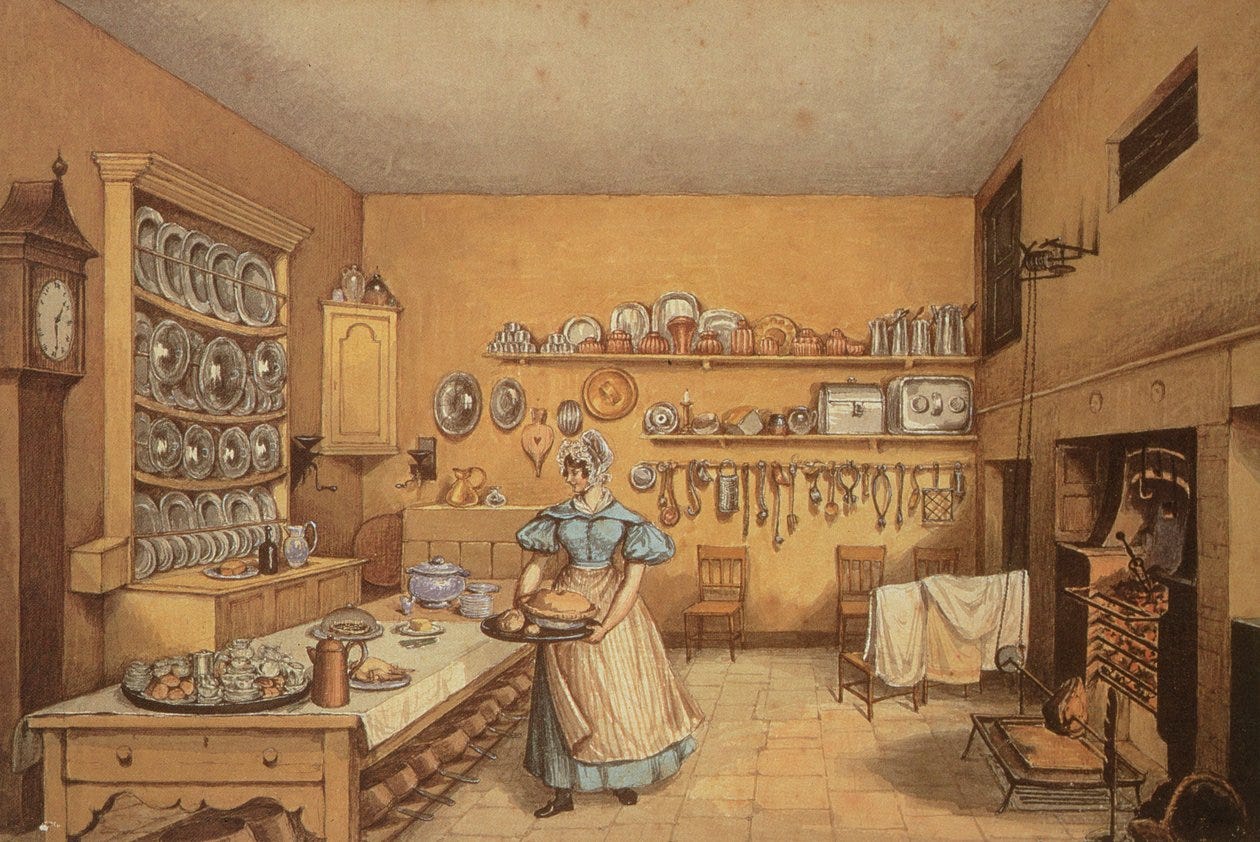
Serving Girl’s Holidayis mucholder than that other song. This is an abridged version, and translated into modern English, of a song from the 14th or 15th century. Its lyrics are in a book published in 1952 called Secular lyrics of the XIVth and XVth centuries by the respected scholar of old- and middle-English literature and music Prof. Rossell Hope Robbins. As the title suggests, Dr. Robbins’ book only has the lyrics, with no melody. I presume that if I bothered to do so, I could find the source where he found the song online.
Maddy Prior got it from an unidentified book that included this poetic translation of the lyrics from Prof. Robbins’ book. She shortened it and set the lyrics to the melody of a 12th century Latin song Orientis Partibus (hear that here.) Orientis Partibus is a parody song that was sung in Sens, France on the Christmas season’s topsy-turvy day, when roles were reversed and a choir boy officiated as the bishop. That custom was a survivor from how the Romans had celebrated Saturnalia over 1000 years before then.
This song, with Maddy’s setting, has been covered by several folksingers and groups. Here it is sung by Felicia Dale accompanying herself on the hurdy-gurdy. Felicia and her partner William Pint perform as Pint &Dale and are based in Seattle, Washington. They are primarily known for performing nautical songs, which is I how I came to learn about them. This is from an out-of-print 5-song holiday EP called Eight Bells that they released in 2009 .
I’ve waited longing for today:Spindle, bobbin and spool, away!In joy and bliss I’m off to playUpon this high-o holiday.
CHORUS (repeated after each verse): And spindle, bobbin and spool, away, For joy that it’s a holiday!
The dirt upon the floor’s unswept,The fireplace isn’t cleaned and kept.I haven’t cut the rushes yetUpon this high-o holiday.
In pails the milk has got to go;I have to spread this bowl of dough —It clogs my nails and fingers soAs I knead this high-o holiday.
The cooking herbs I must fetch inAnd fix my kerchief under my chin.Darling Jack, lend me a pinTo fix me well this holiday!
And when we stop beside the trackAt the inn, this Sunday, JackWill whet my whistle and pay my whackAs on every holiday.
I’ve waited longing for today:Spindle, bobbin and spool, away!In joy and bliss I’m off to playUpon this high holiday.
If you want to see the original version of the song, including the verses that Maddy edited out, here it is courtesy of Bruce from the Mudcat discussion forum:
Al this day ic han sought,spyndul ne werue ne wond y nought;To myche blisse ic am broutazen this holyday.Wybbe &c.
[Chorus] Wybbe ne rele ne sypyyn yc ne may ffor ioyze that it is holydayAll vnswope ys owre vleth,& owre fyre ys vnleth,Oure ruschen ben vnrepe zeth,azen this hy halyday.Ye moste feschun worton In;thredele my kerchef vndur my khyn;leue iakke, lend me a pynTo thredele me this holiday.Now yt draweth to the none& al my cherrus ben vndone;y moste a lyte solas mye schoneto make hem dowge this holyday.Y most mylkin in his payl;Outh me bred al this schayl,zut is the dow vndur myy naylas ic knad this holyday.Iakke wol brynge me onward in my wey,Wyth me desyre for te pleyze;Of my dame stant me non eyzean neuer a god halidayIacke wol pay for my scotha sonday atte the ale-schoth;iacke wol sowse wel my trotheury god haliday.Sone he wolle take me be the hand,& he wolle legge me on the lond,that al my buttockus ben of sond,opon this hye holyday.In he pult & out he drow,& euer yc lay on hym y-low;‘by godus deth, thou dest me wowvpon this hey holyday!’Sone my wombe began to swelleas greth as a belle;durst y nat my dame telleWat me betydde this holyday.
If your Old English has gotten a bit rusty and you can’t read that, you can find a translation of the full poem to modern English here. Be prepared for a surprise ending regarding how the singer enjoyed her holiday.