Please note this episode deals with sexuality and sexual violence and may not be suitable for all listeners. Some material may be triggering.
If you do find yourself triggered or having difficulty, please contact your local rape crisis center. If you need assistance locating support, please use RAINN.org in the US and Ending Violence in Canada to locate supportive services.
Kerry:
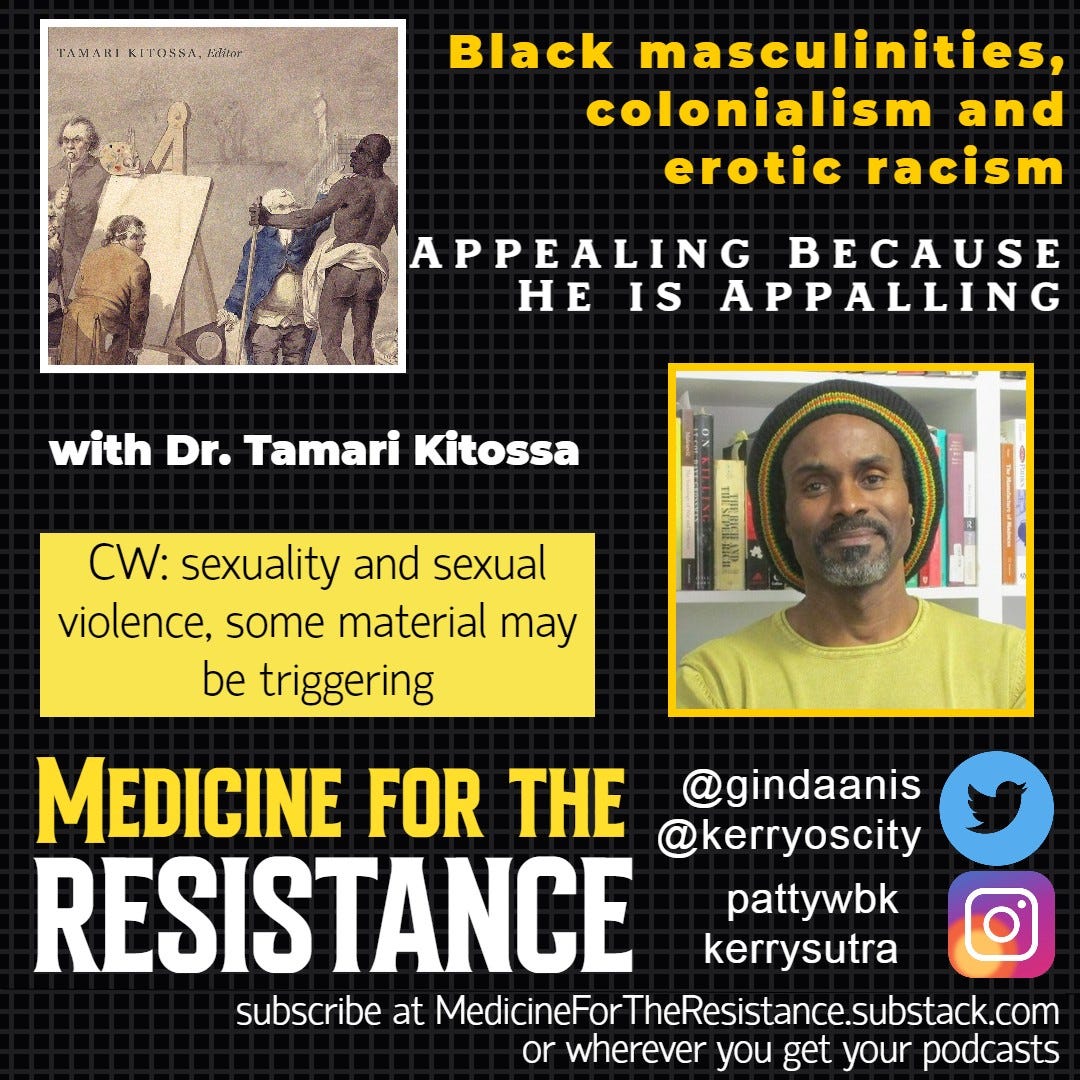
We're talking about Tamari’s book, Appealing Because He is Appalling. And it's all about the idea of Black masculinity, colonialism, and erotic racism. And this is a topic that is so near and dear to my heart. Because it's very much about how we perceive ourselves sexually, and how these ties really affect how we are showing up in these colonial spaces. How has the systematic racism, colonialism, you know, all the isms affected us, and in particular, a very forgotten piece of this space, which is the Black man. Black men have been railroaded into one real vice where, where there, I've always looked at it like we we see them, you know, in this sinister space as one product, or we see them as an infallible space and another end of that product. Like it's almost nonexistent. There's no space in between. And Tamari, I really want us to get a moment to, to unpack all of it, because there is a lot here and so much stuff that I had no idea about. And I'm sure we'll we'll get to talking. I'm sure we will. Let's get dive in.
Tamari:
Yes. No, thank you so much. I really appreciate the opportunity to be with you. And Patti again. Is this our second conversation? I think it's our second?
Patty:
Yeah, at least second, maybe third. We’re old friends now.
Tamari:
Yeah. We often do not speak about Black men and disabilities, you know, to talk about police violence, without talking about the disabling of Black men, either psychologically or physically. We're just missing a huge part of that conversation. But not just the the disabilities that arises from being incarcerated or interaction with the police. But the brilliant thing about the paper that Leroy and I wrote, and I wrote is that we take this back to slavery. And slavery was the production of disabilities. And if you look at the nature of resistance and rebellions, from slavery onward, very often you're talking about individuals that were disabled.
So if you go to Haiti, you found that Boukman and others who were the founding figures of the Haitian Revolution, those people were all physically disabled, they had either limbs that were dismembered, or some other such thing. Harriet Tubman, right, she took a piece of metal to the head and had convulsions, all her life. So disabilities is a major part of Black resistance and rebellion.
And if you know, I mean, I think we can get get to this, again, is to talk about Emmett Till, and disabilities. That is a really important piece of disabilities history that not a lot of people know. And Leroy introduced me to it. And I did a bit of research on that. And it's just absolutely amazing that this young boy had a speech impediment. So he had like a speaking disability and his mother in Chicago taught him in order to form his words, he should whistle. So that led to, uh, I forget the name of the guy that led the charge. I think his last name was Bryant in thinking that this little boy was whistling at his wife and his wife knew that that was not the case. And upon her deathbed admitted that it was all concocted. So disabilities is a major part of resistance. But it's also produced by anti-Blackness and the particular targeting of Black men.
So about me. So I'm a professor of sociology at Brock University. been there since 2006. And my areas of specialization and interest are Blackness and anti-Blackness in Western and Asiatic cultures. I do not separate the west from the east because it's all Asia people talk about the European continent. All the continents begin with “A” except for North and South America which are joined by an isthmus.
Patty:
Yeah, I saw Roxanne Dunbar Ortiz, I was listening to a panel she was on and she referred to the Asian peninsula of Europe.
Tamari:
That's what it is. There's no Eurasia, it's Asia..
Kerry:
I just love that. That is a drop of knowledge. Now, you know,
Keep going, Tamari, with, with, with this interest of yours being, you know, Blackness, anti-Blackness and understanding, I really want to hold space. First off, for the topic matter that we're going to be discussing tonight. I really recognize I mean, we've we've gathered before, and I really recognize, you know, how our Black men especially, are not necessarily honored, nor do we lend voice for what their experience dealing with a colonial system can be. And I really would love for us. One we're honoring you. I'm I also want to just acknowledge the the bravery or the the fact that you're speaking out and giving us some context, because I think that it's unusual in some of the ways that we've we've been told about Black men, you know, and and what there are, and I really want you to give us some of that. What, when we talk about this book, what was your thought process and putting it together and compiling it? What is it about?
Tamari:
You know, so my main thought processes was that I went through my undergraduate years, taking courses in feminism, and women's history. And my my second published essay was a critique of first wave feminism in Canada. Talking about, looking at the first wave feminists in Canada, they were really anti-immigrant. They're really hated Chinese people. They were eugenicists. They hated mixed race unions and couples, and they particularly hated Black men and white women. And they were all about this Nordic Anglo keeping Canada white. And if anybody's going to get the vote, it should be them, it should be them because they're the models of civilization.
So I went through studying this stuff. And then I kept thinking about my experiences growing up in Toronto. And as a young adult, going to nightclubs and something just didn't sit right with me. Because, you know, I had experiences where I have to wonder what explained it.
Like if, you know, I gave one instance in the introduction, where walk into a club, downtown Toronto, was about 22 years old. And, you know, young white woman, looking my age walks directly in front of me, like, and I you know, I couldn't get up, get away from her because she's like, walking right in front of me, right? So I just walk into the club, like, what's going on here, right? She just walks right in front of me, looks me in the eyes, and clutches my testicles, and my penis, and squints and then gives me that look, and then lightly squeezes and then walks off and what what the f**k just happened? Like, this doesn't make any sense, right? So of course, my night was ruined.
But as an undergraduate student, I'm thinking, Okay, this doesn't fit with the narrative that men are the ones that dominate women, men are the ones that objectify women, it just didn't fit in my experience. And the more brothers that I spoke to, the more I kept hearing the same thing. But there was nothing in the literature that would help me to explain what this was.
And so I actually intended to write my dissertation on this very topic. And so I approached a white feminist scholar who does at when I was a student at OISE, whose specialization is gender, sexuality. So I thought, Okay, this is this is someone that I could work with, who can help me process like, what theory can explain my experience and experiences of other Black men? So I sat down with this person who I hoped would have been my supervisor. And I explained my my interest in this topic. And this white woman just looked at me and busted out laughing and said, Now you know how we feel. Like oh, s**t, okay.
So there's no way that I can write a dissertation that would deconstruct this phenomenon, because I will be basically assailing feminist theory. Right so it that idea never left me. And so when I just went I was theorising you know how to…