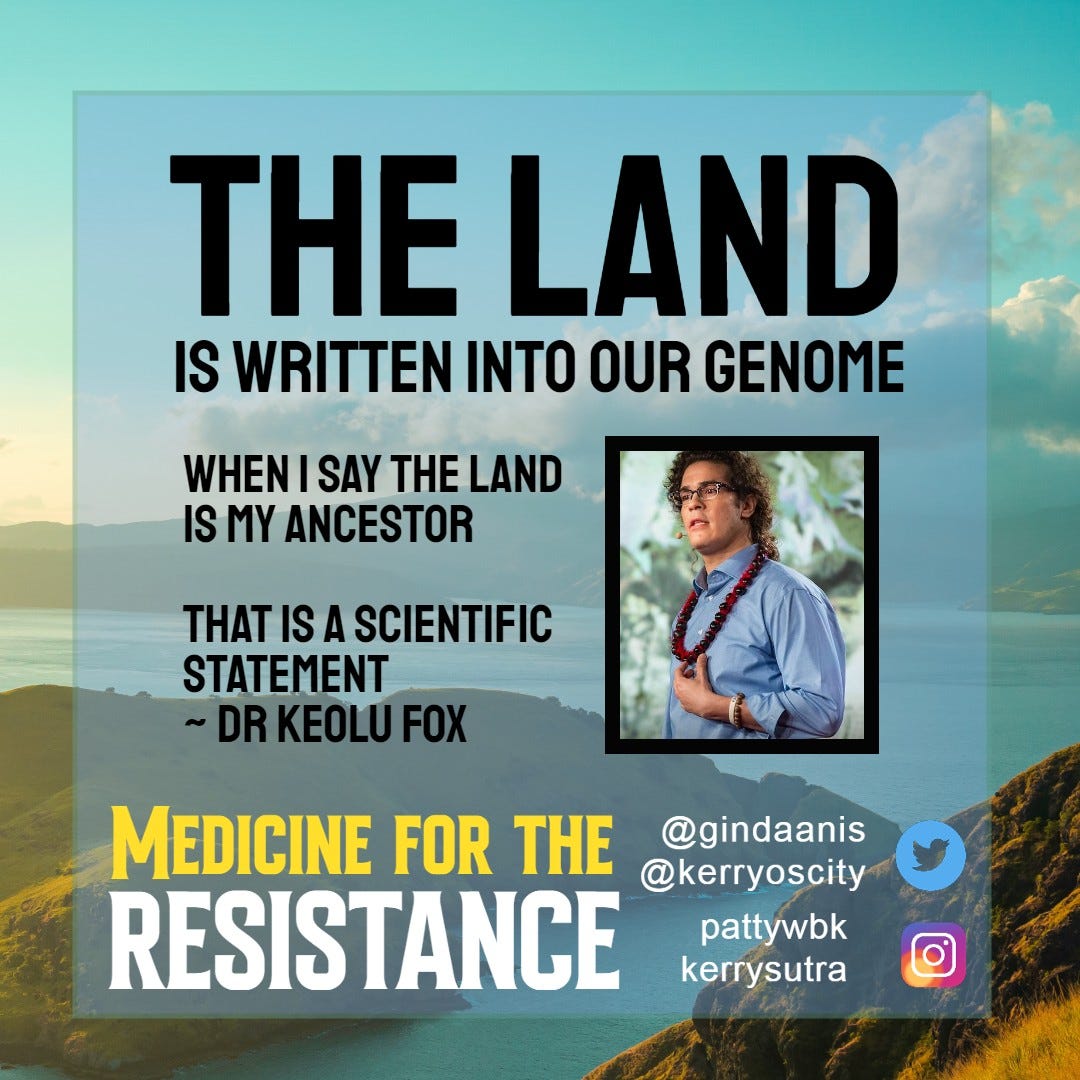
the land is my ancestor
Patty
So, anyway, so we're here with Keolu Fox. Chanda had made this comment, quoting you about the land is my ancestor, and that is a scientific statement. And she was just completely taken by that comment. And then so was I. And that's really all I've been thinking about. Because it's just such a, it's just such a neat way of thinking and understanding our relationship with the other than human world and our connection to place, and all of that. And so yeah, so now I'm going to let you introduce yourself. And what you mean by that phrase, when you say the land is our ancestor,
Keolu
Roger that. Aloha everybody, my name is Keolu Fox and my mo'oku'auhau, or my genealogical connection or origin is to the Kohala Kapaʻau which is the northernmost district of the Big Island of Hawaii. And I'm joining you from the Kumeyaay nation here in La Jolla. And it's a beautiful day, it's always a beautiful day here. But I'm a genome scientist, I focus on all kinds of things. And mostly, I have been really thinking about that idea.
And I've been centering around that idea for a little bit. Because many of you know, there have been a lot of things going on where we live, where we're from the Big Island right now. Our volcano is active, and Pele is letting her hair down. But we have another very sacred place. And that's Mauna a Wākea, Mauna Kea, right? There have been all of these protests in this, this tension that's kind of like, played out in a lot of different ways. Because we have a problem with settler colonialism. And we have scientists, who would rather seek authorization instead of instead of consensus building and taking care to actually asked our people what we want.
And so I thought about this idea of like, what is actually shaping our genomes over time, right? We always have these comments about our, our genealogical connection to the Āina, right? Like one of my favorite online scholars, was a medical doctor, his name's Dr. N. Emmett Aluli., is always saying the health of the land is the health of the people and the health of the people is the health of the land. And when you think about that, historically, it's actually the same thing. So, what our community is saying about a, hey do you need to dig four stories into the Earth, into this Āina, you know, not only our ancestors buried there, and there’s fresh water aquifers, and there's, it's a very sacred place for cultural protocol. But it's also our ancestor.
And so I think that gets lost to a lot of my Western colleagues with a certain worldview, they're, they're willing to accept the idea that, you know, natural selection, and Charles Darwin and these finches on these islands have been shaped by this different geography. But they're not willing to accept it in terms of humans, because they're human exceptionalists. So from our point of view, it's like, we are, the Mauna, the Mauna is us, it really has shaped our genomes. So has the ebb and flow of the moana, the ocean. So has high elevation in the Himalayas. So in that sense, you know, I think Indigenous people have it right, because we have not really completely separated ourselves from the Āina.
That's why we believe in sustainability. We, you know, indigeneity is sustainability. Like it's the, it's synonymous. And I can give you a bunch of examples, but I think, I think that idea is really powerful, because it allows you to like, with just complete fluidity, connect all of these really important ideas around natural selection and evolution, and also Indigenous epistemology. And if you look historically to like the ways we talk about biological complexity in the Kumulipo, which is an ancient origin chant, which was famously translated by Queen Liliuokalani. And you'll see that like, if you look at where this this, this story starts this chant is Pule, where it begins is with like darkness. Right? And then we get into single celled organisms, slime molds, and then we build up the complexity you see over time. And, and, and I'm not like an authority scholar on that. But I think it's so important that it's not. It's not wrong at all. You know, in fact, it was right before, maybe somebody like Charles Darwin had put it together in English. So I think that's a really important idea. And the ways that we think about evolution and natural selection in our relationship to the Āina is really important.
Patty
Yeah, I'm reading right now, though, I always have, like, so many books close to me, Salmon and Acorns, Feed Our People. And early on in the book, she kind of makes a very similar point, because she's talking about the Kuruk people in Northern California, and the interconnectedness of the salmon and the water and the people and the geography and, you know, and how we impact the environment and the environment impacts them. And it goes, you know, and everything just kind of keeps weaving, weaving back and forth. It. And I think you're right, I mean, in that connection that we have, that is indigeneity, the, you know, kind of that maintaining that connection, but now I you know, as we talk about that, you know, I'm looking at Kerry, who's part of the you know, the African diaspora who maybe doesn't know, you know, kind of she talks about, you know, connecting with Ghana, but not, I'm gonna let you talk about that.
After you turn your mic on, I'm gonna let you talk about that
*laughter*
Today, I learned from AW Peet to talk about turning your mic on rather than being mute. Yeah, I can you're going to be ableist. learn from AW on a daily basis. I love them.
Kerry
Okay, thank you for that reminder, because I have the headset going and then clicked off. And I didn't realize both really does matter. So anyway, what was coming to mind for me as I was listening to this conversation, and, you know, just feeling into this information. You know, what just came up just from, like, I think it's that soul space is, of course we are, and what comes up when we think about, you know, the earth, you know, the space of our being, being connected through this human genome being a part of the earth and all of it being interconnected. Why? What I what I believe has happened is, as we have moved into this colonial space, that disconnection is been such a disruption that has affected our genome, and had has us acting in ways that is not like ourselves, and what what I take when we think about myself and my, my Blackness, in, in my wanting to know, where my where I come from, I feel into this ancestral memory. And I know, it's an epigenetic memory of something that my, my ancestry has not known for a very long time. And yet, I feel it. And that's why when we are having this conversation, I was so interested, I've been reading and listening and watching some of your work in the last day, actually, I really sat down and watched it. And it's, it makes me go in, it makes me go to that deep space. And what what do we offer out? Or what words would you offer out for those of us who don't have that direct connection? And yet the earth that special, that special link is calling us?
Keolu
Hmm, I think that is a brilliant question. And I think like couching it that way, too, because of the forced migration of people is still a diaspora. Right? And that is a really powerful and important idea in terms of thinking about, it's not just shaping our genome or mo'oku'auhau and our genealogy but we have this term we love in Hawaii and it's Ka mua, ka muri, and it means walking backwards into the future. And actually, we say that all throughout throughout the moanoculture. So Tahiti, Marquesas, Samoa, Maori, like we all We all say this this term. And I think it's a really important thing to think about.
So when we like when we think about our radiation and diaspora, across the Pacific, if I just focus on island people, we have a founder people who are on waapa, right? They're on boats, they're going they find a new place. They represent like a fraction of that genomic diversity that…