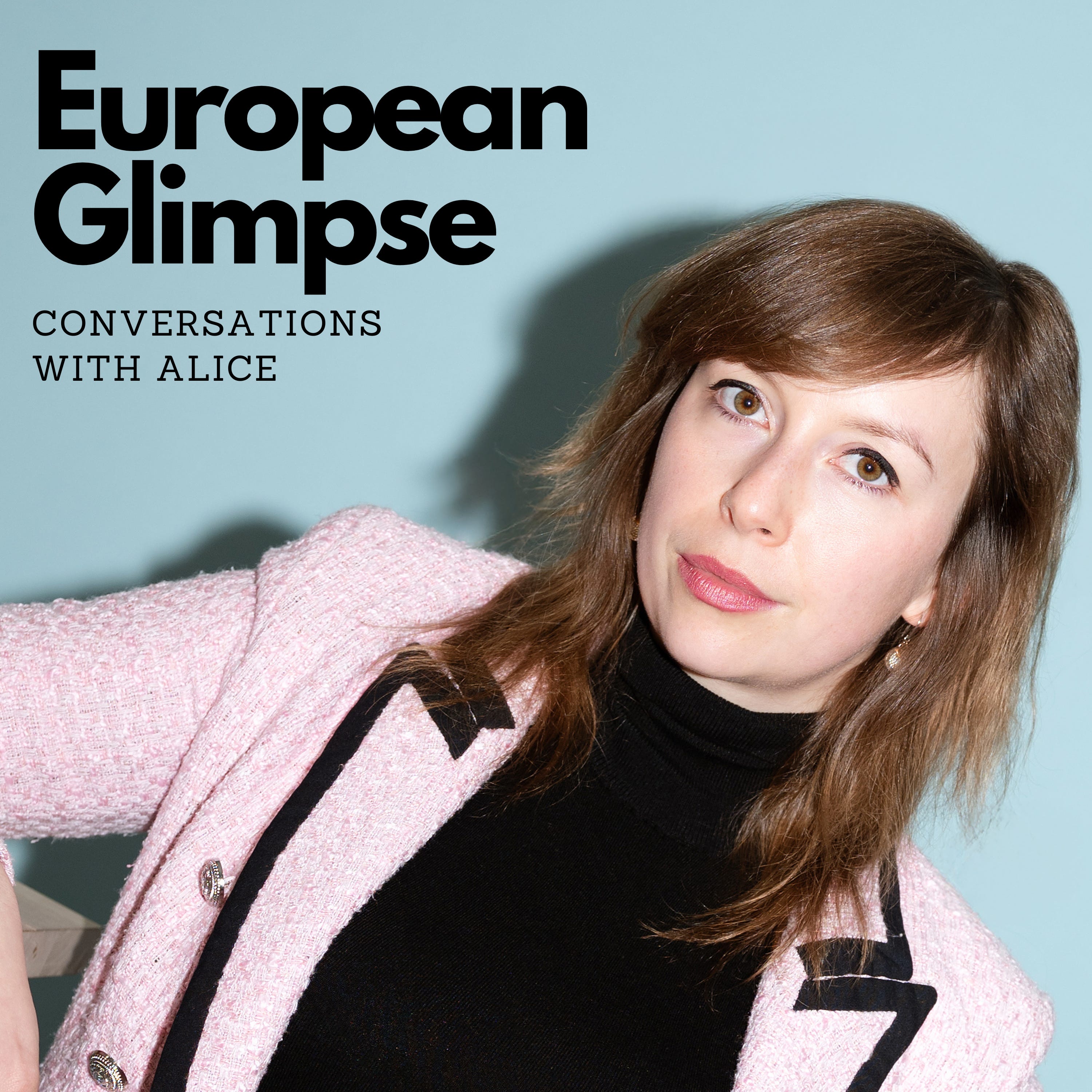
Welcome to European Glimpse! In this first episode, I will share why I believe it is important to talk about Europe!
Here’s the transcript:
What does it truly mean to be European? For me, that question is deeply woven into the fabric of my own family history, particularly through the lives of my two grandmothers. In this first episode of European Glimpse, I'll share how their very different worlds shaped my understanding of the continent and how it, frankly, inspired me to create this podcast.
My grandmother on my father's side was a tall, eastern German woman with blue eyes and pink cheeks. She was born in 1937, many of her childhood memories were about war.
The sounds of bombs falling on her homestead key of Magdeburg. The smell of ash. The sticky and hot air as people were huddling together in basements to stay safe. She rarely spoke of those horrors. But I'll never forget that one time when I was
But I'll never forget that one time, when I was about seven, at a family gathering. She simply looked at me and then said, when I was your age, I ran through fire. Then, just as quickly, she looked away and changed the subject. That single sentence has always stayed with me, a glimpse into a childhood so utterly alien to mine.
My grandmother's family had experienced two world wars which Germany lost. Later she saw how the Berlin Wall was built, separating families and friends.
In her new home state in eastern Germany, the German Democratic Republic, school children and adults alike were taught that the West was the enemy.
My grandmother learned Russian when she was young, both in school and on the streets. She shared stories about young Russian soldiers collecting the watches German women were wearing. Uri uri, they said, mispronouncing the German word for watch. Uo.
Many years later she saw the collapse of the socialist system and Germany finally being reunited again. For some people this meant freedom, but for others it meant loss.
I don't think my grandmother ever felt like she was a European.
On the other side of my family, my maternal grandmother experienced a vastly different life. She was born in 1945 in a small village without proper plumbing in Bulgaria, close to the Greek border. In her family, the elders were sharing stories about that time when the Ottomans were in control of the area
and how the most beautiful woman in town was subjected to what is now Turkey. Since those days people had started to feel increasingly patriotic, yet politics seemed kind of irrelevant. Everyone in the village was a farmer, and taking care of the crops and animals was the most important task. After World War II, people found out that the monarchy in Bulgaria had collapsed,
and quickly learned about the new ideas for the economic and social order under the name of socialism.
When she was young, my maternal grandmother never learned about the political killings that took place during her childhood.
but you did experience the expansion of education and the industrialization of that period.
She received a professional training, started the family early and worked for decades. If you don't work, you can't eat. I remember her repeating the old communist saying.
The socialist values in Bulgaria have withered away as the country has introduced the market economy, joined the European Union, and lost roughly a third of its population to migration and a plummeting birth rate. The children are all in the West, my grandmother and her friends say. I don't believe that she sees herself as European, but I shall ask her the next time I get the chance.
My life is very different. I very much identify as European. Partly because of this mixed background I've just described and because I grew up between the values of both Eastern and Western Europe. I grew up in Germany.
Another part is that I had the privilege to travel the continent. I remember one of the pivotal moments of my life was when I got a scholarship as I was studying in university. This meant I could spend a semester in Madrid. I fell in love with the city and its beautiful architecture and lively neighborhoods. I met people from all over the continent and realized that we had quite a bit in common.
We wore the same clothing from big international brands, we liked the same music artists, and we watched the same Disney cartoons as we were growing up. However, I was particularly struck by the stories, questions, and even jokes surrounding World War II when I was in this international community, even though we were all born roughly half a century after the war ended. Later,
I had the chance to study as well in Poland and Denmark, one year respectively. Even though the mentalities of both nations are very, very different, I always found ways to connect with the locals. Interestingly, World War II was something people would bring up. There must be something about those international communities where World War II is just defined as a pivotal moment that everybody has to talk about.
Those experiences made me realize that Europe can only be understood against the backdrop of its own past. And frankly, European nations, their identities and stories mirror the interwoven history of the continent.
To me, Europe is about experiences, different traditions, values, and personal stories of the many different people who live here. But I definitely feel I don't know what is going on in other countries. When I scroll through social media or the news, the timeline is full of world news, including stories about Chinese trade or US politics.
It seems to me that I'm more likely to come across stories and trends taking place in the US than on what is currently happening in Austria, Greece or Sweden. But I think it's important for us Europeans to look at our own situation right now.
I'm not saying that we should ignore the influence of other countries or that it's bad in any way. But our geographic location has a big effect on our culture, our politics, our economy. So does our history. Even when I read stories about Europe, as rarely as they appear, it as well seems to me that a lot of them are rather negative. And I've gotten tired to see memes about Europe becoming the world's museum.
This observation or this meme doesn't correspond at all with my own reality.
European Glimpse, this podcast, is my very own way of finding out what people are talking about in other countries, what types of problems they observe, and what they are creating in their very own spaces. And now, I want to hear from you. Whether you're a student, a professional, a journalist, a scholar, or simply somebody who's sensitive to the cultural differences in the continent. Send me your thoughts, your stories.
I would like to talk to you and record a podcast episode. And you can reach out to me just by mailing me at europeanglimpse at gmail.com.
Thank you for being here and listening to this very first short episode of European Glimpse. My name is Alice and I'm really excited to share more stories and insights in the upcoming episodes. Until then, take care and keep your eyes on Europe.