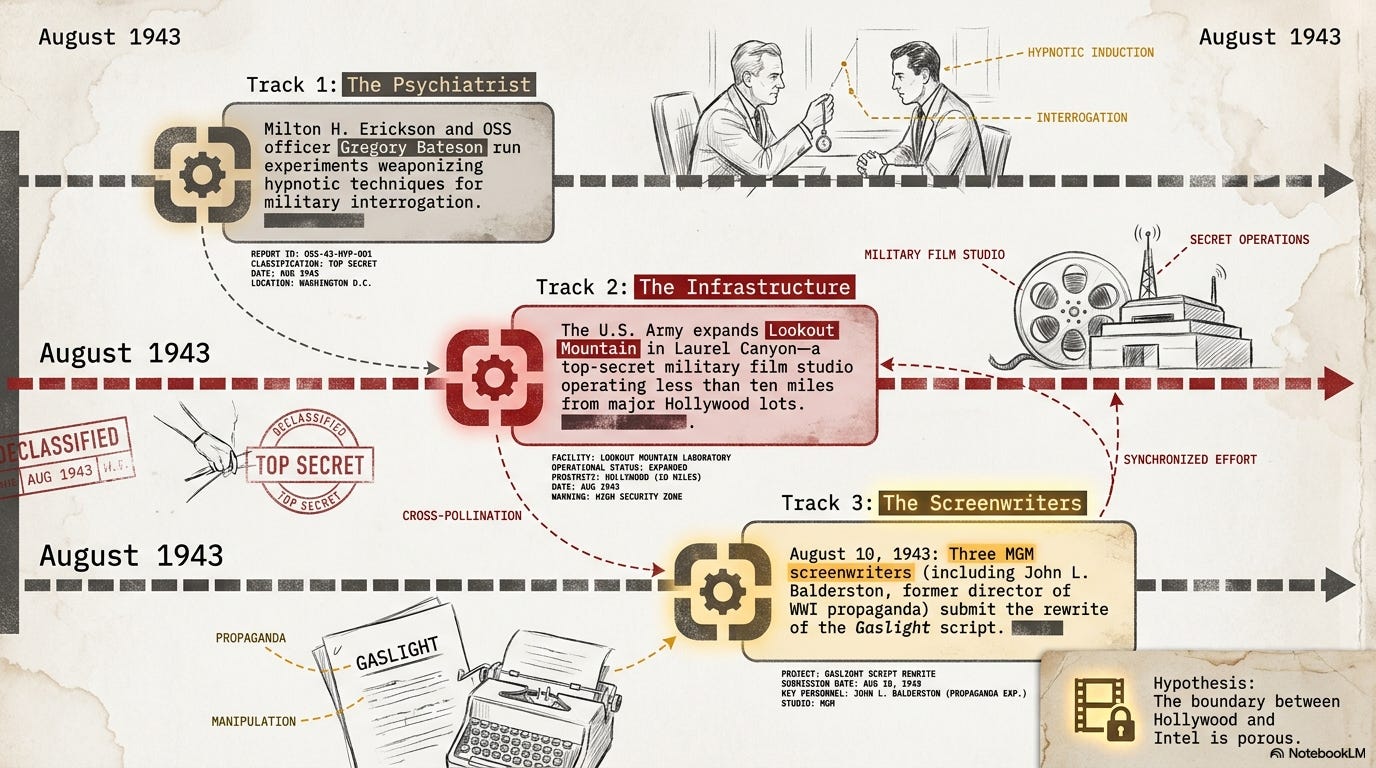
This podcast-style “deep dive” unpacks Peter Duke’s Substack article proposing that the 1944 MGM film Gaslight was engineered as a covert demonstration (and possibly a live audience test) of Milton H. Erickson’s clinical hypnotic techniques, coinciding with OSS psychological warfare research during World War II.
The Duke Report is a reader-supported publication. To receive new posts and support my work, consider becoming a free or paid subscriber.
Setup and Thesis
(00:00:00 – 00:02:30) Opening hook and thesis. The hosts invite listeners to imagine being in a 1944 movie theater watching Gaslight — and to consider that the audience may have been participating in a covert U.S. military psychological experiment. They introduce Peter Duke’s Substack article, Did the U.S. Military Test Milton Erickson’s Hypnotic Techniques Through a Hollywood Film?, framing the film as a meticulously engineered demonstration of clinical hypnosis rather than a conventional thriller.
(00:02:30 – 00:05:30) From Hamilton’s play to the MGM rewrite. Gaslight began as Patrick Hamilton’s 1938 stage play, where the husband Jack Manningham is a crude bully who yells at his wife Bella and openly demeans her. The 1944 screenwriters (John Van Druten, Walter Reisch, John L. Balderston) renamed the characters (Gregory Anton and Paula Alquist), stripped out the brute-force bullying, and added an entirely new 30-minute Italian courtship sequence that functions as a textbook hypnotic induction.
(00:05:30 – 00:09:10) Who Milton Erickson was. Erickson (1930s–1980) revolutionized clinical hypnosis by showing that deep trance states can be induced through ordinary conversation — strategic stories, truisms, calculated ambiguity, and structured language patterns that bypass the conscious mind’s critical faculties. His methods were later codified as the “Milton Model” inside NLP. The hosts use a network-security analogy: Hamilton’s play is a DDoS attack (brute force, alarms blaring), while Erickson’s approach mimics a friendly handshake protocol that gets the firewall to hand over administrative access voluntarily. The shift is from coercion to induction.
Original Post:
Act One: Pacing and Leading (The Italian Courtship)
(00:09:10 – 00:12:10) Pacing via the piano accompanist role. The writers made Gregory a piano accompanist to Paula, an aspiring opera singer — a profession whose literal job description (matching breathing, tempo, phrasing) aligns with clinical pacing. This establishes limbic resonance: Paula’s mirror neurons register “this person is like me,” lowering defensive thresholds. When Paula asks for a week at Lake Como to think clearly, Gregory does not resist; he paces her departure with “The sooner you go, the sooner you will come back.”
Yet Another Piano Hypnotist:
(00:12:10 – 00:13:30) Embedded post-hypnotic commands. Before Paula boards the train, Gregory says, “While you’re away, never forget for one moment, I’m here waiting and in love with you.” The hosts isolate the embedded imperatives — never forget, I’m here, waiting, in love with you — as commands designed to operate unconsciously during her absence.
Act Two: The Lake Como Honeymoon — Seven Techniques Stacked
(00:13:30 – 00:15:10) Utilization of the hypnopompic state. The honeymoon scene exists nowhere in Hamilton’s play. It opens with Paula in a hypnopompic (half-waking, theta-wave) state of heightened suggestibility. Gregory utilizes this natural biological opening rather than forcing a rigid script — a foundational Ericksonian principle.
(00:15:10 – 00:17:15) Mode switching across VAK channels. Gregory rapidly shifts Paula through visual (”What were you dreaming of?”), auditory (”I heard it in music”), kinesthetic (”I want a feeling of the early morning”), then back to visual (”with the sun rising, lighting your hair”). The host compares this to driving in the rain while the GPS, radio, and passenger questions compete for working memory: critical evaluation collapses under cognitive overload.
(00:17:15 – 00:19:10) Presupposition loading and indirect suggestion. Gregory asks, “Where would you like us to settle?” — a sentence whose structure presupposes the relationship is permanent. Paula gets only the illusion of agency (she picks geography). He then tells a wistful story about walking through London in winter, longing for a home on a quiet square. Narrative functions as a Trojan horse: Paula projects into the emotions of the story and volunteers the information Gregory wants — her late aunt’s London house.
(00:19:10 – 00:22:00) Refusing the lead and future pacing. When Paula offers the London house, Gregory refuses: “No, Paula, beloved, I would not ask that of you.” Refusal masks intent and forces Paula to become the active agent of her own manipulation, pushing him to accept the house. He then anchors present sensory comfort (sunlight, her hair, morning calm) to the imagined London future — future pacing. The host notes the statistical implausibility of seven specific Ericksonian techniques appearing in correct clinical sequence by coincidence.
Act Three: Sowing Doubt
(00:22:00 – 00:26:00) The Yes Set and the brooch. Gregory gives Paula a family brooch while planting a negative suggestion: “You might lose it. You are inclined to lose things.” Negation forces the brain to activate the concept (Daniel Wegner’s white-bear experiments). He then steals the brooch and later runs a yes-set: “You were wearing the brooch” (yes), “I asked you to be careful” (yes), “You’ve been forgetful lately” (yes — because he has been secretly moving her things), then the payload: “You’re inclined to lose things.” The linguistic shift from an action to an identity (”the kind of person who…”) is the decisive move. Hamilton’s play contained the same hidden-object plot device but rendered it as yelling; the screenwriters replaced a fist with a hypodermic needle.
Act Four: The Confusion Technique and the Missing Picture
(00:26:00 – 00:30:30) Cognitive overload and the missing painting. Erickson formally described the confusion technique in a 1948 paper. The host analogy: opening 70 heavy tabs until the RAM maxes out and the antivirus freezes, letting malicious code slip into the root directory. Gregory hides a painting and gathers Paula with the servants. He opens with a double bind: “If you will put things right when I’m not looking, we’ll assume it did not happen” — accepting amnesty concedes guilt; refusing it looks hostile. He escalates by making the older maid swear on a Bible, then cornering Paula with: “Shall I ask the other maid to kiss the Bible, Paula, or will you accept her word?” Either answer leads to his conclusion. When Paula locates the hidden painting behind a clock through her own competence, he reframes her success as guilt: “So you knew where it was all the time.”
Act Five: The Negative Hallucination — Four-Step Protocol
(00:30:30 – 00:36:10) Training Paula not to perceive reality. The hosts distinguish a positive hallucination (seeing what isn’t there) from a negative hallucination (failing to perceive what is there). Erickson demonstrated subjects who could not see a chair in his office yet unconsciously walked around it. The screenwriters break the induction into four steps:
* Step 1 — Denial of the percept. The gaslights visibly dim; Gregory tells Paula the light is steady.
* Step 2 — Reattribution to internal state. When Paula hears real footsteps (Gregory searching the sealed attic), he says, “You get tired. Don’t worry,” relocating the cause from environment to her biology.
* Step 3 — Installing the frame. Gregory tells Paula her mother was mad, died in an asylum, and began by “imagining things.” The story functions as a converter that turns accurate sensory data into proof of hereditary insanity.
* Step 4 — Authority through warmth. He delivers the diagnosis with tender concern: “Now perhaps you will understand why I cannot let you meet people.” Incongruent communication (gentle words, rigid posture, angry micro-expressions) — which Gregory Bateson linked to schizophrenia-like states — breaks her internal social compass.
The hosts contrast this with Hamilton’s stage play, where the husband simply yelled at his wife to stop talking about the lights.
Act Six: Locking the Trap
(00:36:10 – 00:39:55) Double binds and fractionation. At the Dalroys’ piano recital, Gregory publicly finds his pocket watch (which he planted) in Paula’s purse. Every available response confirms his narrative — kleptomania, theft, or hysterical denial. Public embarrassment heightens autonomic arousal, which Erickson noted bypasses conscious processing. Fractionation — repeatedly bringing a subject in and out of trance — is executed through oscillating cruelty and tenderness: cortisol/adrenaline spikes followed by dopamine/oxytocin relief, producing trauma bonding. The theater sequence shows Paula moved to say, “You’re the kindest man in the world,” moments before he plunges her into deeper panic.
(00:39:55 – 00:41:35) Environmental control. Gregory intercepts mail, declines invitations, and seals the sensory environment. He pre-installs his frame into new maid Nancy (played by a young Angela Lansbury): “Don’t bother your mistress. Come straight to me. Your mistress is inclined to be rather highly strung.” He flirts with Nancy in front of Paula to build an unspoken household alliance. The house becomes a sealed ecosystem where Gregory is the sole authorized narrator of reality.
Resolution: The Counter-Operation
(00:41:35 – 00:43:20) Detective Cameron’s clinical intervention. Duke argues the climax cannot be physical because the film has functioned as a clinical text. Detective Brian Cameron does the neurological opposite of Gregory — he re-paces Paula by validating her sensory evidence. She says the lights are dimming; he confirms it. She hears footsteps; he hears them too. The environmental seal shatters. In the final scene, Paula, now freed, weaponizes Gregory’s own techniques against him while he is tied to a chair: “I’m mad. I might do anything with this knife. How can a mad woman help her husband?” The patient becomes the practitioner.
The Pedagogical Architecture
(00:43:20 – 00:45:15) Five hallmarks of a training film. Duke identifies five features that suggest pedagogy rather than pure drama: (1) techniques introduced in isolation before combination, (2) each technique produces a visible, measurable effect on the subject — the camera lingers like a clinical observer, (3) techniques are deployed in the exact correct operational sequence (rapport → influence → overload → perceptual restructuring → maintenance), (4) complexity ramps appropriately, with three or four techniques layered into a single sentence by the climax, (5) the film ends by explicitly demonstrating the counter-technique.
The Historical Paper Trail
(00:45:15 – 00:47:30) OSS, Balderston, and Lookout Mountain. In August 1943, when the script was being written, Milton Erickson was consulting for the OSS (precursor to the CIA) alongside anthropologist Margaret Mead and her husband, OSS officer Gregory Bateson, whose work on double binds the film appears to illustrate. Declassified documents show the group experimenting with the weaponization of hypnotic techniques for interrogation and morale manipulation. Screenwriter John L. Balderston had previously directed information for the U.S. Committee on Public Information in England and Ireland during World War I. The U.S. military was simultaneously building Lookout Mountain Air Force Station in Laurel Canyon — a classified film studio a few miles from the MGM lot — and boundaries between Hollywood and military intelligence during the war were essentially non-existent.
(00:47:30 – 00:49:20) Duke’s three possibilities. (1) Three screenwriters independently and coincidentally reinvented decades of advanced clinical methodology in correct sequence during the exact months the OSS was refining the same techniques nearby — mathematically implausible. (2) The writers acquired the knowledge through informal back channels via Balderston’s intelligence connections intersecting Erickson’s OSS circle. (3) U.S. intelligence intentionally used the production as a controlled mass-scale test of whether Ericksonian techniques, delivered through charismatic actors, could produce measurable psychological effects on theater audiences of millions.
(00:49:20 – end) The closing provocation. The hosts extend the implication forward: if a black-and-white film in 1944 could structurally induce a negative hallucination, what can a personalized, AI-driven, 24/7 digital ecosystem do to perception of reality today — with mode switching, yes sets, and dopamine-cortisol fractionation loops woven into algorithms, feeds, and immersive environments?
Thanks to the generosity of my readers, all my articles are available for free access. Independent journalism, however, requires time and investment. If you found value in this article or any others, please consider sharing or even becoming a paid subscriber, who benefits by joining the conversation in the comments. I want you to know that your support is always gratefully received and will never be forgotten. Please buy me a coffee or as many as you wish.
The Duke Report - Where to Start
My articles on SubStack are all free to read/listen to. If you load the Substack app on your phone, Substack will read the articles to you. (Convenient if you are driving).
Foundational Articles
* Do You Know the Difference between Liberty and Freedom?
* The Power Structure of the World
* A User’s Guide to Neuro-Linguistic Defense
Podcast (Audio & Video Content)
* Palmerston’s Zoo Episode 01 - Solving the Paradox of Current World History (9 Episodes)
* Oligarchic Control from the Renaissance to the Information Age
* The Grand Design of the 20th Century
* Bots React to Neurolinguistic Defense
SoundCloud Book Podcasts
I’ve taken almost 200 foundational books for understanding how the world really works and posted them as audio podcasts on SoundCloud. If you load the app on your phone, you can listen to the AI robots discuss the books on your journeys across America.
* The Duke Report SoundCloud Channel
Duke Report Books
* Over 600 foundational books by journalists and academics that never made the New York Times Bestseller list, but somehow tell a history we never learned in school. LINK