Updated Graphics! 01.29.2026
The podcast presents my book Stealth Power and the Illusion of Democracy as a blueprint for stealth conquest: the use of economic dependency, engineered chaos, managed media, and staged governance to transform democratic societies into centralized control systems, followed by the suppression of dissent through surveillance and targeted destruction.
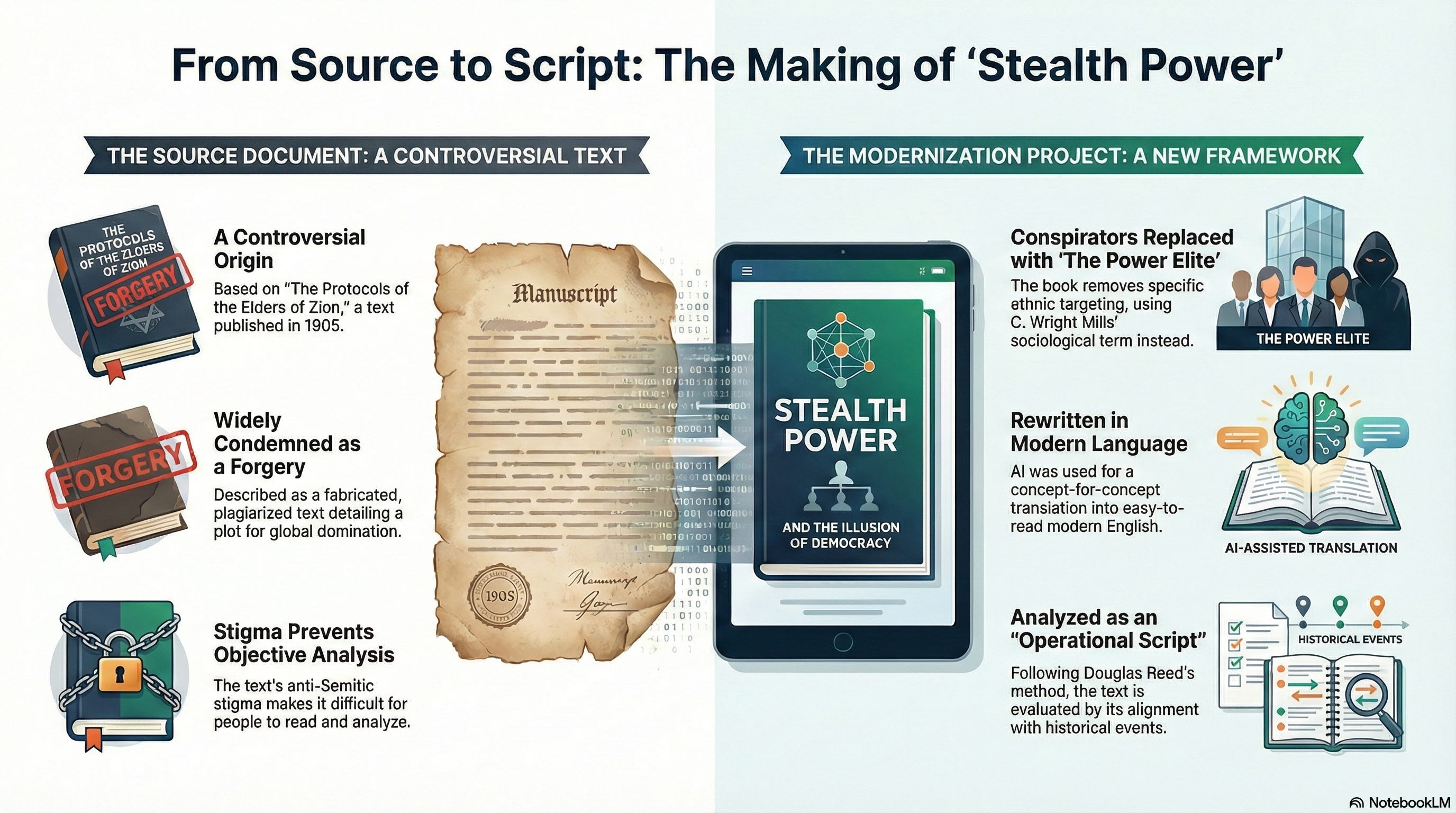
Stealth Power and the Illusion of Democracy by Peter Duke began as a modernization project based on The Protocols of the Elders of Zion, a text published in 1905 and later branded a forgery, with a long record of political abuse.
This book rewrites that source into contemporary English, removes ethnic targeting, and replaces the original alleged conspirators with a generalized ruling category called the Power Elite, using the term in the sense associated with sociologist C. Wright Mills. The framing device comes through the “metadata” argument attributed to mid-century journalist Douglas Reed: treat the document as an operational script, then evaluate its internal mechanics by tracking whether its strategic claims align with the observed architecture of modern power.
Power Elite Philosophy: Force as Political Reality
The book opens by establishing a governing axiom: political authority rests on coercive capacity, and moral language functions as packaging. The text treats legitimacy as a managed belief rather than a binding constraint because institutions respond to leverage, dependency, and enforcement. This philosophy divides society into two roles: a planning class that calculates outcomes, and a mass public that reacts to stimuli. The public appears as “the mob,” used as a functional description of crowd behavior — volatile, emotional, and easily redirected — so control requires steering rather than persuasion.
This worldview drives the book’s tone and sequencing. The text treats manipulation as a craft. It treats governance as engineering. It treats mass politics as a psychological environment that must remain stable enough to extract labor, taxes, and consent.
Economic Mastery: Conquest Through Debt
The book places finance at the center of modern conquest because credit reaches deeper than occupation and scales faster than war. It describes a strategic shift away from territorial acquisition toward economic capture, in which victory means ownership of a nation’s obligations. Debt becomes the instrument that converts sovereignty into compliance, since a government that depends on external financing must preserve creditor confidence to function.
The book breaks this down through internal and external loans, then emphasizes the interest burden as the enforcement mechanism. A state borrows for war, infrastructure, or emergency spending, and the project completes quickly enough to generate public approval. Interest payments then arrive as a permanent drain, funded through taxation, and the tax stream routes productive output into creditor channels. The book describes a feedback loop: rising interest costs, tightening budgets, growing public anger, and the state borrowing again to maintain operations. At that point, policy autonomy collapses because refusal threatens default, and default threatens regime stability.
Gold, Scarcity, and Monetary Gatekeeping
In the historical setting assumed by the original framework, gold functions as the reserve monetary lever because scarcity creates command over settlement. The book treats gold hoarding as a model for subsequent monetary control: whoever governs the medium of exchange governs trade. From this perspective, monetary policy functions as a steering mechanism that determines which sectors expand, which regions decline, and which political coalitions gain the resources to dominate elections, the media, and legal advocacy.
Land, Taxation, and the Destruction of Independence
The book extends economic warfare into property and inheritance, focusing on land as the material basis of independence. A landholder who produces food, houses tenants, and employs labor retains a degree of autonomy that resists financial coercion. The text treats that autonomy as a threat to centralized control, so it targets land through property taxes, inheritance taxes, mortgages, and carrying costs that force liquidation. Under sustained pressure, families sell assets to meet obligations, and capital consolidates land through banks, corporate vehicles, and investment structures.
This mechanism operates as political engineering because it changes who can afford permanence. When ownership becomes expensive and precarious, citizens trade long-term independence for short-term survival.
The Price Pincer: Wage Gains Without Purchasing Power
A major tactical section describes the “price pincer,” a method for controlling workers through synchronized wage and price movements. The strategy increases public support for higher wages while raising the prices of essentials — food, shelter, and energy — faster. As wages rise, the household experiences temporary relief, and purchasing power declines as necessities absorb the gain. The book treats the psychological outcome as the real objective: fatigue, anxiety, and constant financial strain reduce political attention and increase dependence on institutional relief.
Narrative control supports the pincer because price shocks require explanation. The book describes public narratives that attribute inflation to scarcity, supply disruptions, or natural misfortune, thereby preventing citizens from identifying the steering hand.
Luxury Engineering and the Household Debt Trap
The book introduces a second constraint: luxury appetite. It describes a cultivated desire for status goods and upgrade cycles that turn wage gains into spending, which then leads to consumer debt. This creates a household version of the sovereign debt trap because payment obligations limit the ability to refuse, relocate, strike, or resist. The system becomes behavioral: people protect their financing arrangements by avoiding risks, and the political order gains stability through private fear.
Methods of Conquest: Liberalism as a Solvent
The book treats liberalism in the nineteenth-century sense — relaxation of authority — as a tool for dissolving older structures. As monarchies, aristocracies, and churches lose cohesive authority, social order fragments and power vacuums form. Financial power then fills the vacuum by coordinating resources faster than dispersed civic institutions. The book frames this as conquest through destabilization: the public celebrates liberation while structural control migrates into banking, contracts, and permanent bureaucracies.
The Slogan Trap: Liberty, Equality, Fraternity
A recurring device in the book is the use of political slogans that mobilize mass action while generating permanent conflict. “Liberty, Equality, Fraternity” serves as a prime example: a chant that feels morally complete, spreads easily, and evokes revolutionary energy. The book treats the slogan as a trap because it produces competing demands that keep factions fighting, thereby exhausting civic cohesion and clearing space for financial consolidation.
Political Theater: Parliaments as Exhaustion Machines
The governance section describes representative institutions as performance stages that absorb attention through spectacle. Endless debate, partisan conflict, and procedural gridlock keep citizens emotionally engaged while delivering minimal resolution. The text treats public exhaustion as the intended outcome because exhaustion produces disengagement, which reduces scrutiny of the deeper systems that govern credit, law, and information.
Compromised Leaders and Governance by Leverage
Leadership selection becomes an engineering problem in this framework. The book describes a preference for leaders with vulnerabilities — crimes, scandals, debts, humiliations — because leverage produces obedience.
A compromised figure obeys to avoid exposure, and the visible executive role becomes a transmission belt for directives formed elsewhere. The book frames this as governance through files, intermediaries, and threat management.
Deadlock as Preparation for Central Rule
The book presents deadlock as a strategic condition that prepares the public to accept concentrated authority. When institutions repeatedly fail, citizens crave relief.
Relief arrives in the form of a single ruler presented as the solution to chaos. The book frames this as the planned transition point where democratic theater yields to explicit central control.
Media and Information Control: The Vishnu Strategy
The book shows how mass communication is the core control system because belief governs behavior. It describes a control filter that governs what reaches the public, then proposes a tiered structure designed to preserve credibility. The structure includes an official press that defends the regime, a semi-official press that performs neutrality, and a controlled opposition press that captures dissent.
The controlled opposition performs the most important function: it provides dissidents with a home while channeling their energy into a managed channel. People who seek truth find a platform that echoes their anger, then build identity and community within an environment that the system can monitor and steer.
Taxation on Thought: Crushing Independent Publishing
The book describes economic constraints on publishing as a means of suppressing independent creators without overt censorship. Stamp taxes, cost barriers, and regulatory burdens reduce the number of viable outlets, leaving only capital-backed publishers. When distribution requires money and money flows through a controlled financial system, information centralizes by structural necessity.
Education and the Removal of Political Literacy
Education appears as a long-term pipeline for compliance. The book describes the removal of political literacy — law, governance mechanisms, power analysis — from curricula and its replacement with vocational training and obedience conditioning. Citizens learn to operate within systems while remaining blind to ownership structures and control pathways.
Governance Transformation: The Super Government
A central concept in the book is a “super government” tightening its grip on nations through incremental centralization. Borders remain on maps, elections continue, and sovereignty becomes ceremonial as authority migrates into transnational bodies, treaty structures, and financial governance. The process unfolds gradually because gradual change avoids mass recognition.
Suppression of Dissent: Surveillance and Fear
The endgame requires enforcement. The book describes a society saturated with informants, in which a significant portion of the population spies on the rest, producing an ambient fear that prevents organization. Social trust collapses, and self-censorship becomes the default survival strategy. The text also describes internal cleansing after consolidation, including the elimination of insiders who know too much about the system’s construction.
Northcliffe as Narrative Enforcement
The book closes with the Lord Northcliffe episode as an illustration of suppression directed at a powerful insider who diverges from the approved line. Northcliffe, associated with The Times of London and the Daily Mail, enters the narrative as a media titan who seeks to publish views beyond the boundaries of containment. The text describes rapid isolation, the removal of control within his own empire, and a fatal outcome, as framed through Douglas Reed’s account. The episode functions as a warning inside the book’s logic: enforcement reaches any altitude once a figure threatens the script.
Endgame: Open Rule After Stealth Conquest
The final movement describes coordinated seizure of authority across states, followed by a centralized regime that seeks stability through surveillance, administrative discipline, and managed economics. The book describes post-conquest reforms designed to quiet the population once control becomes total, because the system seeks predictable compliance after it secures the field.
The book’s central question persists through the closing pages: when a society runs on theater, debt, and narrative constraint, which lever restores agency—attention, coordination, institutional literacy, or the refusal to participate in managed conflict?