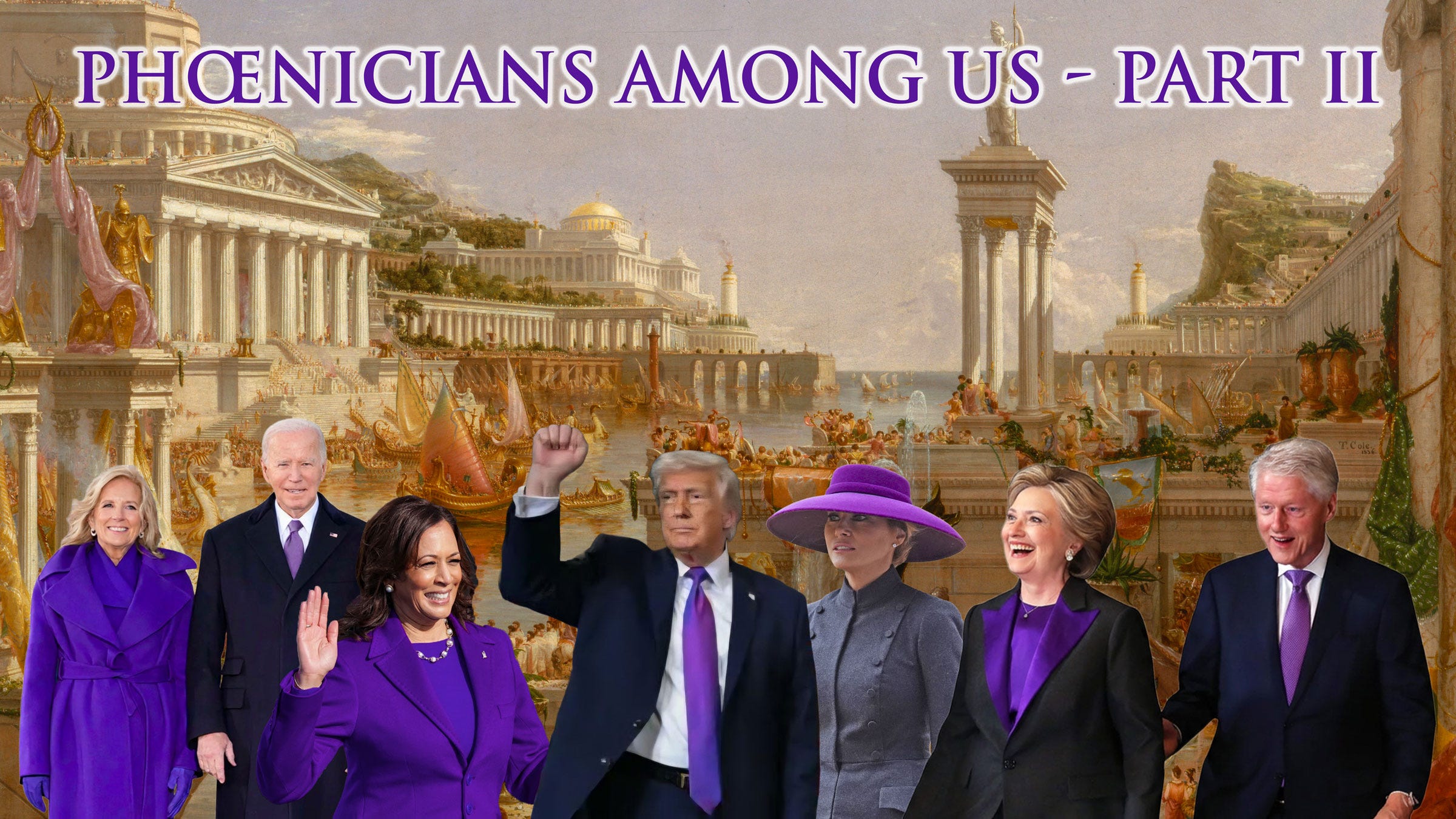
Peter Duke welcomes Mrs. Heritage History back to The Duke Report Podcast after a two-month gap, noting strong audience demand for her return (00:03:14). She frames the episode’s central thesis: the Roman Empire functioned as a Phoenician empire, operated by Phoenician networks, and conventional history obscures this. She announces a “preponderance of evidence” approach rather than a linear narrative, drawing on roughly 40 books of Roman history she has read over 30 years (00:04:22–00:06:07).
Part One:
Peter draws a parallel to the American empire being labeled “American” rather than “British,” and she extends the analogy further — Rome, Britain, America all represent the same network shedding its outer identity while retaining its operational methods, like a snake shedding its skin (00:06:36–00:07:18).
She begins with a review of terms from Part I (00:10:12). When she says “Phoenician,” she does not mean the narrow coastal strip of Tyr, Sidon, and Byblos. She means the entire Mediterranean-wide network of Tyrian colonies, Carthaginian outposts, and local elites across Spain, Italy, and Greece who intermarried with Phoenician families over a thousand years. These communities spoke different languages but shared commercial ties, cult worship, and secret society membership. Tyr, Carthage, and Cadiz (ancient Gades) are the three critical cities (00:10:47–00:15:38).
She then traces what happened when Tyr and Carthage fell (00:15:46). Alexander destroyed Tyr; ten years later, Alexander died. Within a year, she argues, the Tyrians relocated to Alexandria, rebranded as “Alexandrian Jews,” and reconstituted their trade network under the Ptolemaic dynasty. Alexandria rapidly became the largest and wealthiest city in the Eastern Mediterranean.
She identifies Skull and Bones’ “322” as referencing 322 BC, the year after Alexander’s death (00:16:02–00:18:22). Peter offers a useful analogy: just as Californians label all Latin American immigrants “Mexicans” regardless of origin, the Alexandrians likely labeled incoming Levantine migrants as “Jews” without distinguishing Canaanites, Tyrians, and actual Judeans (00:19:32–00:21:53).
When Carthage fell, its wealth, library, and population had already been evacuated (00:22:34). Utica, a Phoenician city just north of Carthage, absorbed its trade routes. Cadiz likewise accepted Roman governors while keeping its entire commercial infrastructure intact. She emphasizes that a maritime empire can relocate by loading ships, burying treasure on islands, and maintaining underground libraries — including a secondary library in Alexandria that survived Caesar’s fire and lasted another 400 years (00:24:04–00:27:35).
Peter connects this to his framework of epistemological warfare: a catastrophic library fire provides convenient cover for removing an entire body of knowledge from public access and relocating it under private control (00:28:00–00:28:31).
She clarifies her terminology one more time (00:28:35): “Tyrants” refers specifically to the Tyrian bloodline elite; “Phoenicians” refers to the entire network, including mixed families who spoke Spanish, Italian, Greek, and Etruscan and maintained Phoenician commercial and cultic connections.
The Duke Report is a reader-supported publication. To receive new posts and support my work, consider becoming a free or paid subscriber.
Peter then raises Francis Yates’s The Art of Memoryand offers his theory that oral mnemonic traditions — memory palaces, monuments, symbols, jewelry — allowed this network to transmit knowledge across generations without writing it down, and that the MKUltra programs show overlap with these ancient memory palace techniques (00:29:35–00:32:13). She agrees, noting that Homer memorized the entire Iliad while blind, and that Druids held writing in contempt — the capacity for memorization in the ancient world far exceeded anything modern people practice (00:32:58–00:33:15).
She reviews Julius Caesar from Part I (00:33:16). Caesar operated as a Phoenician-backed “made man” — a term she identifies as specifically Mafia-derived, meaning someone sponsored into power by an organized crime network. Marius (a seven-time consul who converted the Roman army from a citizen militia to a mercenary force) was his uncle.
Crassus, Rome’s wealthiest crime boss, financed him. His grandmother’s lineage is untraceable, which she treats as significant, given that Roman genealogical records for famous families extend back 500 years. His conquest of Gaul exceeded his authority, killed or enslaved over a million people, and relied on turning tribes against each other (00:33:27–00:38:09).
She then previews her leading indicators of Phoenician influence (00:38:12): speaking Punic, matrilineal succession, pederasty as a power and mentorship dynamic, the equestrian class, orgies and promiscuous noble women with indifferent husbands, mystery cults worshipping Punic gods, populist politics binding the ultra-wealthy to the urban mob, latifundia (agribiz replacing family farms), monumental architecture, and control of literature and historical writing. She quotes George Webb: “History is not written by the winners — it’s written by the perpetrators” (00:50:12).
She addresses matrilineal relationships as a critical yet nearly invisible indicator (00:39:54). Bloodlines and hidden wealth (“dark money”—jewels, gold, unacknowledged property) pass through women, which makes genealogical tracking deliberately difficult, since names follow men but power follows women. She notes Ptolemaic near-total incest, Habsburg and Rothschild intermarriage, and the pattern of American “rags to riches” men whose wives’ family backgrounds reveal hidden wealth. Peter illustrates the matrilineal principle with his own background: his father is Ashkenazi, his mother Catholic, so under Israeli matrilineal law, Peter Duke is not Jewish — but his daughter (whose mother’s mother was Jewish) would qualify for Israeli citizenship (01:16:17–01:17:09).
Pederasty receives extended treatment (00:41:00). She distinguishes it from modern “pedophilia” framing, arguing it functioned in the ancient world as a structured mentor-protégé system reinforced by sexual trauma-based conditioning. An older man would identify a talented younger boy, mentor him, and marry his daughter to the protégé — creating interlocking family alliances.
Secret societies operated as all-male for this reason. Peter adds the example of Horatio Alger, a known pederast whose “rags to riches” stories all feature a young boy befriended by an older man (01:19:24–01:20:41).
The equestrian class receives the most detailed economic treatment (00:45:43). Originally, wealthy Romans who could afford a horse, by the Punic War era, the equites had become their own social class — non-patrician, often non-Roman, extremely rich. A 218 BC law barring patricians from maritime trade and finance opened the door for equestrians to take over all commercial activity. Flush with silver from newly conquered Spain (which she calls “the silver house of Europe”), they became tax farmers, government contractors, road builders, and bankers. The Gracchi passed a law giving equestrians sole power over juries that judged senators, creating enormous leverage over the old patrician class (01:31:01–01:42:31). Peter compares this to oil millionaires displacing old European money, then Silicon Valley billionaires displacing oil money — new technology creating new wealth categories that force their way into governance (01:32:28).
She presents the Severan Dynasty (193–235 AD) as her most direct evidence (00:50:30). Septimius Severus spoke Punic as his native language, came from a Phoenician colony, and married Julia Domna, daughter of a priest of the sun god Elagabalus (another name for Baal) from Emesa, Syria. Succession passed through the women: Julia Domna’s sister and her daughters produced the last two Severan emperors, both boy emperors. Elagabalus, the emperor, served as a priest of the sun god and dressed as a woman. Septimius renamed the southern portion of Syria “Syria Phoenice” and made Tyre its capital city, 200 years into the Imperial era. Roman emperors built temples to Phoenician gods at Baalbek (ancient Heliopolis, “City of the Sun”), and she argues that these are always dismissed as “pagan” temples even when they exhibit distinctly Phoenician characteristics (00:51:26–00:59:28).
Spain occupies a major section (00:59:33). Phoenicians settled Spain around 1000 BC — Seville, Malaga, Cartagena, Barcelona, Cordoba, all trace to Phoenician founding or governance. When Phoenician Spain surrendered to Rome, the cities accepted Roman governors but retained their gods, trading routes, farms, and money. Cadiz functioned as “the Las Vegas of the Roman Empire” and was the first city Julius Caesar granted full Roman citizenship (01:02:42). Josephine Quinn’s In Search of the Phoenicians found child sacrifice artifacts (tophet circles) in Sardinia, Carthage, Malta, and Sicily (01:03:41). Peter adds Ralph Glidden’s 1928 discovery of 64 infant skeletons buried in a circle around a ceremonial urn on Santa Rosa Island, about 20 miles offshore from his location, which would place Phoenicians in Southern California during the same period (01:05:04). She connects Columbus’s launch from the Canary Islands — likely Phoenician-settled — as further evidence of pre-Columbian transatlantic knowledge (01:06:30–01:07:11). She argues that archaeological evidence for Jews in Spain only appears after the 400s AD, while Phoenicians occupied Spain for 1,500 years before that, and connects Spanish conversos to the founding of the Jesuits (01:07:39–01:12:08).
The Five Good Emperors all trace to Spain (01:12:58). Trajan and Hadrian came from Spanish families. Antoninus Pius and Marcus Aurelius were Italian but married into the Trajan family through women — Sabina’s sister’s daughters. She traces the succession through wives, sisters, and daughters, arguing that what gets taught as unrelated emperors adopting promising young men is actually matrilineal continuity obscured by patrilineal naming conventions (01:13:00–01:15:56). Commodus portrayed himself as Hercules, whom she identifies as the Romanized version of Melqart, a specifically Phoenician god (01:20:48). Peter adds that Melqart-Hercules masks appear over the entrances of the Mellon Auditorium in Washington, D.C., built in the 1930s, labeled as “Greco-Roman tradition” (01:21:09–01:21:44).
The rapid moral transformation of Roman nobility receives attention (01:23:26). Rome transitioned from a patriarchal society with the biblical “helpmate” ideal to one characterized by extreme promiscuity concentrated among the nobility. She cites Messalina (Claudius’s wife), Maecenas’s wife (who slept with Augustus), and Agrippa’s wife (Augustus’s daughter Julia) as examples of powerful men indifferent to their wives’ flagrant affairs — a pattern she reads as cult conditioning rather than personal weakness.
Peter draws parallels to Pierre Trudeau and Macron (01:26:28–01:27:02) and identifies the Starbucks twin-tailed mermaid logo as Melusine, a Phoenician goddess variant of Messalina (01:27:07).
She runs through the Julio-Claudian dynasty briefly (01:27:56), noting the matrilineal succession through women (coded red in her slides), pervasive murder among potential heirs, Livia Drusilla’s suspicious role in clearing the path for Tiberius, and Nero’s marriage ceremony with a man (Sporus) dressed as a woman.
The 100-year fight over Italian citizenship occupies the political core of her argument (01:49:33). She frames every major conflict of the late Republic — the Gracchi’s murders, the Social War (four devastating years), the War of Octavius, the Sulla Civil Wars, the Catiline Conspiracy, and Caesar’s march on Rome — as iterations of one fight: Phoenician-backed equestrians attempting to dilute Roman citizenship so they could swamp the Senate and control the consuls who appointed generals who commanded armies. She quotes the warning: “If you give citizenship to the Italians, they will swamp everything” (01:50:06). Caesar finally accomplished it by military conquest, packing the Senate with 300 loyalists, and extending the franchise to all his allies, starting with Phoenician colonies. The Republic was finished (01:59:37–02:01:18). Peter compares this to modern illegal immigration strategies aimed at controlling elections (01:42:35).
Latifundia — the Roman word for agribiz — transformed the Italian countryside from family farms to enormous slave-staffed estates growing specialized cash crops (01:47:00). She argues the Phoenician traders deliberately promoted this transformation because food dependency gave them ultimate leverage: if you control maritime trade and a population imports all its food, you control that population. She compares modern Idaho (giant corporate dairy and potato operations) to Wisconsin (family farms) and notes that the pattern of buying up land, encouraging debt, then crashing the economy to confiscate holdings has been repeated for 2,000 years (01:45:03–01:47:32).
The Cilician pirates arose immediately after the fall of Carthage and Corinth (02:03:06). Over a thousand ships, control of 400 cities, and were the primary suppliers of slaves for the latifundia. Pompey “cleared” the Mediterranean of pirates in three months, which she reads as a negotiated deal rather than a military victory. He gave them all amnesty and settled them as farmers and merchants across the Roman Empire. They brought the cult of Mithras with them (02:03:34–02:07:16). Peter notes that the Phrygian cap worn by Mithras, by the Cilician pirates in her illustrations, and by the Statue of Liberty also appears on the U.S. Senate seal, the U.S. Army seal, at least a dozen American state seals, and at least a dozen foreign government seals (02:07:53–02:08:32).
He offers his interpretation: the Galli (castrated slave-priests of Cybele) also wore Phrygian caps, and the cap on the British crown’s interior — surrounded by a golden cage — signals that the monarch serves at the pleasure of the oligarchy, a caged bird (02:12:20–02:13:13).
Peter shares a discovery about the word “testament,” deriving from “testicle” — a witness who could swear on his progeny (02:09:37). Abraham asking his servant to place his hand under his thigh was a verification of intact manhood. She connects this to the universal practice of castrating male slaves, the social division between intact men (who could vote, witness, and judge) and castrated men (slaves or priests), and the industrial brothels of the ancient world staffed by boys castrated in infancy and raised as female prostitutes (02:10:01–02:12:06).
The episode closes with Phoenician religious influence in Imperial Rome (02:13:57). Cybele and Bona Dea served as women-only mystery cults involving sacrifice. The cult of Isis and Serapis served as the primary Phoenician religious vehicle: Isis as the patron of sailors and maritime trade, Serapis as a hybrid god created by the Ptolemies. The Roman Senate repeatedly opposed the worship of Isis; the equestrians and emperors promoted it. Vespasian performed miracles in the name of Isis and Serapis to legitimize his rule during the Year of Four Emperors (02:22:26–02:22:56). She connects the dollar sign to the Pillars of Hercules superimposed with the “S” from a Spanish symbol, traces the Jesuit “IHS” monogram to “Isis Horus Set,” and reads the serrated-edge “sun” symbol on the Jesuit emblem as pederastic iconography rather than solar symbolism (02:17:46–02:20:41).
Peter wraps the episode at two hours and 23 minutes (02:23:18). She emphasizes that this evidence ought to be commonplace among Roman scholars and that its absence constitutes proof of institutional suppression. Peter directs listeners to her Substack (North Idaho Local / Mrs. Heritage History) and to The Duke Report, and thanks her for synthesizing 30 years of research into the episode (02:26:15–02:28:17).
Thanks to the generosity of my readers, all my articles are available for free access. Independent journalism, however, requires time and investment. If you found value in this article or any others, please consider sharing or even becoming a paid subscriber, who benefits by joining the conversation in the comments. I want you to know that your support is always gratefully received and will never be forgotten. Please buy me a coffee or as many as you wish.
The Duke Report - Where to Start
My articles on SubStack are all free to read/listen to. If you load the Substack app on your phone, Substack will read the articles to you. (Convenient if you are driving).
Foundational Articles
* Bots React to Stealth Power and the Illusion of Democracy
* Do You Know the Difference between Liberty and Freedom?
* The Power Structure of the World
* A User’s Guide to Neuro-Linguistic Defense
Podcast (Audio & Video Content)
* Palmerston’s Zoo Episode 01 - Solving the Paradox of Current World History (9 Episodes)
* Oligarchic Control from the Renaissance to the Information Age
* The Grand Design of the 20th Century
* Bots React to Neurolinguistic Defense
SoundCloud Book Podcasts
I’ve taken almost 200 foundational books for understanding how the world really works and posted them as audio podcasts on SoundCloud. If you load the app on your phone, you can listen to the AI robots discuss the books on your journeys across America.
* The Duke Report SoundCloud Channel
Duke Report Books
* Over 600 foundational books by journalists and academics that never made the New York Times Bestseller list, but somehow tell a history we never learned in school. LINK