Mrs. Heritage History and I will do a livestream and take questions on this on SubStack on June 30, 2026.
00:03–00:10 — The Purpose of the Episode
Mrs. Heritage explains that this third installment follows the earlier episodes Phœnicians Among Us and Phœnicians Among Us - Part II,but shifts the emphasis toward the last several centuries. Her goal is to connect modern developments with a much longer historical narrative stretching back two thousand years.
Before beginning, Peter Duke establishes a disclaimer. He explains that the discussion revolves around the Sephardim, but not in the ordinary sense. He recounts examining the word and finding that it traditionally refers to Jews of Iberian origin. Mrs. Heritage’s argument uses the term differently. She identifies the Phoenician settlers of Spain with the historical Sephardim and repeatedly stresses that Phoenicians and Jews overlap without being identical categories. Duke returns to this distinction throughout the interview.
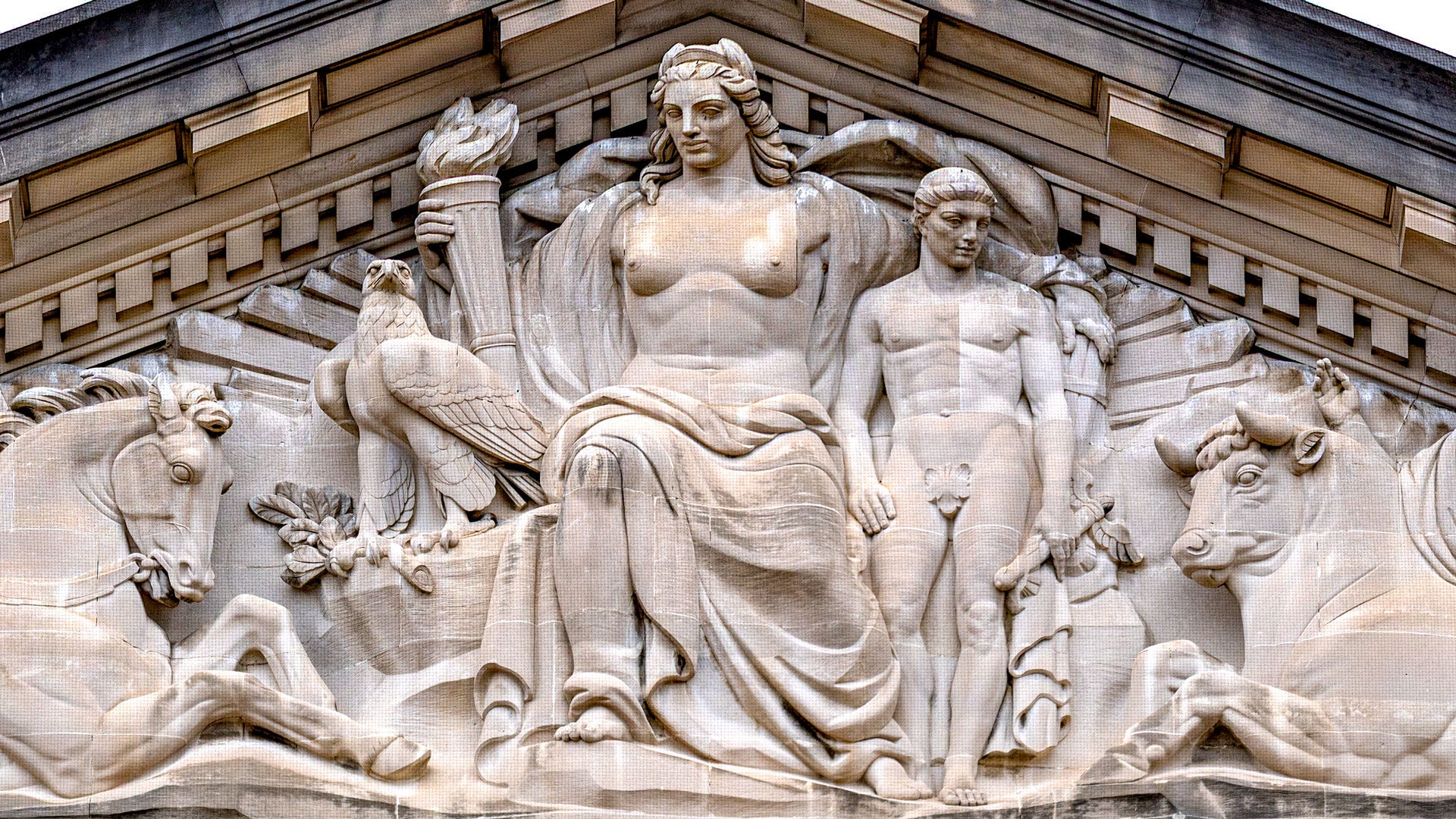
Duke then recalls his January 2021 visit to Washington and describes the Mellon Auditorium and National Archives. Symbolic figures and interpretations supplied by Pat Moise serve as a bridge into the larger historical argument.
Mrs. Heritage replies that powerful families such as the Mellons illustrate her larger thesis that Phoenician traditions extend beyond Jewish identity.
00:10–00:18 — Why Sephardic History Became Central
Mrs. Heritage explains that her chronological approach led her into the sixteenth and seventeenth centuries, where she repeatedly encountered Sephardic communities. She argues that Portuguese trade, Dutch commerce, banking, intelligence networks, arms dealing, and the East India Company all contained strong Sephardic elements.
At approximately the fifteen-minute mark she recommends several books that she believes illuminate these subjects.
Books Mentioned
* Jewish Pirates of the Caribbean — presented as an account of Sephardic influence in the Americas and especially Latin America.
* The Grandees — described as a history of American Sephardim.
Mrs. Heritage argues that such histories receive little attention compared with discussions centered on Ashkenazi Jews.
This leads directly into a critique of the Khazar theory. She argues that Khazar conversions occurred centuries after the institutions she is describing had already developed.
00:18–00:29 — Temples, Banks, and the Roman Empire
The discussion broadens into a survey of Jewish traditions. Mrs. Heritage reviews Israelites, Mizrahi Jews, Romaniote Jews, and Hellenistic communities and argues that interactions between Jews and Phoenicians extend back into antiquity.
Peter Duke introduces ideas influenced by Michael Hudson concerning temples functioning as banks. Mrs. Heritage expands on the concept, describing temples as centers of wealth, intelligence, communication, and religion.
The conversation then turns to the Christianization of Rome. Mrs. Heritage argues that pagan institutions adapted rather than disappearing entirely and that financial considerations shaped many of these transformations.
Duke compares monotheism to a modern corporate roll-up.
00:29–00:36 — Eastern Europe and the Ashkenazim
Mrs. Heritage discusses Bohemian mining, German-speaking merchants, Baltic trade, and Vikings. She rejects Khazar-centered explanations of Ashkenazi origins and cites older authorities.
Books Mentioned
* History of the Jews in Russia and Poland— Mrs. Heritage physically holds up a nineteenth-century Jewish history and points to its chapter on the Khazars.
* Two Hundred Years Together, by Aleksandr Solzhenitsyn (referred to as his final work on Jews in Russia) — cited as supporting the limited importance of Khazar conversions.
She insists that Spain and the Sephardim remain the principal story.
00:36–00:45 — Spain as the Treasure House of Antiquity
Spain becomes the foundation of the presentation.
Mrs. Heritage argues that Iberia supplied the ancient world with silver, gold, copper, iron, mercury, and tin. Cadiz occupies a central place in her account. She portrays Phoenicians as masters of mining and metallurgy who guarded their technical knowledge.
She believes the importance of Spain has been greatly understated and argues that Roman conquest represented adaptation rather than destruction.
00:45–00:58 — Visigoths, Moors, and the Reconquista
Mrs. Heritage moves through Visigothic Spain and the Islamic conquest. She describes Moorish Spain as prosperous, literate, and intellectually advanced.
Peter Duke observes that the term "vanished libraries" often implies that books were removed rather than destroyed.
At this point, Duke refers to a recent discussion involving James Delingpole and Robert Frederick concerning Francis Bacon and the phrase “knowledge is power.”
Figures and Books Referenced
Mrs. Heritage then discusses Castile, León, and Aragon, describing the growing tensions that culminated in the pogroms of 1391.
00:58–01:03 — Conversion and Expulsion
Mrs. Heritage argues that conversions long predated the expulsion of 1492. By that point some Sephardim had become Christians, some Muslims, and others remained Jews. In her framework, “Sephardim” and “Jew” had already ceased to be equivalent.
01:03–01:25 — Portugal and the Commercial Empires
The discussion follows the diaspora after 1492.
Portugal becomes the first major destination. Conversos and merchant families become deeply involved in maritime trade and the Portuguese empire.
Attention then shifts to Holland and Amsterdam. Dutch commerce, shipping, finance, and intelligence networks emerge as continuations of earlier structures.
01:25–01:33 — Britain and London
The center of gravity shifts from Holland to England. Merchant families and aristocratic circles become intertwined. London emerges as a major node in the story.
01:33–01:40 — Symbolism and the American Flag
Peter Duke introduces his interpretation of the American flag. He associates the red and white stripes with solve et coagula. Red represents dissolution and white recombination. He argues that the pattern implies continual transformation.
The Union Jack becomes the next subject. Duke discusses the crosses of St. George and St. Andrew and their symbolic significance.
01:40–02:00 — Banking Families and Germany
Mrs. Heritage repeatedly returns to maternal lines and dynastic continuity.
She argues that major banking families originated in Bavaria, Frankfurt, and the Rhine rather than Eastern Europe. Public attention, she says, shifted toward Eastern European Jews while older families remained less visible.
02:00–02:12 — Scapegoats and Modern History
Peter Duke introduces the two goats of Leviticus, one sacrificed and one sent into the wilderness. He uses the imagery to discuss public blame and collective narratives.
The conversation expands into immigration and twentieth-century perceptions.
02:13–02:15 — Books on Aristocracy and Elite Families
The discussion turns toward genealogy and aristocracy. Mrs. Heritage refers to a work by L. G. Pine concerning the British aristocracy. Someone had sent her the book intending to prove that elite families were Jewish. She argues that the marriages described in the book support her own interpretation.
Peter Duke then discovers that Steven Birmingham’s work forms a trilogy.
Books Mentioned
* Tales of the British aristocracy by L. G. Pine.
* The Grandees, by Steven Birmingham.
* Our Crowd, by Steven Birmingham.
* The Rest of Us, by Steven Birmingham.
Duke remarks that he now has additional books to add to The Duke Report reading list.
02:15–02:25 — Intermarriage and Maternal Lines
Mrs. Heritage returns once more to maternal inheritance and elite intermarriage. These themes recur throughout the interview and form one of the principal mechanisms in her interpretation of continuity across centuries.
02:25–02:33 — Contemporary Researchers and Conclusion
Peter Duke reflects on commentators including:
* Stu Peters
* Candace Owens
* E. Michael Jones
He suggests that many researchers approach what he considers a deeper explanatory layer without fully crossing into it. He also acknowledges the possibility that some understand more than they publicly say.
The interview closes with Duke encouraging viewers to support The Duke Report. He announces that he is working on Reframing Reality and hopes to publish it by Christmas. He thanks Mrs. Heritage History and ends the recording.
Books Mentioned During the Interview
* Christopher Columbus and the Participation of the Jews in the Spanish and Portuguese Discoveries - Dr. M. Kayserling (1894)
* Did the Phoenicians Discover America? - Thomas C. Johnston, (1913)
* The International Jew - Dearborn Independent / Henry Ford (1913)
* John Finnemore - Barbary Rovers - Peeps at History (1912)
* The Grandees: America’s Sephardic Elite - Stephen Birmingham
* Jewish Pirates of the Caribbean - Edward Kritzler
* Our Crowd — Steven Birmingham
* The Rest of Us — Steven Birmingham
* History of the Jews in Russia and Poland - Simon Dubnow
* Two Hundred Years Together — Aleksandr Solzhenitsyn
* Book on the British Aristocracy - L. G. Pine
Thanks to the generosity of my readers, all my articles are available for free access. Independent journalism, however, requires time and investment. If you found value in this article or any others, please consider sharing or even becoming a paid subscriber, who benefits by joining the conversation in the comments. I want you to know that your support is always gratefully received and will never be forgotten. Please buy me a coffee or as many as you wish.
The Duke Report - Where to Start
My articles on SubStack are all free to read/listen to. If you load the Substack app on your phone, Substack will read the articles to you. (Convenient if you are driving).
Foundational Articles
* Do You Know the Difference between Liberty and Freedom?
* The Power Structure of the World
* A User’s Guide to Neuro-Linguistic Defense
Podcast (Audio & Video Content)
* Palmerston’s Zoo Episode 01 - Solving the Paradox of Current World History (9 Episodes)
* Oligarchic Control from the Renaissance to the Information Age
* The Grand Design of the 20th Century
* Bots React to Neurolinguistic Defense
SoundCloud Book Podcasts
I’ve taken almost 200 foundational books for understanding how the world really works and posted them as audio podcasts on SoundCloud. If you load the app on your phone, you can listen to the AI robots discuss the books on your journeys across America.
* The Duke Report SoundCloud Channel
Duke Report Books
* Over 600 foundational books by journalists and academics that never made the New York Times Bestseller list, but somehow tell a history we never learned in school. LINK