Thank you Thomas Gilligan, Steshu Dostoevsky, Frank Miscione, Christine Mose, Ordo Purgatio Flamma, and many others for tuning into my live video! Join me for my next live video in the app.
The Charlie Kirk ARG by Peter Duke of The Duke Report examines how alternate reality games, reality television, and political media share a single design language of control. Duke — filmmaker, photographer, and founder of The Duke Report — builds the episode as an operational analysis of perception, revealing how entertainment structures migrate into governance. He situates his argument in lived experience, personal history inside the media industry, and first-hand observation of right-wing political events, constructing a thesis that modern politics functions as an immersive game engineered for psychological engagement.
The Duke Report is a reader-supported publication. To receive new posts and support my work, consider becoming a free or paid subscriber.
Ontology of Control
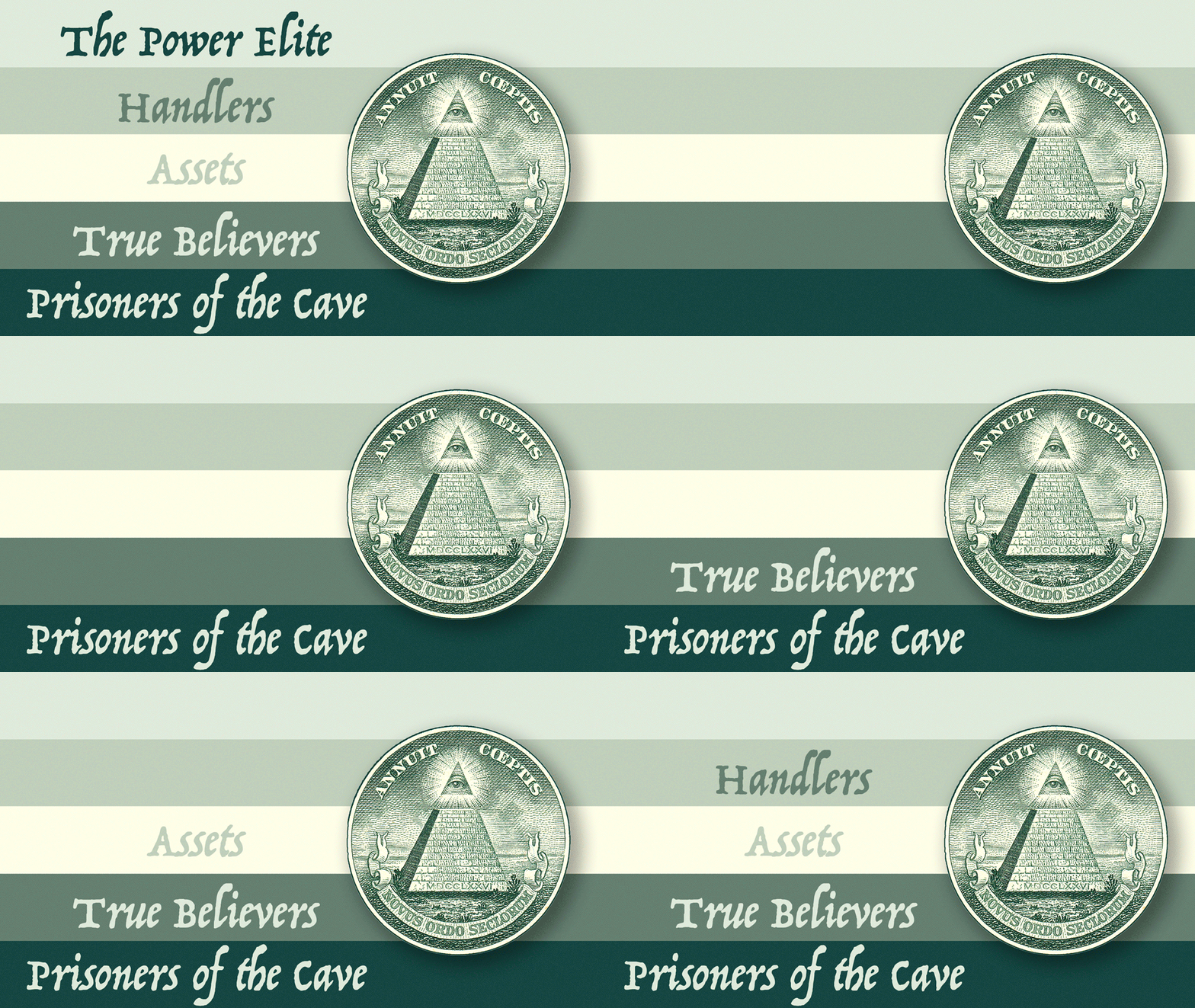
Duke opens with his ontology: a layered model of human organization. He defines five strata — prisoners, true believers, assets, handlers, and the power elite.
Prisoners inhabit mediated reality through television and social feeds. True believers form ideological groups built on collective frustration. Assets are recruited from these believers to execute directed actions. Handlers coordinate assets through information, access, and rewards. Above them, a small elite preserves dominion through finance, intelligence, and transgenerational networks. Duke asserts that history and politics unfold inside this architecture of managed belief rather than within the surface drama of democracy. The framework becomes the lens for his study of media as a psychological instrument.
The Intelligence Logic of MICE
He introduces the intelligence acronym MICE — Money, Ideology, Compromise or Coercion, Ego or Family — as the operational matrix of influence. Money governs dependency. Ideology governs motivation. Compromise governs obedience. Ego and family govern loyalty. Each factor acts as a control vector applied through recruitment or manipulation. Duke extends this logic beyond intelligence agencies to media production, suggesting that television, social networks, and political campaigns deploy the same psychological engineering used in covert operations. Within this schema, the visible performer — politician or celebrity — functions as an asset animated by unseen handlers.
RAND, Avalon Hill, and Systems Thinking
Duke traces his comprehension of systems back to his childhood in Woodland Hills, California. His mother, a librarian with Q clearance at RAND Corporation, managed classified archives of nuclear research. A neighbor, also a RAND employee, introduced him to Avalon Hill’s strategic war games such as Bismarck, Stalingrad, Gettysburg, and Waterloo. Each cardboard counter represented a division of roughly ten thousand men; each roll of dice abstracted the death of thousands. Playing these games taught Duke how to translate human life into mathematical probability, a skill he later recognized as essential to modern command systems. This early encounter with abstraction created his lens for viewing politics as simulation — an orchestrated environment governed by rule sets and strategic actors.
Mark Burnett and Game Theory in Television
Duke turns to Mark Burnett, the British producer of Survivor and The Apprentice. Burnett, a veteran of the Falklands conflict, relocated to Los Angeles and ascended rapidly from vendor to global television executive. Duke treats Burnett’s portfolio as deliberate experimentation in governance psychology. Survivor models a democratic game structure where losers elect the winner; The Apprentice models an authoritarian structure with a single arbiter—Donald Trump. Both apply John Nash’s non-cooperative game theory, rewarding deceit, alliance, and betrayal as mechanisms of advancement. Burnett’s later presidency at MGM, the studio that controls the James Bond franchise, deepens the link between media, the intelligence myth, and empire. For Duke, these shows serve as behavioral laboratories that test mass appetite for authority and competition.
Donald Trump and the Principle of Kayfabe
Duke observes Trump’s induction into the WWE Hall of Fame and his staged feud with Vince McMahon as enactments of kayfabe— the wrestling convention of maintaining narrative illusion. When McMahon rebranded World Wrestling Federation to World Wrestling Entertainment after testifying that wrestling was scripted, he institutionalized the principle that performance requires belief.
Trump’s wrestling theatrics demonstrate how spectacle fuses with politics. Duke equates kayfabe with the ARG maxim “This Is Not a Game” (TINAG): both preserve immersion by erasing acknowledgment of fiction. Once the audience accepts the illusion, it becomes participant rather than observer. Within this frame, the Trump presidency and the surrounding media ecosystem appear as a continuous interactive production.
Blexit, Turning Point USA, and the Social Media Stage
Duke integrates his direct experience as a photographer embedded in right-wing political events. At the 2018 Blexit rally in Los Angeles, hosted by Candace Owens and Charlie Kirk of Turning Point USA, he documented a production calibrated for viral visibility.
Lighting, camera angles, and audience choreography mirrored the logic of influencer marketing. Duke describes it as the first political event he attended that functioned entirely as a content pipeline. The structure resembled an alternate reality game: mission prompts, character arcs, audience roles, and real-time feedback through likes and shares. He interprets Kirk’s operation as a networked ARG where followers enact ideological missions within digital ecosystems. Participation replaces persuasion. The act of engagement becomes the proof of belief.
Anatomy of Alternate Reality Games
To ground the comparison, Duke dissects ARG structure. A rabbit hole — a mysterious URL, phone number, or object—initiates the story. Ticks, or timed content releases, sustain progression. Collective intelligence, the crowd’s collaborative problem-solving, propels the narrative toward an endgame.
Designers, called puppet masters, maintain secrecy and continuity. The governing rule, TINAG, forbids acknowledgment of fiction. The player’s world becomes the stage. Examples include The Beast (2001), I Love Bees for Halo 2, Nine Inch Nails’ Year Zero, and The Dark Knight’s Why So Serious campaign, which engaged eleven million participants across seventy-five countries. These events proved that distributed populations could be organized through story architecture and digital clues—evidence, Duke contends, of mass-behavior programming through entertainment mechanics.
From Marketing Experiment to Institutional Tool
Duke identifies a pivot from commercial ARGs to what developers term “serious games.” These systems recruit player engagement for education or social engineering rather than promotion. The World Without Oil simulation asked participants to document life under energy collapse. The World Bank’s Urgent Evoke project operationalized the model at scale. Funded with half a million dollars in 2010, it enlisted African university students to design community solutions to hunger, sanitation, and climate challenges. Over 20,000 registered, 8,000 remained active, and 25 projects secured $30,000 in micro-funding. Participants earned World Bank certifications and invitations to Washington, D.C. Duke reads this as institutional confirmation that global finance experiments with behavioral games to shape civic action and ideology through narrative play.
War of the Worlds as Proto-ARG
The episode situates the lineage earlier. In 1938, the Rockefeller Foundation funded Princeton University’s Radio Research Project to study audience response. Orson Welles’s broadcast of H. G. Wells’s War of the Worlds became its live experiment. Listeners who tuned in after the disclaimer believed Martians had invaded New Jersey. Duke calls it the first analog ARG—a coordinated manipulation of perception using mass media as immersive theater. The experiment demonstrated that realism, timing, and authority could induce collective hallucination. From that precedent, Duke draws a continuous thread from early broadcast psychology to present digital persuasion campaigns.
The Parallel Between ARG and Wrestling
Duke closes the conceptual loop by aligning ARG methodology with professional wrestling’s dramaturgy. Both rely on continuous narrative, controlled revelation, and participant complicity. The puppet master mirrors the wrestling promoter; TINAG mirrors kayfabe. Reality persists because the audience desires coherence. In this model, political movements become serial productions sustained by attention rather than policy. Authenticity functions as a script device. The border between spectator and performer dissolves. Society becomes an audience performing its own belief.
Charlie Kirk and the Gamification of Political Reality
Returning to Kirk, Duke defines Turning Point USA as a distributed ARG executed through social media algorithms. Users adopt missions—share content, attend rallies, confront opponents — and receive digital affirmation. Kirk and Owens act as charismatic assets directing crowd behavior through influencer charisma. Their funding networks, media partnerships, and event logistics form the game's infrastructure. Duke’s photographs from Stop the Steal events reveal operational patterns: identical signage, synchronized talking points, coordinated viral loops. The visible spontaneity conceals managerial design. Within his ontology, these operations express the logic of handlers and assets, executing narrative scripts for higher interests embedded in finance and intelligence-linked institutions.
Artificial Intelligence and the Next Phase
Duke warns that AI now extends the ARG framework. Algorithms can adapt storylines to individual user behavior, tailoring ideological reinforcement in real time. Each participant receives a unique but coherent version of the same overarching narrative, maintaining engagement while fragmenting consensus. This adaptive storytelling underlies social-media personalization and political micro-targeting. The technique turns perception into an engineered environment where users co-create propaganda without recognizing authorship. Duke interprets this convergence of AI, ARG design, and influencer culture as the blueprint for total psychological governance.
Psychological Sovereignty and Resistance
The Duke Report positions discernment as the final domain of autonomy. Duke argues that awareness of narrative architecture restores mental sovereignty. He calls this discipline “EpiWar™️” — the war over epistemology, the struggle for control of how knowledge is formed. His objective is to provide analytical tools that expose manipulation systems and enable independent reasoning. For Duke, the contest for freedom no longer occurs on battlefields but within cognition. The mind is the territory; attention is the currency; clarity is defense.
The Structural Order of the Game
In Duke’s formulation, the convergence of ARGs, game theory, and media spectacle creates a new operational regime. Power manifests through participation. Belief generates metrics that justify continued programming. Institutions capture human intention through feedback loops of performance and reward. The distinction between civic action and scripted engagement evaporates. Narrative continuity sustains authority. The game endures because players maintain its rhythm through repetition.
Final Convergence
Peter Duke concludes that the contemporary political sphere operates as a permanent alternate reality game. Producers and financiers design missions disguised as activism. Influencers like Charlie Kirk execute the visible layer of play. Citizens act as distributed characters inside a narrative that harvests their loyalty and labor. The system thrives on immersion, not consent. To exit, one must perceive structure — see the strings, recognize the puppet masters, and refuse scripted participation.
Thanks to the generosity of my readers, all my articles are available for free access. Independent journalism, however, requires time and investment. If you found value in this article or any others, please consider sharing or even becoming a paid subscriber, who benefits by joining the conversation in the comments. I want you to know that your support is always gratefully received and will never be forgotten. Please buy me a coffee or as many as you wish.
The Duke Report - Where to Start
My articles on SubStack are all free to read/listen to. If you load the Substack app on your phone, Substack will read the articles to you. (Convenient if you are driving).
Foundational Articles
* Do You Know the Difference between Liberty and Freedom?
* The Power Structure of the World
* A User’s Guide to Neuro-Linguistic Defense
Podcast (Audio & Video Content)
* Palmerston’s Zoo Episode 01 - Solving the Paradox of Current World History (9 Episodes)
* Oligarchic Control from the Renaissance to the Information Age
* The Grand Design of the 20th Century
* Bots React to Neurolinguistic Defense
SoundCloud Book Podcasts
I’ve taken almost 200 foundational books for understanding how the world really works and posted them as audio podcasts on SoundCloud. If you load the app on your phone, you can listen to the AI robots discuss the books on your journeys across America.
* The Duke Report SoundCloud Channel
Duke Report Books
* Over 600 foundational books by journalists and academics that never made the New York Times Bestseller list, but somehow tell a history we never learned in school. LINK