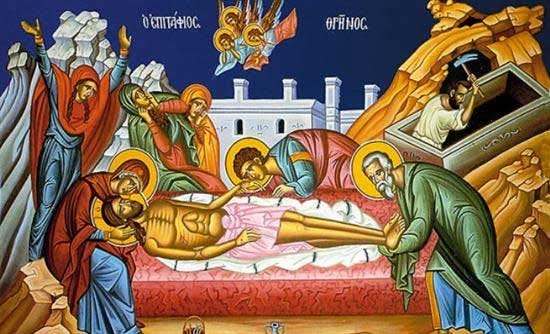
It was finished. Or rather, Jesus’ work was finished — but his body was still hanging on the cross. His spirit had gone from it, but his body was still there.
The body is something fundamentally important in our tradition. We often think of the Greeks as the ones who celebrated the human body — you see all those beautiful sculptures — and assume the Jews dismissed it. But not at all. The Jews treated the body as sacred, not perhaps as sensually as the Greeks, but as something created by God from the beginning. For God made man from the dust of the earth, breathed into his nostrils the breath of life, and man became a living soul. It was the breath of God, the Spirit, entering into the body that God fashioned with his own hands from the dust of the earth, that makes us who we are: human beings.
And there is both a danger and a power about a dead body, a corpse. So much so that even in our society, which tends to downplay the importance of the body — treating it as configurable, something we can put cyber-implants into and alter however we like — we still have this sense of the body as something terrifying, especially a dead one. You can notice this in the very fact that we go out of our way not to encounter dead bodies. We’re very careful when there is one. I happen to know someone who handles these things, and we’re very careful to make sure that as few people as possible see it, that it’s all dealt with nice and neat so nobody actually has to encounter a dead body.
But the body is a part of us. That’s why we preserve and venerate and honour the relics of the saints — because it’s all that we have left of them right now in terms of the physical, in terms of their actual presence.
And here, the body of Jesus was a lifeless corpse hanging on the cross. It’s at this point that Joseph of Arimathea gathers up his courage and goes to Pilate to ask for the body. This was indeed an act of courage, because this is the body of a condemned criminal — more than that, a potential insurrectionist, someone who was killed for being the King of the Jews.
So Joseph of Arimathea gathers his courage, goes to Pilate, and asks for the body. Pilate is surprised to hear that Jesus is already dead, so he checks with a soldier, who confirms it. He grants Joseph the body. Joseph takes it down from the cross and, with the help of Nicodemus, anoints it with myrrh and aloes, wraps it in a shroud, and places it in his own new tomb.
At that point, of course, the Jewish authorities are worried that the disciples might come and steal the body, so they go to Pilate, who says, “Take a guard and make it as secure as you like.” They roll a very heavy stone across the entrance, seal it, and place a guard.
The next day is the Sabbath, so Jesus rests in the tomb. Nothing happens. Then Sunday morning, the women come — the myrrh-bearing women, whom we are celebrating today, along with Joseph and Nicodemus, though we usually think of the myrrh-bearers primarily in terms of the women. The women are coming to the tomb to anoint Jesus’ body. The guards aren’t particularly worried about them: they haven’t seen the modern movies so they don’t actually know the women can can just pull a cool-looking girl boss move and the three of them will take down the two soldiers and steal the body. So the soldiers are not worried about that and, of course, the women are not thinking along those lines either because, you know, bodies matter. They’re probably not trained in any kind of martial arts and so they’re actually just worried about who’s going to roll the stone away from the tomb for them because it’s really large, very heavy. It took a bunch of people to move that stone into place, and it’s going to be even harder to get it out of place and they’re not expecting that the guards are going to be particularly helpful.
Then they arrive at the tomb. The guards are gone. The stone is rolled away. And they encounter men dressed in white who tell them: “Why are you looking for Jesus here? He is not dead. He is risen. Go tell his disciples.” And Mark’s Gospel ends with them running away, saying nothing to anyone, because they were afraid.
I think we can infer from the fact that they did indeed say something to the apostles — as all the Gospels confirm — that when Mark says they said nothing to anyone, he means they said nothing to anyone they passed on the street. That would have been dangerous. But they did tell the apostles. They were, in fact, the apostles to the apostles — the sent ones to the sent ones, the first witnesses to the good news of the resurrection.
So why do we celebrate the myrrh-bearers? Well, for one thing, it took courage — and courage is worth celebrating. But more importantly, what they did was something fundamentally and foundationally good. Not only were they honouring the body of our Lord and God and Savior Jesus Christ: they were taking care of it.
Our Lord’s spirit had departed from his body: he had given up his spirit into God’s hands, and so his body was at that moment the most vulnerable it had ever been — it was dead. He could do nothing with it. He was entrusting his body to our care.
He had spoken about this before. When the sinful woman came in and wept and washed his feet with her tears and dried them with her hair and anointed him, and when Mary of Bethany anointed him with fragrant perfume, he said that they had anointed his body for burial — they had prepared it to be buried. These acts were questioned: “Why wasn’t this expensive perfume sold and the money given to the poor?” And he said, “The poor you will always have with you, but you will not always have me.”
What Christ is saying is, first, that the body is important — the body is a part of who he is. But more importantly, he is defending worship, because his body is still here. His body is still among us. We are, in fact, a part of his body: the Church. And the same reverence, honour, and respect that we are called to give to the body of Christ — the same care that we would naturally and honourably show to his body if it were lying helpless in our midst right now — is precisely what we should be showing to one another as we gather here as the body of Christ.
It takes courage to do this. It takes courage just to gather sometimes, depending on the social conditions. It takes courage to identify with the body of Christ, because we don’t always have a good reputation in the world. And it requires a depth of love and compassion as we encounter one another in our brokenness here as the body of Christ in the Church.
We are all broken, even as Christ’s body was broken. We are all in various ways helpless and vulnerable, even as his body was at that point helpless and vulnerable. And what we need from one another — from those who are alive, from those who have strength and agency and resources, even just the ability to do something — is the generosity, the love, the compassion to allow us to deal with that brokenness. To allow us to allow God to deal with that brokenness. Because he will. And he reveals this in how he deals with the body of his own Son, the Logos made flesh.
For God himself does not abandon his Holy One to the grave, as Peter says in his first great sermon at Pentecost. Rather, he heals him and raises him up — raises him up in glory, in new life, in a resurrection body that can no longer be killed, because death has been destroyed.
And so as we come and worship God, as we come and worship with one another, this time, this energy, this effort that we put in is the reverence we are paying to the body of Christ. It is our act of courage, our act of compassion, our act of love, extended to Christ as we see him in one another. This is the power of God at work in us. This is the love of God at work in us. This is the resurrection life of Christ at work in us, raising us up from our dead isolation, uniting us to one another in love and in glory — to his glory, the glory of the Father and of the Son and of the Holy Spirit.
Christ is risen! Indeed he is risen!
Scripture readings referenced:
* Mark 15:43-16:8