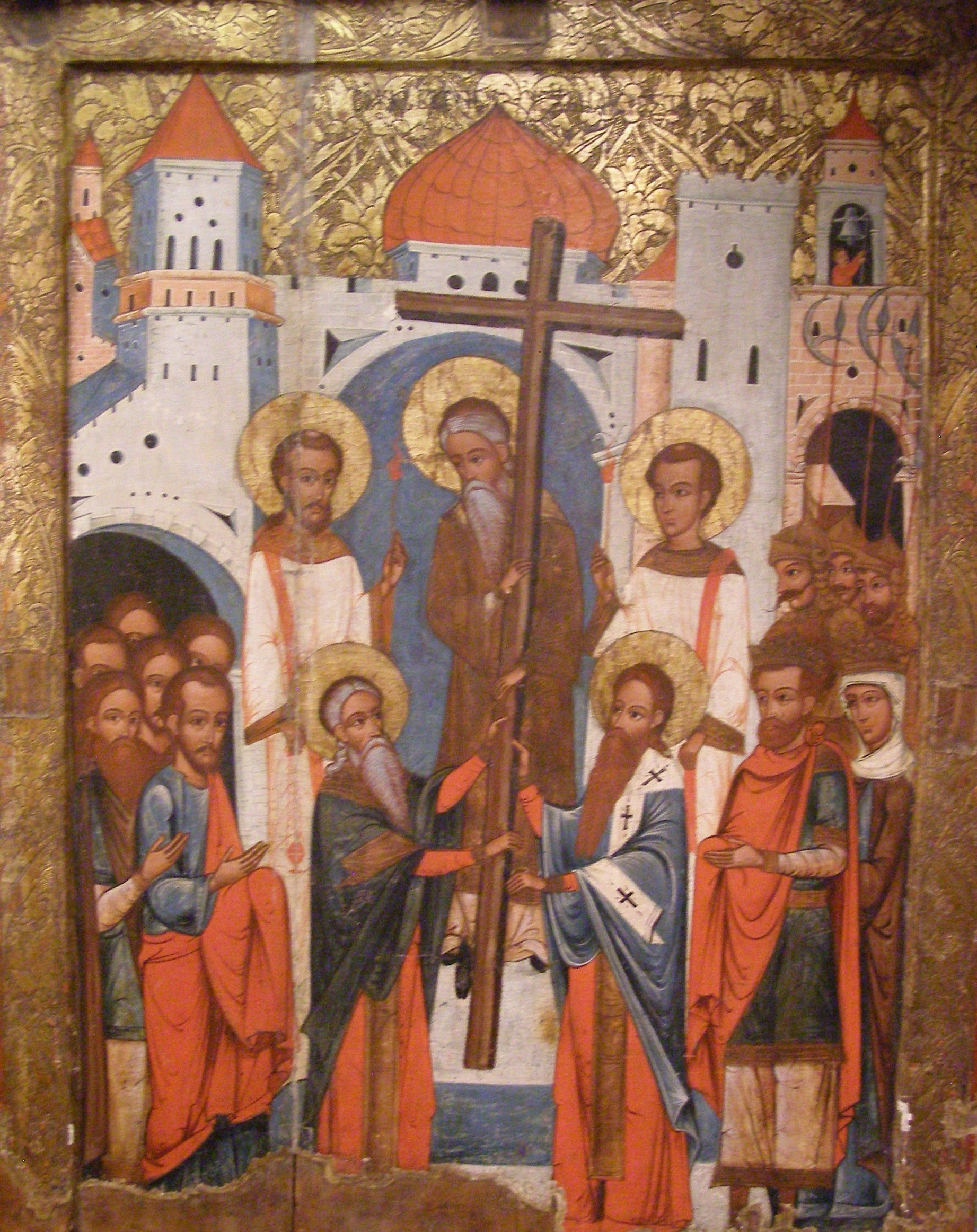
Of all the 12 great feasts of the church—or 17 great feasts, or 17 ranked feasts if you’re following Father Alexander Rentel—this is probably one of the most political. This feast, the Feast of the Exaltation of the Cross, commemorates the finding of the cross by the Empress Helen, mother of Constantine, and also the recovery of the cross when it was captured by the Persians, and then the emperor Heraclius conquered them and brought the cross back to Jerusalem.
So there’s a lot of politics involved here. I want us to consider where that comes from and where we go with it.
The most important thing that we need to start with is, of course, the origin of the feast. But to get at the origin of the feast and the significance of this particular event for Christians, you have to understand the cross. That’s one of the reasons why we just heard a summary version from the Gospel of John about Jesus’ crucifixion. If you don’t understand the cross and what it means and what it represented for centuries up until that point, then you’re not going to get the significance of what happened at that moment.
The cross was, of course, the great instrument of torture and death by which the Romans struck fear into the hearts of their enemies. It was one of the most horrifying, torturous, and excruciating ways that man has ever devised for his fellow man to put him to death. When you are crucified on the cross, it’s a long and agonizing, torturous ordeal just to die, because, of course, embedded in the heart of every human being by God himself is the desire to live, is that instinct to preserve life.
As you’re hanging on the cross, you start to suffocate because your arms are stretched out and you have to push yourself up to take the next agonized breath, and then you let yourself down because you can’t sustain that. It’s just a long ordeal. People survived on the cross for entire days before they finally passed away in agony, naked, and hung up there for everyone to see what would happen to Rome’s enemies and to tremble.
So it was a horrifying and a very political symbol.
Imagine now, this is centuries’ worth of the experience of being in the Roman Empire. This is what has been the instrument of torture and death for everybody—except the Christians. For Christians, of course, this now takes on a new meaning. This takes on a new resonance because the cross, this instrument of torture, fear, death, and oppression, becomes for the Christians, because of what Jesus accomplishes on the cross, because of not only his death but his resurrection, it becomes a symbol of God’s power over death, of God’s mercy as he reaches out to us, of God’s love as he embraces us. He stretches out his hands in the person of his Son to embrace us and the whole world by offering us his mercy.
The other aspect of the Christian experience up until that point, when the Empress Helen found the precious cross, was one of torture and death. If you hang around here on Saturday evenings, you’ll hear the reading of the lives of the saints, and you’ll hear over and over and over again just how many of them were tortured and died for the faith. Jesus himself prepares his disciples for this. Just before the bit that we read, he says to his disciples,
If the world hates you, you know that it hated me before it hated you. If you were of the world, the world would love its own. Yet, because you are not of the world, but I chose you out of the world, therefore the world hates you. A servant is not greater than his master. If they persecuted me, they will also persecute you. If they kept my word, they will keep yours also. But all these things they will do to you for my name’s sake, because they do not know him who sent me.
And he goes on to say, “If they’ve done this to me, they will do even worse to you.”
And again, that prophecy was fulfilled. His disciples, generation upon generation, were tortured and suffered and died for the gospel. But the strange thing was that no matter what the Romans did, they couldn’t seem to stamp this Christianity out. In fact, it was really weird. Christians would go singing to their deaths. The people looking on would be inspired by this, and some of them would stand up and say, “I too want to be a Christian.” This is obviously the best-case scenario. There were also horrible worst-case scenarios where people who professed to be Christians were taken and left the faith at the very last minute because they couldn’t face the suffering and the death that was in store for them.
But Jesus is clear, and the apostles are clear, that those who persevere to the end will be saved. You need to be ready to die for what you believe. If it is the truth, if it is indeed the source of eternal life, you need to be ready to lay down your life no matter what torture comes, and persevere in that until the end, because the only thing worth living for, and therefore the only thing worth dying for, is the Truth—the truth that at the heart of the universe is a God of love.
So, after generation upon generation of suffering, torture, and death at the hands of the authorities, at the hands of those who ran the empire in which they lived, all of a sudden you had this emperor who came along and first proclaimed an edict of toleration and then began to show his favor to the church. Then his mother came to the Holy Land, seeking out the places that Jesus had walked, and been born, and died, and raised again. She even commissioned one of the first archaeological digs as she learned that this cross had been buried, but people knew where it was. And they took the cross out from where it had lain and found it to be life-giving. They raised it up. She raises it up. The mother of the emperor of Rome raises up the cross and honors it. This could only be a miracle. This could only be the hand of God at work. This could only be the fulfillment of prophecy. And so, the Christians rejoiced and continued rejoicing every year over this amazing work of God.
I’ve said often that I feel like we are living in a time that’s maybe parallel to those early years in the Roman Empire. Admittedly, it’s probably kind of hyperbolic. Most of us are not getting killed and tortured for what we believe. It happens. It happens quite frequently over in Egypt, and occasionally we face something like this here. But this should not be a surprise to us. As Jesus said, he has chosen us out of the world. If we were of the world, then the world would love us, but we’ve come out of this world system into the light of the Gospel, and therefore we are considered a threat: potentially hateful, obviously wrong, and dangerous to the existing order of things. And so, yeah, it’s not surprising that they would not like us very much. We should not be surprised.
That being said, if we are going to suffer for the sake of the Gospel, we have to be very careful about how we do that. Yeah, sure, it would be great to live in a time when the country was at least theoretically Christian again. We had a time like that: it was problematic, but our laws were kind of informed by the Christian faith, and most of the people considered themselves Christians, at least nominally, and went to church occasionally. That was nice. That was great. We’re not there now, and it would be nice if that came back. But really, we have to think about how is it to come back? We have to be very careful about how we think about that.
When Jesus was before Pilate, what does he say? When Pilate asks him, “Are you a king?” Jesus says to him, “Well, you said it.” But then he goes on to say, “But my kingdom is not of this world. If it were, my servants would take up arms and fight for me.” And Pilate knows this stuff. There’s all sorts of insurrection. That’s why Pilate gets sent to this horrible backwater, and he’s not happy to be there, because there are all these insurrections. The Jews keep rebelling, and some guy named Theudas not too long ago rose up with 400 men and was put down in this bloody revo…