“Little children, love one another.”
These were the words of the Apostle John when he was too feeble and old to say anything else to his flock. All he would say to them was, simply: “Little children, love one another.”
Last night, as we were listening to the readings at Vespers, we read the epistle readings for the Holy Apostle Simon the Zealot, whose feast day is celebrated today. It was a mistake, apparently — according to the Typikon, this year that feast is transferred to Tuesday, but I’m glad we made that mistake, because the Apostle John and his writings have a deep and abiding place in my heart. In fact, this mission was originally the Orthodox Mission of St. John the Theologian. Bishop Seraphim eventually said, “Oh yes, well, we’ll keep St. John, but we’ll give you St. John of Shanghai instead.” So I was like, “Oh, okay — who’s that?”
John, in his epistle that was read last night, says two things that are pivotally important, that are the core of our faith. He says: “God is love.” As C.S. Lewis points out, it doesn’t say that love is God. It says God is love. If there is one word that can sum up who God is for us as human beings, in terms of our ability to know and understand him, that word is love. And then John goes on to say that anyone who claims to love God but does not love his brother is a liar, and the truth is not in him. Because how can you say that you love God whom you have not seen, if you do not love your brother whom you have seen?
It’s interesting that these epistles were chosen for Simon the Zealot. The Zealots were — I suppose we would think of them today as a separatist group within the Roman client kingdom and eventually province of Judea. They were committed to winning Israel’s independence by any means necessary. They didn’t much care about methods or what they had to do or undergo. In fact, a splinter group of the Zealots would apparently sneak up behind Roman soldiers or Roman sympathizers and stab them in the back with a dagger.
This is the world Simon the Zealot came from — maybe he wasn’t part of that splinter group specifically, but that was his movement. And yet, among the same twelve apostles, you also have Matthew. Matthew was a tax collector — exactly the kind of person that Zealot splinter group would have crept up behind and stabbed. And they’re both there, among Jesus’ disciples.
This is what I want to talk about today, because I think it is absolutely pertinent to us — especially as we look at the Gospel reading we just heard — in our current, highly divided political climate. It is very difficult nowadays, it seems, even to talk to one another, let alone to understand one another.
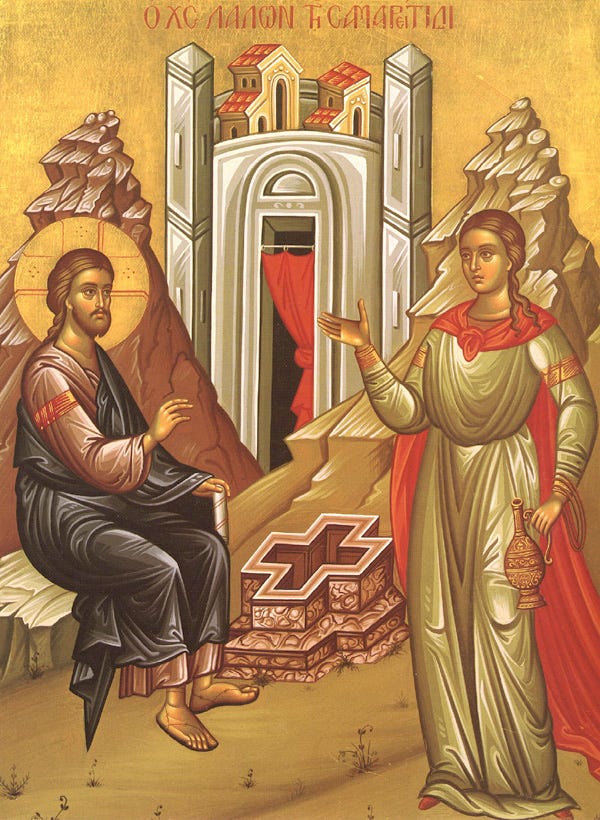
So let’s look at the Gospel reading: Jesus’ encounter with the Samaritan woman, which is the feast that has actually bumped the Holy Apostle Simon the Zealot to Tuesday. And, as we do so, I want to front-load our reading of it by thinking carefully about who the two people are who are sitting down and talking to one another — or at least, I think Jesus was sitting down; she might have been standing.
Usually we think about this story in terms of the Jewish-Samaritan divide. The Jews hated the Samaritans — that comes up in a number of stories and parables. Jews would even go around Samaria to avoid it. Jesus didn’t: he went through Samaria. Because the Samaritans were imposters, they had a false religion, they only recognized the first five books of the Pentateuch, and even then only partially, and from the Jewish perspective they were interlopers who had taken the land. The Babylonians had resettled the populations, these people had been placed there, and they now occupied what was supposed to be the land of the Jewish people — and they weren’t giving it back. So they did not like one another. So that’s usually the starting point. And that’s a fairly good starting point.
But of course the person Jesus was talking to was also a woman. In those days there was more of a divide between men and women, with rules and social expectations around who would talk to whom — and who wouldn’t talk to whom. But more than that, as we go on in the story, we realize this is a very deeply troubled woman. She’s had five husbands, and she’s living out of wedlock with a man who is not her husband. She’s also a bit of a liar. She’s a social outcast. She’s a bit of a zealot for her false Samaritan religion.
In fact, if there’s anyone the Son of God — the one who insisted on the holiness of his people Israel, who gave the Law and said “You shall not commit adultery,” who hates sin in every form — if there’s anyone whom this man would not want to speak with, it’s probably this Samaritan woman. She’s a sinner, she’s a liar, she’s an adulteress — or at least there’s something wrong there… it’s not actually specified — she’s a social outcast, she’s a Samaritan. There’s no possible hope of any kind of mutual understanding coming out of this.
But of course we’re not talking about just anybody sitting down to speak with her. We’re talking about the Son of God. We’re talking about Jesus. We’re talking about the one who is the love of God incarnate.
And so Jesus is tired. He’s sitting by the well. His disciples have gone to the village to find food. And this woman of Samaria comes up — and he talks to her. That’s the first thing we have to think about. And I want us to think about it in terms of our own positions. Is there anyone we wouldn’t talk to? Anyone we’d write off as a lost cause? But for Jesus, she’s not a lost cause. He says, “Give me a drink.” He’s actually putting himself in a relatively vulnerable position here, making a request she could simply refuse — which, in a manner of speaking, she kind of does at first.
But he opens up the conversation in a way that both of them can understand. They’re at a well; it’s relevant to the situation. And she says, “How is it that you, being a Jew, ask a drink from me, a Samaritan woman?” (Since Jews have no dealings with Samaritans.) So the first issue he encounters right away is identity. There’s no question about her identity — she’s a Samaritan woman, that’s clear — but this identity is what should keep them absolutely apart. Identity is a fraught issue today. It divides us and makes us not want to engage with certain people. This is not new.
And Jesus doesn’t address that question actually. He doesn’t get dragged into establishing the terms of the conversation before it can go anywhere. Instead, he gets right to the heart of the matter: this woman needs healing. Because this is what love does — love cares about the other person, looks for the best in them, wants the best for them. So he immediately addresses the heart of the matter with: “If you knew the gift of God, and who it is who says to you, ‘Give me a drink,’ you would have asked him, and he would have given you living water.”
OK, so, that’s a bit weird, but it’s something that will be at least a little attractive to her. Living water — what’s that? She does get interested in it a bit later, but initially she focuses on the practical: “Sir, you have nothing to draw with and the well is deep. Where are you going to get this living water?” And then — I love this — “Are you greater than our father Jacob, who gave us this well and drank from it himself, as well as his sons and his livestock?” Our father Jacob. That’s brash. Possibly even arrogant. She’s talking to a Jew — a descendant of Jacob — and and claiming that he’s “our father Jacob and he gave us this well.”
Interestingly, this also is nothing new: Isaac dug wells all over the place and people were chasing him away from each of these wells. Wells are important, and the Samaritans have established their claim to this one and she’s going to defend that claim!
Here we have politics. Politics threaten now to derail the conversation. Because this is the Jewish homeland, it’s supposed to be part of the land God gave to the Jewish people, and the Samaritans are occupying it. And we’ve seen in modern times what happens wh…