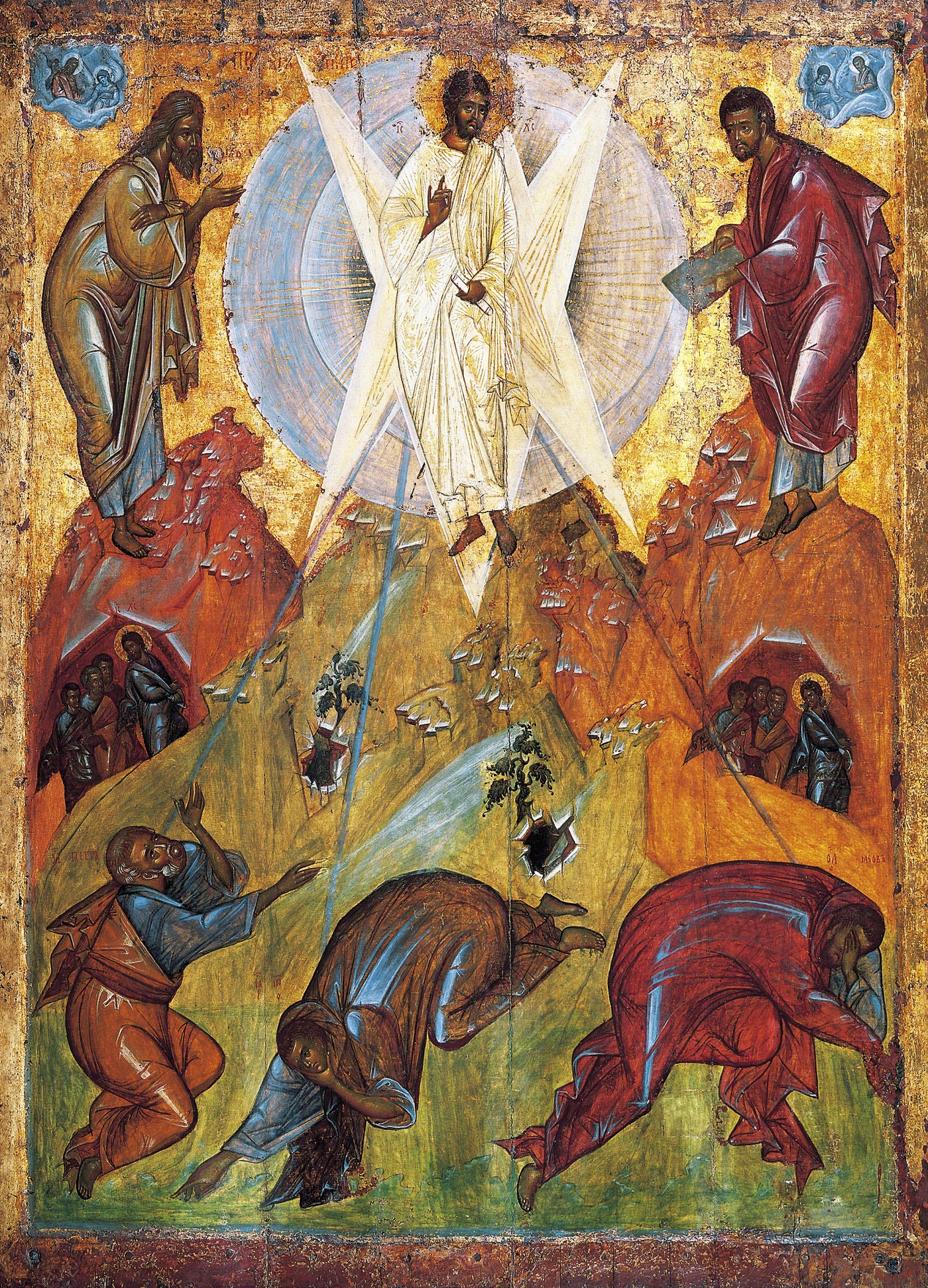
When I think of the great feast of the Transfiguration, I always think about encouragement. This feast above all — well, I guess Pascha is the most encouraging; Pascha is off the charts — but this feast really seems to be focused on encouragement. You hear it even in the hymnography: one of the reasons Christ went up on Mount Tabor at this point was to encourage his disciples, so that as they knew what was going to happen to him, they would also know who he really was.
This incident is recorded in all three of the Synoptic Gospels — Matthew, Mark, and Luke — and interestingly, in all three it occurs in roughly the same context. The Gospels rearrange things sometimes, especially Luke, but here we have three things occurring one after the other in all three accounts.
The first is Jesus asking his disciples who he is. He says, “Who do people say that I am?” They answer: “Some say Moses, some say Elijah, some say one of the prophets.” But then he turns to them and asks, “Who do you say that I am?” And Peter answers, “You are the Christ, the Son of the living God.” Jesus responds, “Blessed are you, Simon, son of Jonah, for flesh and blood has not revealed this to you, but my Father who is in heaven.”
Peter then messes up a little, because the very next thing Jesus does is tell his disciples what is going to happen to him. They’ve just confessed him as the Messiah — they have a whole set of preconceptions about what the Messiah will do, what he’ll be like, what will happen when he comes — and Jesus blows all of that up with what he says next. The Son of Man is going to be betrayed into the hands of sinful men, crucified, and die. And Peter says, “No, no, we have to make sure this doesn’t happen to you, Lord.” And Jesus turns to Peter and says, “Get behind me, Satan.” He goes on to say that unless someone takes up their cross and follows him, they cannot be his disciple.
Given that this is the context in all three Gospels for what happens next, you can see why the disciples might have needed some encouragement at this point. It’s like: okay, great, the Messiah is here — and he’s going to die, and nothing we were expecting is going to come to pass, and now he’s telling us we have to do the very same thing, take up our cross and follow him to our deaths. This doesn’t sound like much fun.
So it’s at this point that Jesus goes on a hike with his disciples up Mount Tabor. I just had the pleasure of going on a hike with some of my family. One of the things about hiking is that it’s great, especially when you get to the top — you look out and the whole world is spread out before you. But the hike itself is often tough, especially up a mountain, especially if you’re getting older like I am. My legs start feeling like rubber; I’m not sure I can actually make it all the way. The disciples were far more used to walking than we are, but this must have been, to some extent, their experience too as they hiked up Mount Tabor with Jesus.
When they get up there, they’re tired, and they drift off. When they look up, they see Moses and Elijah standing with Jesus, and Jesus’ garments are — I think it’s Mark who says — whiter than any laundry soap could make them. Just absolutely brilliantly white. He is transfigured before them, transformed.
And what are they talking about? The disciples overhear some of the conversation, and Moses and Elijah are talking with Jesus about the things that are going to happen to him. So even here, it’s in the context of what is to come.
Then Peter, again not quite sure what to say, says, “Lord, it’s good for us to be here. We should build three tabernacles — one for you, one for Moses, and one for Elijah.” And he has some justification for this. Moses is a pretty important person. He leads the children of God out of captivity, leads them to Mount Sinai where they encounter God as he delivers the law through Moses to his people. On that mountain, it’s all darkness — they look up and see no form of anything, just darkness. In fact they’re so scared that when they hear the voice of God, they tell Moses, “You go up — you’re the one who needs to talk to God face to face, because if we hear him, we’ll die.” So Moses goes up into the mountain and talks with God face to face, as a man talks with a friend, and receives the law from him.
While he’s up there, he asks to see the glory of God. And God says, “Sure, we can do that — but this might be dangerous for you, so I’m going to hide you in a cleft of the rock, and I’ll pass by in front of you. You’ll just see my back, but you’ll get to see my glory as far as you can bear it.” And he does this, covering Moses with his hand as he passes by, and he proclaims his name: “The Lord, the Lord God, merciful and gracious, long-suffering and abounding in goodness and truth, keeping mercy for thousands, forgiving iniquity and transgression and sin, by no means clearing the guilty, visiting the iniquity of the fathers upon the children and the children’s children to the third and fourth generation.” He proclaims to Moses who he is. And Moses makes haste, bows his head to the earth, and worships.
And of course Elijah was pretty important too — one of the first really great prophets, who does all these amazing miracles. He too meets God on the mountain. When he does so, it’s a little less glorious in its circumstances; he’s on the run from the king and queen who are trying to kill him. But God strengthens him and brings him to the mountain. There he hears a great wind — but the Lord is not in the wind. There’s a great fire — but the Lord is not in the fire. There’s a great earthquake — but the Lord is not in the earthquake. The Lord is in the still, small voice. And then Elijah goes and anoints kings and essentially rearranges the geopolitical landscape of his day.
So yes, Moses and Elijah are really, really important — it kinda makes sense that there should be three tabernacles, one for each. But at that point a great cloud overshadows them. The Fathers describe it as a cloud of light, not of darkness. And a voice comes out of the cloud: “This is my beloved Son, in whom I am well pleased. Hear him.” They fall on their faces, and when they get up, Moses and Elijah are gone. All they see is Jesus.
This is the encouragement given to Peter and James and John, to prepare them for what is to come. This is the encouragement given to us, to prepare us for what is to come. This is the revelation of the new order that God himself is establishing in Christ — something that transcends the Mosaic Law, something that transcends even the greatness of the greatest of the prophets, something that reveals to us the very name and nature of God himself. God made flesh. God made one of us. Revealed to his disciples, revealed to us, in his glory — as far as we can bear it.
This is why the fathers were so captivated by this incident and loved this feast. Because this is the revelation of who we are destined in Christ to become. This glory that Christ has, which he shares with us. The glory he had from the beginning of the world, which he sets aside in order to become one of us and subject himself to death, even the death of the cross — and which is renewed in him. As one of the Desert Fathers says, holding up his hands: “If you will, you can become all flame.” The glory of those who are created in the image of God, as that image is renewed in us, as we are in Christ. That is our destiny. That is what we are called to: to become all flame, to be consumed by the glory of God, to be partakers of the divine nature, in Christ.
But it’s hard to get there, which is why we need the encouragement. Peter, even after speaking about our becoming partakers of the divine nature, goes on to exhort his readers — reminiscing on this event precisely in order to encourage them. In his second epistle he writes:
We have these great and precious promises, that through them we may become partakers of the divine nature, having escaped the corruption that is in the world thro…