We were blessed, today, to have Fr. Nathanael, one of the founding members of St. John’s, with us. Here is his homily on the Gospel for today.
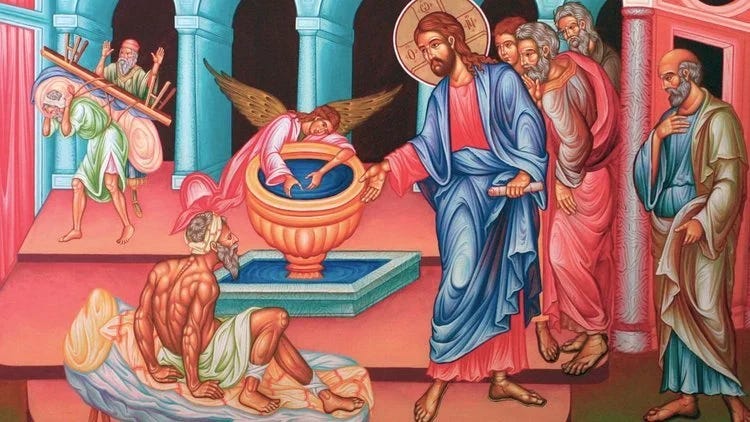
Our Gospel reading today was a composite one. The first part is the commemoration of the paralytic, where Christ heals a paralyzed man at the pools of Bethesda.
Now, like all the Gospel readings, this is a treasure chest full of jewels. All I’m going to do today is take one or two jewels out of that chest — but there’s a lot more there, and you have to go digging for it yourself. This is why I always encourage people to make it a practice through the week leading up to Sunday: take the Gospel that’s going to be read and read it every day, think about it, meditate on it, try to plumb its depths. That way, when you get to the sermon on Sunday, you’ll already have a pretty clear idea of what the priest is going to talk about.
But today — this is the Sunday of the Paralytic. This man was at a pool in the vicinity of Jerusalem, and he had been waiting there for 38 years. That’s amazing. 38 years waiting for his healing.
Now, is there significance to that number? I don’t know — there probably is, but I haven’t figured it out yet. What I did want to draw attention to is how Scripture builds symbolism into these events. It points out that there were five porticos around this pool. Well, that’s symbolic. What else is five? The five books of the Law — that would be the first thing to come to mind. So these five porticos surrounding the pool symbolically represent the whole Old Covenant, the Law.
And within this Law, every now and then an angel would come down, stir up the water, and whoever got in first got healed. Now the Church Fathers — and I’m not making this up — saw this as a picture of grace coming through the Old Testament. But was it enough grace? Was it for everybody, throughout the whole world, for all time? No, it was limited. And Christ’s grace, the grace we have through Jesus Christ, is not limited in that way. That was the whole point — illustrating that the grace of the Old Covenant was lacking.
So Christ asks the man, “Would you like to be healed?” Of course he’d like to be healed — he’s been waiting there for 38 years! But Christ asks anyway, because he never does anything to us that we don’t want. He is very polite. He won’t overpower you or override you. He will ask you what you want.
The man says yes — well, an implied yes. He doesn’t actually say the word. And how does Christ heal him? Does he call another angel down and get him into the pool? No. He simply says, “Take up your pallet and walk.” Just like that. It’s done. There’s your healing.
Another thing we can easily see in the symbolism of this pool is our own baptism. Whoever went into the pool — that was a symbol of baptism. And so those of us who have been baptized in the Church have this healing. That’s what it really is: an inner healing. We are healed of our sins.
Those of you who have been recently baptized — rejoice in this. This is what has happened to you. Those of us who were baptized longer ago may have lost some of that joy. So how do we renew it? That’s what confession is for. I want to encourage everyone here: come to confession, come to healing. The priest is not there to judge you, and he’s certainly not going to gossip about what he hears. Come for the healing.
And those of you like Anthony who are looking forward to baptism at some point — know that that is what you’re going to receive. It’s a healing moment. It’s where we are healed of our sins and all the vices and the icky stuff within us that, if we look deeply enough, we actually don’t like about ourselves. That’s the start of the healing of all that.
So come to confession, be healed, and let the joy of your healing show to the world.
In the name of the Father, and of the Son, and of the Holy Spirit. Amen.
Scripture readings referenced:
* John 5:1-15