Those of you who have been coming to St. John’s for a while will know that the Sunday of the Last Judgment and the parable of the rich man and Lazarus are my two least favourite passages on which to preach. Because this is a warning. We are coming to the edge of Lent, and we are deliberately given this passage to contemplate, the passage where Jesus talks about the Last Judgment. And we have to approach it carefully, with balance. But we also have to acknowledge this is very clearly a warning. And so it would be irresponsible of me to tone down that warning. And there is that temptation. It seems to be rampant now, even within the Orthodox Church, to somehow tone down what our Lord is saying here.
And I think it’s understandable on a number of different levels. I think the first level on which it’s understandable is that we really are not sure about this whole concept of eternal punishment, of God judging, of this fire that is consuming, that is talked about here, prepared for the devil and his angels. I think the first thing that really gets us troubled about this is that we’re actually not quite sure that God is good. And to be fair to us and to our society, I think that’s part of our Greco-Roman philosophical heritage. Don’t get me wrong. We as Christians like the Greek philosophers. They were getting pretty close, especially Socrates, starting to realize that, hey, maybe all these stories about the gods are kind of crazy, and maybe there really is only one God, and they were kind of groping their way towards it. And so we like them, but they’re not our primary reference point as followers of Jesus Christ. Jesus is. He is the fullness of the Godhead made flesh. He is the ultimate revelation of who God is and what he is going to do. And so he is our primary referent point.
If you have any concern about whether or not the Creator and Sustainer of the universe is essentially good, I would point you to the cross. And this is the primary difference, I think, between the Hebraic understanding of God, which is what we are all actually embracing when we come to Christianity, which I think is epitomized by Abraham when he is faced with the impending judgment of God. God speaks to Abraham and speaks to him like a friend, actually, and says, shall I conceal from Abraham what I am about to do? And then he goes on and talks about how he’s about to judge the cities of Sodom and Gomorrah for their wickedness, to send down fire and brimstone upon them, to consume them. And Abraham’s response is, “Shall not the judge of all the earth do right?” I love that response. Because it’s a rhetorical question, so implicit in it is the answer. Well, of course he’s going to. And then, of course, Abraham proceeds to bargain with God and to get him down as far as possible. It’s like, oh, make sure that God is as merciful as he can possibly be. Because, again, that’s the human instinct here. But I think that should be our starting point as followers of the one true Creator God, as followers of Jesus Christ: shall not the judge of all the earth do right? So whatever we have here, whatever this solemn warning is really about, we can rest assured that God is good.
I think perhaps the next reason that we struggle with this passage, and particularly with the notion of the judgment of God, is that we’re a little bit sheltered here in North America. For the most part, we don’t actually get to see evil in all of its horror, in all of its absolute, disgusting, horrific wickedness. The guards at Auschwitz, who delighted in causing extra pain to the people that they were planning to exterminate, is now far away. It’s far back in the rearview mirror. The Gulag Archipelago, about which Solzhenitsyn wrote in such sickening detail. Communism has fallen. It’s okay. And so we haven’t experienced, for the most part, any of us directly, any of this kind of level of evil. Now, we do get glimpses of it. I think Tumbler Ridge was one of those moments when we get a glimpse into the power, the extreme danger, the destructive horror that is pure evil.
And the thing is—well, I’ll get to what the thing is. Because what I want to start with first is what the judgment reveals. The Last Judgment reveals that God is more horrified by this evil than we are. And he’s going to do something about it. This is the basis on which the Old Testament says, “‘Vengeance is mine, I will repay,’ says the Lord,” which Paul himself quotes to say, okay, you can leave vengeance to God. You can trust that God is going to deal with this.
But the third and most important thing that I want to draw our attention to in terms of the reason why we have trouble with this, is a misunderstanding of what exactly the judgment of God is. And for this, we should look at the teaching. He’s just telling us more or less what is going to happen in terms that we can at least begin to understand. So he begins with, “When the Son of Man comes in his glory and all the holy angels with him, then he will sit on the throne of his glory.” This is a very different coming than the first coming. Because where Christ came as a baby, pretty non-threatening, in a manger, in poverty, with not many people knowing about it—this is different. Now he’s coming in his glory with all the holy angels, and he’s going to sit on the throne of his glory.
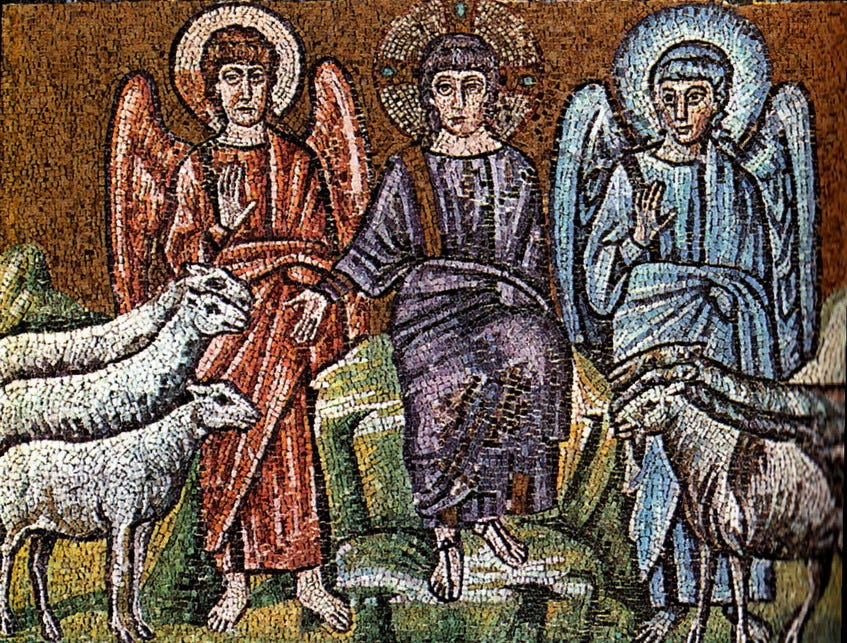
“And all the nations will be gathered before him, and he will separate them one from another as a shepherd divides his sheep from the goats.” It always strikes me as a little unfair to the goats, because goats are cute too, but they’re also wily. But I think the main thing is that just as any person in Jesus’ day would know how a shepherd goes about separating the sheep from the goats—okay, there’s a sheep that goes that way, and oh, that’s obviously a goat that goes over there—this is the metaphor that our Lord is drawing on to talk about this separation that’s going to happen at the end of days. “And he will set the sheep on his right hand and the goats on his left. And then the king will say to those on his right hand, ‘Come you blessed of my father.’” And here I want to actually back up because there was something here I wanted to highlight, which I forgot to do, so I’m going to do it now, which is: All the nations will be brought before him. This, again, is an important aspect of the judgment for us to consider, and even to begin with, because Jesus begins with it. Everybody is going to be judged. This judgment is universal. The criteria that are about to be established apply not simply to those of us who have heard the gospel, not simply to Christians and Jews or to religious people. No, this applies to everybody in the entire world. All the nations are going to be judged. And the criteria is the same for all of them.
So he’s going to separate them as the shepherd separates the sheep from the goats.
And then he says to those on his right hand, “Come, you blessed of my Father, inherit the kingdom prepared for you from the foundation of the world. For I was hungry, and you gave me food. I was thirsty, and you gave me drink. I was a stranger, and you took me in. I was naked, and you clothed me. I was sick, and you visited me. I was in prison, and you came to me.” And then the righteous will answer him, saying, “Lord, when did we see you hungry and feed you? Or thirsty and give you drink? Or when did we see you a stranger and take you in? Or naked and clothe you? Or when did we see you sick or in prison and come to you?” And the king will answer and say to them, “Assuredly, I say to you, inasmuch as you did it to one of the least of these my brethren, you did it to me.”
Then he will also say to those on the left, “Depart from me, you cursed, into the everlasting fire prepared for the devil and his angels. For I was hungry and you gave me no food. I was thirsty and you gave me no food. I was thirsty and you gave me no drink. I was a stranger and you did not take me in. Naked and you did not clothe me. Sick and in prison and you did not visit me.” Then they also will answer him, saying, “Lord, when did we see you hungry or thirsty or a stranger or naked or sick or in prison and did not minister to you?” Then he will answer them saying, “Assuredly I say to you, inasmuch as you did not do it to one of the least of these, you did not do it to me. And these will go away into everlasting punishment, but the righteous into eternal life.”
So this is a very solemn warning, but also a very clear description of the criteria on which we will be judged. So if you’re given a warning, there’s a couple of things you don’t want to do. If I’m to pass on the warning, I must not tone it down in any way, shape, or form, however much I may be tempted to do so. And secondly, I must not change the nature of the warning. And the nature of the warning here is about who we are becoming by our actions. This is the basis on which we will be judged. Because—and here I want to talk about one of the fathers who’s often characterized as possibly being a universalist: St. Gregory the Theologian talks about the salvation of all humanity. But what does that mean? What does it mean to be truly human? What are we as human beings made for?
What makes us human, truly human, rightly human, fully human, is that we love. And that’s precisely the criteria that we see here. And love, not merely in the abstract. Not merely a bunch of feelings. It’s like, okay, well, I just feel love for all humanity, and it’s very nice. I just feel that love. No, this is concrete love. This is the love where your grandmother sits you down and says, “You haven’t been eating enough.” And then sets a huge plate of home cooked food in front of you and says, “Okay, now eat.” That is the love we’re talking about here. Like literally, “I was hungry and you gave me some food.” This is what it means to be human is to reach out to those around us, to those God brings us into contact with, and to see the need that is there in their lives, and to say, “Oh, let me help you with that. You don’t have enough clothes. I have an extra coat in my wardrobe. I’m not really using it. Here, take it. You’re sick and incapacitated, unable to really take care of yourself. Here, let me bring you some food. Here, let me give you some money so you can go get Uber Eats. Here, let me help you in some way, shape, or form,” as opposed to what we saw when the priest and the Levite walk by on the other side. As opposed to what we saw when the brother of the prodigal son refuses to go in.
There is this in us too, this evil, that is stirred up very often by evil itself, this response that begins to dominate our heart, our understanding, our thinking. As we experience evil, as we are the recipients of mistreatment and misjudgment, we can allow that to fester and to poison our hearts and our souls, such that we begin to cut ourselves off from humanity, that we begin to see everyone else as the enemy, and we find ourselves ultimately alone and in despair because of the hatred that has taken over our hearts. And that is not what we are made for, but that is a very real danger that we can fall into, even sometimes motivated by anger at what the injustices are that are being perpetrated in this world. And it eats away at us. It eats away at our humanity and causes us to draw back into ourselves so that we no longer are concerned for the other. We are no longer concerned for mitigating the horrors that other people are feeling, are experiencing. All that is left is this solitary, isolating anger at our fellow human beings, at the God who made and created this world, and there is almost nothing left.
This is the solemn warning. Because if we are going to become truly and fully human, as St. Gregory the Theologian says, we must in order to be saved, then what are we created for? We’re created for something more. We’re created to be filled with love for God, to be filled with love for our neighbor, to be filled with one another, to be united with one another in love and co-suffering service. That is what we are made for. That is the nature of salvation itself. That is the nature of what it means to be human, truly human, in the presence of the Almighty God, who is good and whose goodness we acknowledge and receive and then freely give to those around us. That is the blessed state prepared for us from the foundation of the world: to be truly human, to be truly defined ultimately and wholly by love, to be united with one another and with God in love.
And that is what is manifested here in this visiting the sick, visiting those in prison, looking after those who are thirsty or hungry or naked. That’s why this is the criteria. And the warning is, the very solemn warning is, that those who reject this, those who reject their fellow human beings, those who reject God in anger or suffering or hatred, are opening themselves up for the other state. The state where there is almost nothing left of that true humanity, where there is nothing more than a simple kind of burning wreckage of what used to be a soul. And Jesus says, don’t go there. Don’t do that. This is what must be avoided at all costs.
So for us, as we consider this solemn warning, we need to keep in mind, first of all, the essential and ultimate goodness of God. Shall not the judge of all the earth do right? The answer is, of course he shall. He is doing it right now in his great mercy and love, sustaining us in existence, even as we turn our backs on him and serve him incompletely, inaccurately, not very well, inconsistently. He still loves us. He still sustains us. He still gives us life and breath and everything that we have and are so that we can work out our salvation in fear and trembling by loving one another in basic, practical terms. Loving one another, opening our hearts to one another, welcoming one another, especially those who are in need in any way, shape, or form. And that, too, is something we have to watch because when we see someone in need, we’re often like, I’m not sure I have time for that. I’m not sure I have the energy for that. Well, OK, sometimes you don’t. But if you do, you should do something about it. That is you working out your salvation in fear and trembling before God, opening your heart to the person who is in need and helping them in a difficult and dangerous world and uniting yourself to them, and by uniting yourself to them, uniting yourself to Christ himself.
This is what we are called to do. This is what we were made to do. This is what we must become in order to enter into the blessed state that has been prepared for us by God, who loves us, from the foundation of the world, that we might be with him, with one another, to his glory: the glory of the Father and of the Son and of the Holy Spirit.
Scripture readings referenced:
* Matthew 25:31-46
* Genesis 18:25