Written by Teri Arvesú González
Somewhere along the way, the path of least resistance became shorthand for taking the easy way out. We were taught that if something is hard, push harder. If the door won’t open, keep pushing. If you’re exhausted, dig deeper.
I believe in hard work. I just don’t believe hard for hard’s sake is a strategy.
In business, we do the opposite all the time. We reduce friction. We look at data. We eliminate unnecessary steps. We try to align people with the work where their strengths can create the most value. Nobody celebrates a process that takes 14 steps when it could take five. We optimize it.
Yet when it comes to careers, we can glorify resistance.
Sometimes work is hard because we are stretching, learning, and getting better. But sometimes it is hard because we are compensating for poor alignment.
You may be perfectly capable of succeeding in something that barely uses your strengths, doesn’t hold your interest, or requires enormous energy just to maintain your performance. The question isn’t only Can I do this? It’s What is all this effort producing?
That’s why I think the path of least resistance deserves a rebrand. Least resistance does not mean no resistance. It means less unnecessary resistance.
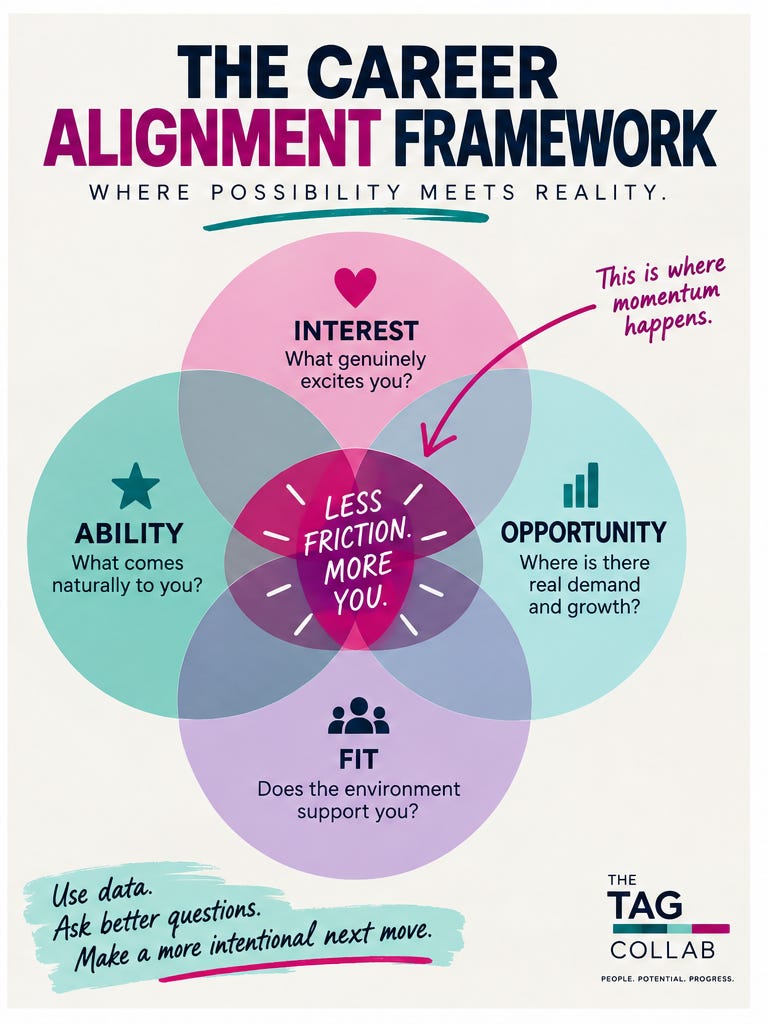
When ability, interest, environment, and opportunity begin to line up, there can be less friction. Less friction can create more small wins. Small wins give us evidence that we’re capable. That evidence can build confidence, and confidence can create momentum.
The reverse can happen too: misalignment → more friction → fewer wins → lower confidence → less momentum. Same person. Same work ethic. Different alignment.
I’ve written before about the idea of stopping the endless effort to fix every flaw and instead understanding where our strengths naturally create value. If that resonates, you can read that article or listen to the podcast.
But I’ve been taking that idea one step further.
Because being good at something does not automatically mean you are interested in it.
You can have an ability that comes naturally and have zero desire to build a career around it. And you can be deeply interested in something that requires skills you haven’t developed yet.
So what happens when we stop looking at any one piece by itself and start asking where they line up?
ABILITY + INTEREST + OPPORTUNITY + FIT
That is the framework I’m increasingly interested in.
Especially now.
I have kids thinking about what they may want to study and do with their lives. At the same time, I hear constantly from people in my industry—and people around my age—who are asking some version of “What’s next?”
Different stages of life. Same underlying question.
How do I make a better decision about where to invest my time, energy, education, and effort?
That is where the idea of return on effort comes in.
There is Compounding Hard: the difficult work that builds skill, judgment, credibility, relationships, or knowledge you can use again.
And there is Compensating Hard: working incredibly hard just to stay in place because you are constantly fighting poor fit.
Both feel hard. But they are not producing the same return.
So before automatically deciding the answer is work harder, I think we should ask: Am I getting better? Does my interest survive the difficulty? Does this environment let me use my strengths? Is the work building something I can use again? Is there a real need for what I’m learning to do?
Hard work matters. But hard work is fuel. Alignment is navigation. Fuel without navigation can take you very far in the wrong direction.
Nothing guarantees success. Timing, economics, access, family responsibilities, health, luck, and plenty of other forces matter. No assessment or framework is a crystal ball.
But that doesn’t mean we should ignore the information we can gather.
We use data to make better decisions in business. We use it when we invest. We use it when we buy a home, evaluate risk, hire people, allocate resources, or make other major life decisions.
So why wouldn’t we use data to help make one of the biggest investments of all: where we put our time, talent, education, and career energy?
That is the question I’ve been sitting with.
I’ve been using research-backed tools and assessments to collect better information for my own kids and for people trying to figure out their next move. Not to predict the future, but to see patterns, narrow possibilities, reduce some of the guesswork, and make the next investment more intentional
Maybe that’s as close to future-proofing as any of us can realistically get: not predicting exactly what the future will look like, but knowing ourselves well enough to make smarter decisions as it changes.
If you’re thinking about a first career move, a pivot, or simply asking yourself “What’s next?”, DM me. I’m happy to share more about the tools and framework I’m using to bring a little more clarity—and a lot less guesswork—to the decision.
Teri Arvesu Gonzalez is the founder of The TAG Collab, a corporate consultancy that partners companies ands to align purpose, brand, and strategy from the inside out.
With a Master’s in Management and Leadership and more than 25 years of experience leading newsrooms, launching initiatives, and driving transformation across Miami, Chicago, and national corporate teams, she brings deep expertise in storytelling, culture-building, and operational alignment.
She is the author of the Stories we Inherit (English) and Las Historias que Heredamos (Spanish) #1 for New Hot Release and best seller on Amazon
Also find me on:
Podcast: on Apple Podcasts and Spotify The TAG Collab
Instagram: https://www.instagram.com/the_tag_collab/
Facebook: https://www.facebook.com/profile.php?id=61576206521962
Linkedin: https://www.linkedin.com/in/teriarvesu/
Linkedin: https://www.linkedin.com/company/thetagcollab/