Written by Teri Arvesú González
Have you ever had someone mention a certain car—and then suddenly you see that car everywhere?
The cars didn’t multiply overnight. You just started noticing them.
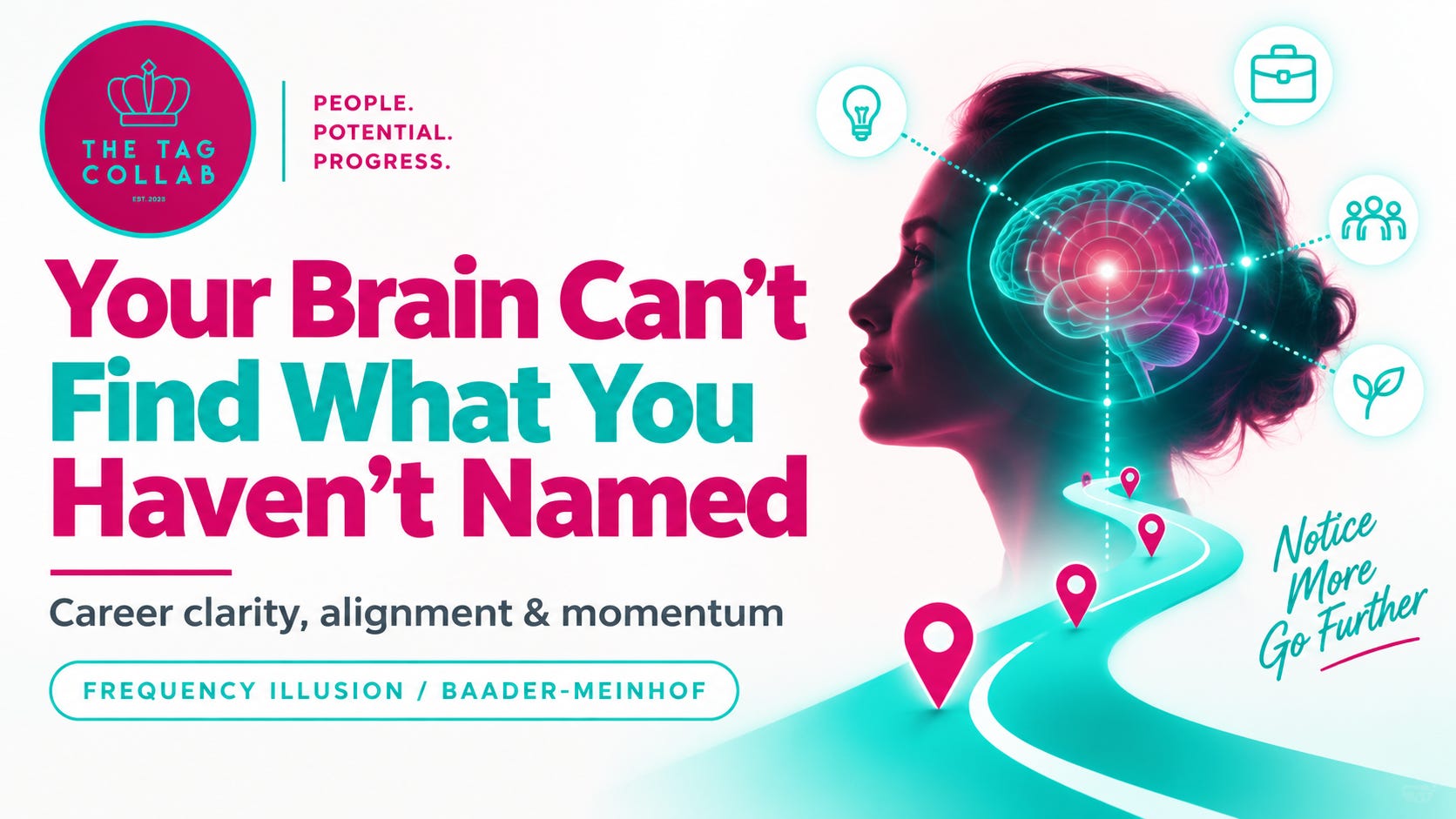
There’s a name for this: the frequency illusion, also known as the Baader-Meinhof phenomenon. Once something becomes relevant to us, our brains become more likely to notice it among everything competing for our attention.
I think goals can work the same way.
“I need to figure out what I want to do” is hard for your brain to act on. But when you begin identifying your strengths, interests, natural aptitudes, what gives you energy, and the environments where you may thrive, you give your brain something more specific.
You are essentially telling it: This is important. Start looking for it.
Psychologists call part of this selective attention. Your brain is constantly filtering information. Clarity helps shape that filter.
And alignment matters too.
When the opportunities you pursue are better aligned with your skills, interests, and strengths, there may be less friction between who you are and what you are trying to do. That doesn’t mean everything becomes easy. It means the effort can feel more natural and worth sustaining.
That can create a powerful cycle:
Clarity → Alignment → Action → Learning → Confidence → Momentum
I learned this personally.
When I left corporate America, I had spent decades knowing what success looked like and what came next. Then suddenly, I didn’t.
I was so numb from the transition that I wasn’t even sure what I wanted to say, much less what I wanted to do.
That experience pushed me deeper into the science of leadership, human behavior, career alignment, and performance. One of the most useful things I learned was that we do not have to figure ourselves out entirely through intuition.
There are assessments, tools, and frameworks that can provide more objective insight into our interests, strengths, aptitudes, motivations, and working styles.
They are not crystal balls. But they can give us evidence.
And evidence gives us something to test.
There is another useful concept called prospective memory—our ability to hold onto an intention even when we are not consciously thinking about it every minute.
In normal language: you plant the thought, go live your life, and then something makes your brain say, Wait. This might matter.
That is why clarity can help create momentum. It does not magically attract opportunities. It can make us better able to recognize relevant ones when they appear.
At The TAG Collab, we have used these kinds of tools and frameworks with leaders, organizations, and people navigating career transitions—helping them better understand their strengths, clarify what comes next, identify where they may be best aligned, and turn that insight into action.
Then I started looking at my own kids.
I have kids in high school and college, and I found myself watching them make decisions about majors, careers, internships, and what comes next.
And I kept thinking:
Why aren’t we doing this for them in the first place?
Why do we wait until someone is 35, 45, or 55 and questioning their career to help them understand their strengths and where they may thrive?
Why are we asking 17- and 18-year-olds to make expensive, consequential decisions with so little objective information about themselves?
So I started applying some of these same principles with my own kids.
Not to tell them what they should become.
To give them better information about themselves.
Instead of asking, What do you want to be when you grow up? I think there are better questions:
What does the evidence tell us about where you might thrive?
And then:
What can you do next to find out?
Talk to someone. Take the class. Shadow a professional. Try the internship. Build the project. Test the hypothesis.
Every action gives you more information.
That is what career clarity means to me. Not choosing your entire future. Knowing enough about yourself to identify promising directions and start moving.
Clarity creates a direction for discovery. Alignment can reduce friction. Action creates evidence. Evidence builds confidence. And confidence fuels momentum.
Sometimes the opportunity you need is not missing.
You just haven’t told your brain what to look for yet.
At The TAG Collab, we are now adapting many of the principles we have used with leaders and people navigating career change into our emerging College & Career Clarity work for young people and families.
I am doing this with my own kids because I believe we can help young people approach these decisions with more insight, more intention, and less guesswork.
If this resonates with you and you have a high school or college-age child trying to figure out what comes next, reach out to me to schedule a conversation. We can explore where your child is today, the questions your family is trying to answer, and whether this approach is the right fit for you.
You don’t need to know their entire future. You just need enough clarity to help them take a better next step and use the right tools to help make it flow better!
Send me an email to schedule a call teri@thetagcollab.com
Teri Arvesu Gonzalez is the founder of The TAG Collab, a corporate consultancy that partners companies ands to align purpose, brand, and strategy from the inside out.
With a Master’s in Management and Leadership and more than 25 years of experience leading newsrooms, launching initiatives, and driving transformation across Miami, Chicago, and national corporate teams, she brings deep expertise in storytelling, culture-building, and operational alignment.
She is the author of the Stories we Inherit (English) and Las Historias que Heredamos (Spanish) #1 for New Hot Release and best seller on Amazon
Also find me on:
Podcast: on Apple Podcasts and Spotify The TAG Collab
Instagram: https://www.instagram.com/the_tag_collab/
Facebook: https://www.facebook.com/profile.php?id=61576206521962
Linkedin: https://www.linkedin.com/in/teriarvesu/
Linkedin: https://www.linkedin.com/company/thetagcollab/