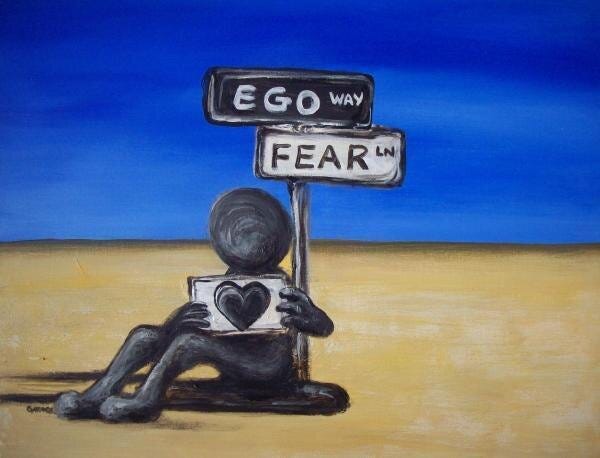
As someone who led new business pitches and had to corral different members of a pitch cast, I inevitably came across fear. Generally, a pitch cast would comprise different levels of the organization, so sometimes presentations would include a couple of C-suite executives to talk broadly about our value proposition and also have more junior-level specialist to talk specifically about certain tactical recommendations. Imagine being a 25–30-year-old director needing to perform in pitch where $5M-$10M in revenue is at stake, all while most of the pitch cast as well as the client’s attendees were far more senior.
Yet culturally we hardly ever address the fear in the room, and this absolutely leads to poor performance with people either giving into the fear or trying to overcompensate by denying that they have any fear at all.
The ego dynamic here is the essential lack of both internal or external support that a person feels.
When a person historically has not experienced an organic, tangible sense of support in their environment or by their parents/caretakers, their natural sense of being will end up feeling like it is deficient – deficient of support, deficient of safety, deficient of security and help. My own experience of this is like being tossed in the wilderness and expected to survive without the necessary tools or training – there’s a kind of desperate helplessness in it. It is a sensation that most of us would rather avoid.
And that is actually what most of us try to do. Ultimately, the ego defends against and avoids this experience in one of two ways:
1. Ego Reaction #1: This sense of deficiency ultimately will come across as a lack of confidence, either diminishing their authority or expertise or simply deferring that expertise to other people. Why? Because to someone who is experiencing an almost debilitating sense of fear, they will put their focus on finding security, and deferring to authority is a tried and true strategy for this type of response.
The ego that chooses this type of strategy will also tend toward indecision. In a pitch environment or important client meeting, we all know that indecision is a presentation killer. Or it might get caught in projecting onto the client that their questions are hostile and aggressive even when they are not, because to this particular ego perspective, the world and “others” are a dangerous place.
Remember that the root of the inner experience of this kind of fear is that one doesn’t have what it takes to survive, and we will end up being suspicious of the environment and those in it, suspecting that they will in some way try to humiliate, criticize, or put us down somehow. The ego in this state cannot trust that relaxation is appropriate at all. It’s as if all the alerts in our system are running without any switch to disarm them.
2. Ego Reaction #2: The other way for the ego to respond is through denying that there is any fear at all, which ultimately leads to an overcompensation or bravado. If you are attuned to someone who is caught in this ego response, you can sense that their attitude or behavior isn’t actually appropriate for the situation. They may seem over-enthusiastic somehow, or in some cases even aggressively trying to amp themselves up.
The fallout here is a lack of attunement with teammates and/or clients, as the ego has effectively taken sensitivity offline. To be attuned, we actually need to be sensitive to where our team members and clients are, but the ego in this case has desensitized us to the experience of fear and as a result also desensitized us to others. Ego behavior here can also come across as hyper-focused and rigid, as the ego is unconsciously clinging to security, which means that it is unable to allow a flow of communication and spontaneity to actually occur.
In a pitch or client scenario, you can see this reaction play out when someone talks too long or is not picking up on cues that the client has already checked out. Or, someone might overpromise as a way to appear more confident and hide the fact that there is underlying fear. Again, the unconscious focus of attention is on security and avoidance rather than relaxing into the moment and seeing what is most appropriate.
The Importance of Psychological Safety
Over the years, there’s been so much talk about psychological safety on teams, but it’s especially important in supporting those who especially suffer from this kind of fear to have enough space to feel the fear.
By not addressing it and actively creating a psychologically safe space for people to experience fear, leaders are essentially saying that fear is not okay. And this is clearly the attitude for a lot of leaders – what matters is performance, not how you are feeling. We leave it up to the individual to deal with their fear, but what do you suggest they do?
The easiest way to create psychological safety here is to simply acknowledge your own fears in the group. “Anyone else feeling anxious about this presentation?” “Oof, I have some pre-show jitters. Anyone else?”
Or if you are lucky enough not to ever be caught up in this dynamic (check first if you are opting for ego reaction #2 here and denying fear in the first place), you can simply ask if anyone is feeling scared and make that experience okay. “Anyone feeling scared about presenting? Most people are, and it’s good to recognize it so we can go into this meeting supporting each other.”
Transformation for the Individual
Taking the lead on allowing fear obviously starts with leaders. If we are not okay with our own fear, then we will not dare to allow others to be afraid either. The more you are able to recognize this dynamic within yourself, the more you’ll be able to support and optimize your teams to allow fear, then face it, then transform it.
Individual work here is required, but given how uncomfortable this feeling of insecurity and lack of support is, we often need a coach to help us actually contact these layers of experiences:
1. Tension: Body tension is always the first signal that some kind of fear is present, so becoming more aware of the specific kind of tension that arises from this sense of helplessness is helpful.
2. Inner Critic: The Inner Critic will inevitably try to get you to avoid this experience of fear and helplessness by telling you it’s not good and you shouldn’t go there. Disarming the Inner Critic removes the defense layer of the ego i.e., “fear is TERRIBLE, don’t feel it.”
3. Patterns: Recognizing the reactions to the underlying fear or free-floating anxiety is the next layer of unraveling the ego structure. Seeing how we either become paralyzed with fear (reaction #1) or try to blast through it (reaction #2) will give us the opportunity to simply be with the fear instead of acting upon these habitual ego reactions.
4. Fear/Lack of Support/Desperation: Contacting the next layer of fear and allowing it to be there. This takes a certain degree of support and capacity because it is SO uncomfortable.
5. Core Belief: If we can hang with the fear long enough, we can see this ego dynamic’s particular core belief is that the world is dangerous and that you need to protect yourself somehow.
6. Essential Support: When we see and experience the core belief, and hold space for it, we can actually experience the sense of support that is actually here for us all the time. This essential support is one that is grounded in the present moment and inherent to our beingness, so it’s not reliant on any kind of external support. It’s as if we’re suddenly able to relax and trust that support will be there and that world and our relationship to it is safe.
The Vision for the Workplace Culture
So, what would this transformation mean for our current culture? Primarily, it would mean more space for essential support to be part of our teams. Culturally, we still have a high degree of individualism, meaning in the arena of anxiety, fear, or struggle, companies still tend to prioritize performance and leave it up to individuals to take care of it themselves.
The following shifts can be a possibility for our culture:
* Not acknowledging fear —> people experiencing direct support
* Isolation/Individualism (people needing to figure it out on their own) —> more cohesiveness and shared experience
* Poor performance impacted by avoiding fear and being caught in ego reactions —> more relaxed, confident performance
* Lack of psychological safety —> naturally feeling more comfortable being wherever you are.
Ultimately, what I am talking about is more presence at work and less isolation. There would be more connection and purpose, because supporting our teammates would naturally be interwoven into our daily interactions if we are empowering and training emotionally intelligent teams.