There is a stone in stone bridges - called a keystone - which if we removed, causes the whole bridge to collapse.
Keystone species are species which when removed from ecosystems cause things to fall apart. Sea otters are a keystone species. When they leave an area, kelp forests get decimated. That’s because the sea otters are no longer keeping in check the population of sea urchins, which will multiply to eat the whole kelp forest. Restoration of the kelp forest can transpire by bringing back sea otters.
Beavers are a keystone species that have played an outsize role in the development of the landscapes and ecosystems of North America and Europe. The removal of them from our continents led to the Great Drying ( a term coined by the geomorphologist and beaver researcher Ellen Wohl) that extended from 1600 to 1900.
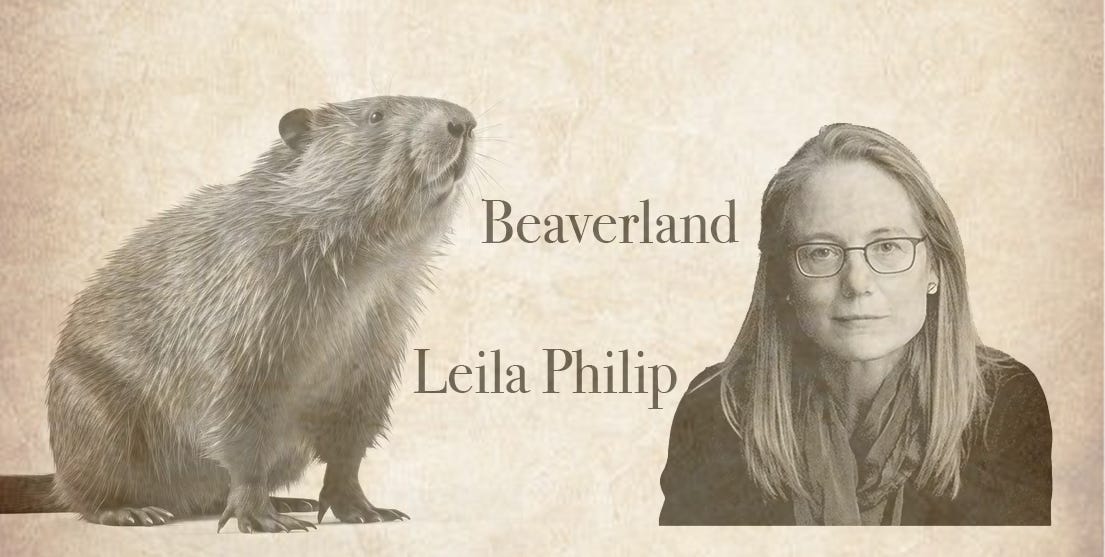
When I connected with Leila Philip, author of Beaverland - How one weird rodent made America, she bubbled with enthusiasm talking about the importance of beavers to our ecosystems.
She writes in her book “When the glaciers of the last ice age melted.. the modern ancestors of today’s beavers wet at it, felling trees and building dams throughout Asia, Europe, and the Americas. In North America, beaver dams, ponds, and waterworks established hydraulic systems that created much of the rich biodiversity of the continent. That was the primordial Beaverland - North America before European colonizatio, when as many as four hundred million beavers filled the continent….. The great boreal forests that sprang up, threaded with beaver made waterways, would have looked something like what I see now- half water-world- streams spreading out through the forest as great fans of water, overspilling banks, then receding in rhythm with the seasons. Unlike the streams and rivers we know today, mostly degraded so that their currents carve channels through the earth, picking up speed and causing more erosion as they cut deeper into the groun, these messy, slower-moving streams and rivers from the time of Beaverland contracted and expanded like tides, they were arteries and veins of water pulsing life into the land”
Paddling in the waters, gnawing trees, placing sticks in the river, this furry creature was unaware that it was altering the living systems on our continents. The beaver did not set out to rewrite our ecosystem, they were just working to create a home for themselves. But local interactions can have large consequences. One of the fundamental insights that have come out of complexity science in recent years is that as you shift of a few rules, make a few tweaks, the whole system can behave in radically different ways. The beaver is that tweak that changes our ecosystems.
Leila Philips writes “Scientists call beavers ‘ecosystem engineers’ meaning they create new habitats, new ecosystems when they build their ponds. The dead trees that now ring the marshy edge of the swamp bring nuthatches, woodpeckers, and other species of birds that feed on the insects in the rotten wood. Great blue herons stalk the shadows and red-winged blackbirds heraid in the trees. In the highest points osprey nest. Meanwhile, the life forms in the water itself increase exponentially. Wetlands are a soup of life, each teaspoonful containing millions of organisms. Water from beaver-altered streams and wetlands has been measured to contain fifteen times more plankton and other microbial life than wetlands without beavers. Zooplankton in particular love the nutrients provided by the beaver poop.”
The importance of bringing back keystone species has been increasingly utilized by the ecorestoration and rewilding movements. In our time of multiple water crises, we would do well to integrate beavers into our water strategy for North America and Europe. Leila Philip writes “we could use beavers to help again to help our water problems.. if we were smart enough - if we were humble and open enough.” The beavers help rehydrate the land, and they help mitigate floods. In the Chesapeake Baybeavers build, for free, stormwater management ponds that that would otherwise cost one to two million dollars, ponds that help extract the pollutants out of the water. Beavers also help stop wildfire. The researchers Emily Fairfax and Andrew Whittle have shown the land is much less affected by wildfires where beavers make dams compared to beaverless areas. [Fairfax 2020].
Here is some of the conversation between Leila Philip and I, edited for clarity and brevity. (If you want to know about the inner life of beavers, that’s in audio form only - go to 57:36 min mark in the podcast)
BEAVERLAND
Leila Philip: Writing Beaverland was like many book projects, a kind of fever dream that just wasn't over till it was over. I would spend six years on Beaverland because I just became so fascinated by beavers and all I was learning, and I had so much fun writing it.
I teach writing at the College of the Holy Cross in Worcester. I give this writing exercise to my students and say, what keeps you up at night? What are the stories you urgently feel you need to tell? It's a way of kind of helping them connect with what's important to them. I always do the assignments with my students and I kept finding that I was saying the environment, back in 2012. I was desperately worried about climate change. So I thought, well, I have to really kind of think about this and I really shifted all my teaching into environmental studies and helped my college found a program in it. I started writing a column for the Boston Globe. My beat was environment politics and culture.
I met my beavers by accident. I met these beavers and that was it. I was taking a walk with the woods with my dog, as I did twice a day, as a break from writing at my desk, and I was walking in the woods, and I heard this bam, and I didn't know what it was. I literally thought maybe a gun had gone off, and I looked to where my dog was looking and there was this small brown head swimming through the water. It was crazy because just a few days before that had been a brown swampy area with no water. Suddenly it was full of water. There was this small head swimming back and forth and bam, the beaver slammed her tail again.
I was just hooked. I mean, the tenacity of this animal. She was telling me to get lost. And I would go down every day and watch this growing pond and this beaver. I swear she was watching me just as much as I was watching her and it just became the anchor of my days. It was incredible the transformation of this wetland.
You know, now that I understand the science, it really still makes my hair stand on end to think about what was happening. I live in Woodstock, Connecticut - a pretty much environmentally devastated part of the country early on. But now here's this beaver that is basically restoring the wetland here. Pretty soon wildlife was coming back. By the end, the gorgeous pond spread almost a half mile long.
Here in the northeast in our woodland areas, if there are some woods around, beavers can build a dam in two or three days, and start the process of ponding. Two beavers had within a week, felled a tree and built up a pretty good size dam in a pinch point where the stream went through a narrow area. They had built it along a existing stone wall. I now understand that the swampy area I thought was just a kind of nothing burger is actually a historic beaver meadow.
History
There actually would have been beavers there going back hundreds of years, if not thousands throughout the Holocene, because that small stream is part of a river network. Beavers will move into a stream network, build a dam, swell it into a pond, and then build more dams. After a certain period of time they'll move on and then the dam will break down, the pond will release its water, and around it will grow up shrubs. Eventually it grows back into a forest. It turns out that this is incredibly important for the forest ecology, plant ecology, as well as the ecology of the river system.