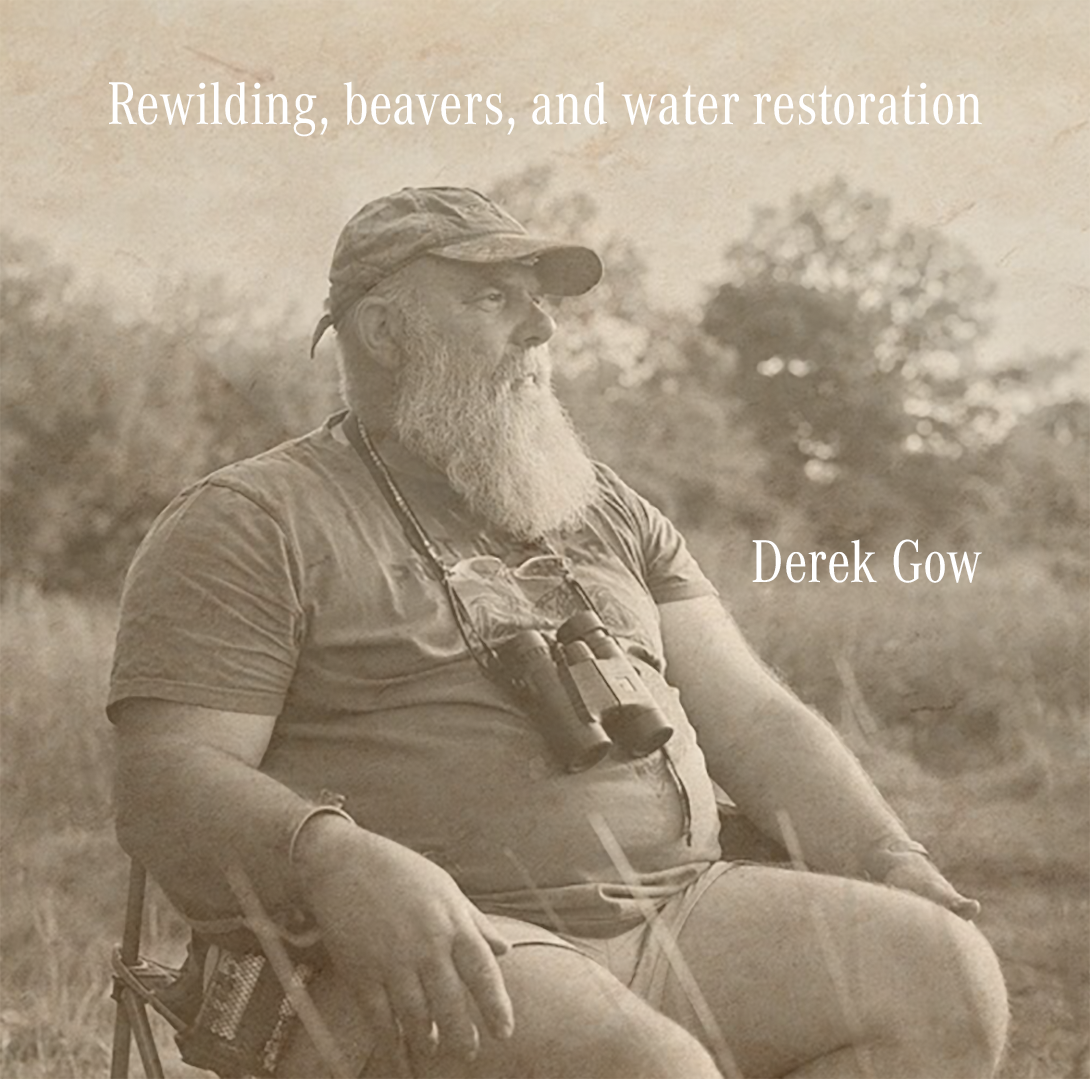
The idea of bringing back the beaver to the UK was an idea that was scoffed as too eccentric, even by environmentalists. But Derek Gow, against a lot of opposition, has pioneered bringing the beaver back, so that they are now once again part of the UK landscape, restoring the wetlands and rivers.
Born in Dundee in 1965, Gow left school at seventeen and spent his early years in agriculture. He was inspired by the writing of Gerald Durrell, and jumped at the chance to manage a European wildlife park in central Scotland before moving on to develop two nature centres in England. That early immersion in wildlife conservation set him on a path that would eventually make him, in the words of George Monbiot the person who has done more to restore Britain's missing fauna than anyone else in the country (words written in the blurb for Gow’s memoir).
Gow was the first to import and quarantine beavers for projects in the UK, sourcing animals from Poland, Bavaria, and Norway. It was the opening salvo in what would become a long and often maddening battle against institutional resistance. Since the early 1990s, in the face of outright opposition from government, landowning elites, and even some conservation professionals, Gow imported, quarantined, and assisted the reestablishment of beavers in waterways across England and Scotland, while responding to the opposition with characteristic bluntness, charm, and what his supporters describe as an almost reckless willingness to keep pushing when anyone else would have given up.
Beavers were once common throughout England, Wales, and Scotland but became extinct in the sixteenth century, hunted for their fur, meat, and castoreum - a secretion used in perfumes, food, and medicine. Their disappearance was the removal of a keystone engineer from the landscape. Beaver dams create wetlands, slow water flows, filter pollutants, and provide habitat for an extraordinary range of species. Through gnawing on stems and coppicing trees, beavers stimulate regrowth that provides homes for more insects and birds, while also enabling more constant water flows and better water retention during droughts.
In 2015, several families of beavers were reintroduced in Devon, in the UK, as part of the River Otter Beaver Trial - the first legally sanctioned reintroduction of an extinct native mammal in the country. Over the following five years, the two original breeding pairs expanded to at least eight, and researchers found 28 dams built across the catchment, impounding water across nearly two kilometres of watercourse. Findings from the trial showed that beavers reduced flood flows by up to 60%, even during very wet weather, by holding back water in newly created wetlands and allowing it to trickle out slowly rather than surge downstream. In the flood-prone village of East Budleigh, a family of beavers constructed six dams upstream, with the measurable result that peak flood flows through the village were significantly reduced. The animals were also found to clean water supplies, removing large quantities of soil, manure, slurry, and fertilisers from rivers and streams.
Beavers have been steadily increasing their numbers over the years. There are now over 2000 in Scotland, and around 500 in England. Wildlife trusts are looking to release more this year.
Today, Gow farms a 300-acre property on the Devon-Cornwall border that he is transforming into a rewilding haven, while continuing to be influential in the reintroduction of the Eurasian beaver, the water vole, and the white stork in England. He has written about the whole extraordinary saga in his book Bringing Back the Beaver.
Here is an edited, abridged section of our interview
Alpha: This whole field of water restoration and rewilding - how did you get into it?
Derek: I started working with water voles which are a very small animal in Britain. Water voles are one of the characters in Kenneth Graham’s book The Wind in the Willows. The character of Ratty, sculling up and down the idyllic English River with his friends, used to represent a very common animal. They were incredibly common in British waterways from the beginning of the twentieth century, and writers at the time referred to their overwhelming presence.
Around 100 years ago water voles prospered. But by the 1960s and 70s, canalization of rivers, concrete banks, pollution, and the introduction of North American mink from fur farms caused massive declines. The animals once lived in chains of colonies along waterways. When those chains break and populations fragment, they can’t find unrelated mates and they disappear.
Today the species has lost around 97% of its British range. The remarkable thing is that they are extremely robust. If you reintroduce them correctly with the right gene base and numbers, they recover easily. Their decline shows how harshly we’ve treated the Earth.
I began working on water vole reintroductions about thirty years ago. We’ve learned a lot, though we haven’t saved them entirely. Early in that work, digging ponds and cutting trees to create wetlands, we began to realize something else must once have been doing this before us. And somebody eventually asked: do you understand what beavers do? At the time, I really didn’t.
So in the early 1990s I went to Poland and spent a month visiting wetlands where beavers had been reintroduced in the 1960s. Wading through these incredible ponds with floating islands of vegetation, orchids flowering, frogs jumping away, dragonflies landing on your head—you reach the great beaver lodges in the middle of this living world.
You quickly realize the animal that created habitat for water voles and many other species is the beaver. People call them a keystone species, but beavers are bigger than that. They are a function of nature itself. Apart from humans and elephants, they may be the third most impactful species on the planet in terms of habitat creation. That was my first journey into understanding beavers.
Alpha: So you were a farmer when you started introducing the voles?
Derek: Yes, on and off. I was also working on conservation projects. And water voles and beavers became central to those.
When I started talking about bringing beavers back to Britain in the mid-1990s, people laughed. Most conservationists thought it was ridiculous.
Yet when I traveled to Poland, Germany, Russia, and the United States where beavers had been reintroduced, I realized it was perfectly feasible. Much of Britain still has the trees beavers need. The problem wasn’t ecology—it was misunderstanding and inertia. Historically beavers were heavily hunted for fur and for a substance called castoreum in their scent glands, which contains salicylic acid, related to pain relief compounds. Because of hunting, their populations collapsed. By the early twentieth century only about two thousand remained in Eurasia. Governments eventually protected them, and slowly populations began recovering.
Alpha: And there are two species of beavers, right? The North American and the European?
Derek: Yes. When Europeans arrived in North America there may have been about 100 million beavers. The fur trade reduced them to around 2.5 million. In Eurasia the collapse happened over a longer period but was just as catastrophic.
Ecologists studying North America have been able to track the environmental impact of removing beavers. Rivers eroded, floods increased, soils washed away, chemicals flowed into waterways, and ecosystems collapsed. Our pursuit of beavers was ruthless.
Yet ancient cultures understood their importance. Leaders of the Zoroastrian religion in Iran over two thousand years ago forbade killing the “water dogs,” warning that deserts would advance if they were destroyed.
Alpha: Wow. They figured that out that long ago?
Derek: Yes. But modern societies largely forgot.
Alpha: So when beavers build dams, how does that affect rivers and floodplains?
Derek: Beavers are lazy animals. When they first arrive in a landscape with wetlands,…