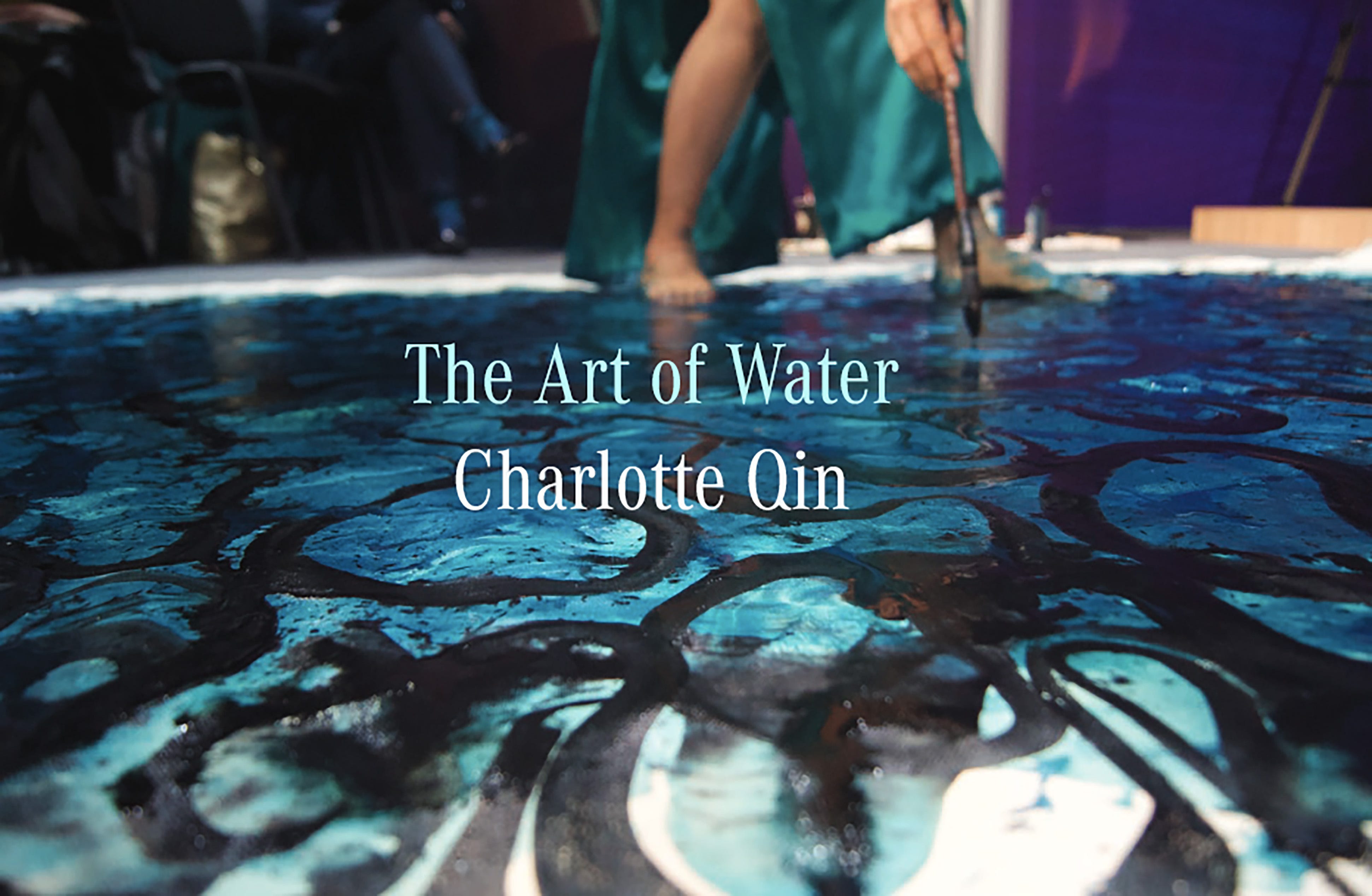
I had the joy of interviewing Charlotte Qin who is a water artist working to capture the emotions and spiritual essence of water through her paintings and her reciprocal performances where the audience engages in a connection with water. I was moved when I watched a performance of hers where glacial ice was brought in, and people spoke embodying the glaciers spirit, as the glacial ice melted.
She comes from a physics background, and integrates science and policy into her art works, seeking to educate people about the many dimensions of water and watersheds.
She writes on her Meeting of Waters project and organization site: “Water is at the heart of life, yet it remains one of the most overlooked crises of our time. Climate change, environmental degradation, and political conflicts have turned water into both a casualty and a weapon. Despite its fundamental role in sustaining ecosystems, communities, and cultures, the urgency of water issues has yet to fully resonate with the public. The complexity of water governance often keeps it siloed—separated across scientific, policy, and artistic spheres. But water is not just a resource; it is deeply woven into our histories, emotions, and faiths…. The name Meeting of Waters originates from La Jonction, where the glacial waters of the Rhône and Arve rivers merge—one clear, one sedimented—visibly illustrating the confluence of forces, ideas, and communities. What began as the artistic practice of an individual has grown into a movement—bringing together scientists, policymakers, artists, and cultural voices to reframe water not just as a crisis to solve, but as a relationship to restore.”
……………………………..
I was excited to connect with Charlotte, because I’ve been working on a number of water art and dance ideas, and interested in bringing together artists, who work with water, and also dancers who would like to do dance pieces around water and watersheds. I have a still emerging idea of collectives of artists and dancers working together to activate the restoration of watersheds. Drop me a line if this sounds interesting.
………………………………
Here’s part of the conversation I had with Charlotte, for full conversation check out the podcast.
Alpha : So after graduating physics, you went and studied art, is that right, or design?
Charlotte: I was doing this joint course between the Royal College of Art and Imperial College London. It was called Innovation Design Engineering. In my impression at the time, it was the marriage of art and science, except that everything is applied. We tend to think science and engineering, art and design, as two pairs, right? But in fact, our artists and scientists think more similarly, whereas designers and engineers were actually, you know, the similar family in terms of how they think. It was a very challenging course for me because I had to think about the users, think about solving problems. Whereas in my natural state, I would just be conceptualizing, trying to understand the system, and then going very deep in my thinking. In that course, I had to prototype. I had to think deeply about sustainability and why the world is messed up the way it is. And that was also when I found water. Not that I wasn't interested in water previously, but it around the same time I had kind of an environmental awakening. I realized I could feel the pain very deeply how water feels. And yeah, so I changed my direction completely. I was doing some cool technological projects involving water in my first year. But then until that awakening came and I was feeling the pain, I realized that water needed help, water needed healing. And it's not something that more technologies can fix. Or it's not something, you know, it's no longer, it shouldn't be used as a commodity again and again, especially by me, to further our egoistic creations, technologies, and crazy stuff we could make. You know, imagine, you know, the, there's so many incredible properties water manifest and we could apply it in so many different ways. But what's the point when the majority of the water bodies are suffering and are broken and needed help? Actually, people don't realize, right? It's the water's voice that needed to be amplified. So that was when I changed my project completely, almost failed my course in the end.
Alpha: How did this come about that you felt the pain of water?
Charlotte: I was in Spain. I went on a meditation trip in the middle of nowhere in Spain and then so I flew over from England. And then after three days, I think I just shed a tear at the end of the meditation and I just realized that, oh, wow, I was chasing after something shiny.
My soul was not quiet enough until then to know my purpose or to hear water. So I really had to quiet down from, you know, all the crazy things going on in London and also my course, you know, imagine this bling-bling technology design course in the middle of London where the Industrial Revolution first started, right? And at that time, I was trying to reinvent more technology to solve something.
Well, you cannot fix a problem using the same solution where that created the problem, right? So that was, I felt like that was what the course was driving us to do without making us critical thinkers first. So that's why like the whole designer engineer, scientist, artist complex came in because I felt like I wasn't taught in the course to think critically. I had to go back to my, perhaps my original training.
I might take a bit longer than most of my classmates to get to where I need to be. But I had to think clearly because I am not here just to resolve a symptom. I want to solve the deep, deep rooted issue, the societal issues. And when we talk about climate change and ecological crisis, it's all rooted in water.
Water is the first thing we need to look at. So that's something I strongly, deeply believed in until years and years later, you know, as I was in Geneva, I was an artist and advocate. I just suddenly realized that, wow, people, people, we speak about the same thing, but we don't see this the same thing at all. Like imagine, like at that time, I was before going to COP and all that, getting into climate change and all that stuff.
I thought climate was water, you know, like water is climate. It's like so obvious, right? But then I was like, actually, not, not everyone thinks the same. Like maybe 90, 95% of people don't think, don't see what I see. And I was really shocked. I think like more and more, it's happening more and more now when I realize, oh, okay, I've been just in my own head.
Alpha: How did you come about the connection of climate water? Was it through readings and books or articles or through your own thinking or what?
Charlotte: Just through my own thinking, you know, like, because I felt like because of my, okay, long story short. Fast forward from my masters, right? Finishing my master, I tried to live like a normal person, getting a job and all that stuff.
It didn't last for very long. Less than a year later, I found myself in the middle of COVID and I was just re-experiencing the pain that I was feeling for water. And I literally had to come out and become an advocate through my art because there were times and days I could only paint. And suddenly I get an exhibition and all that. And so I became an advocate. I was telling water stories through my painting.
That was 2020. And because of this connection with water and I, it's almost shamanistic, right? I feel like I can feel water's pain. I can tell water's stories.
I feel like water needs a voice. And I'm willing to do that through me, through my art. And then I was like, okay, let's bring it to the society. Let's collaborate with people who are also working in the water space. So that's when I slowly, more and more created this meeting of water's initiative that is making everyone do art. And so we tell the water stories through different voices. We personify water by imagining ourselves being water bodies, which w…