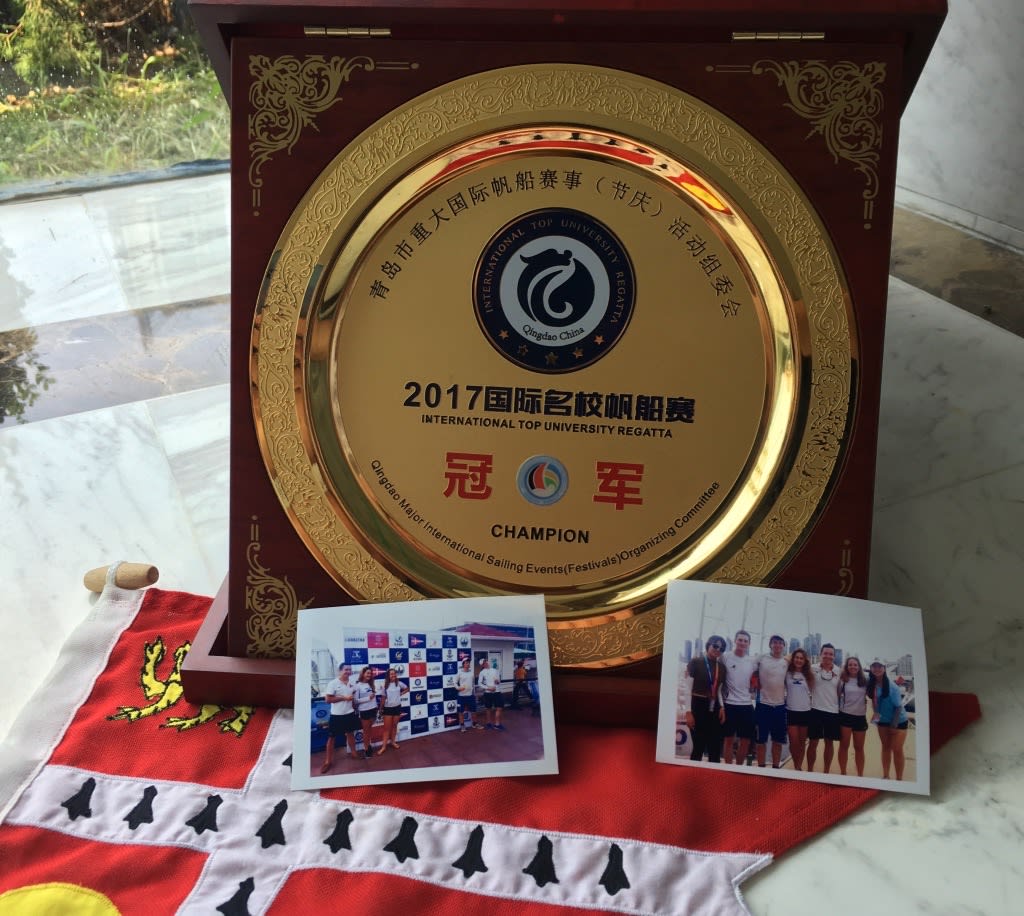
In 2017, I had the rare privilege of leading the Cambridge University sailing team to two victories that remain forever etched in my memory, and not just for the 32 pounds of silverware (more on that below).
Each instilled leadership lessons far beyond the racecourse. That year, I led our team to success against Oxford in the annual Varsity Match, and a few months later, led another crew to win the “ITUR” International Top Universities Regatta in Qingdao, China, against over a dozen highly skilled teams from across the world.
Sailing is a strange sport. It’s at once brutally physical and intensely cerebral.
Many of my closest sailing friends are literally physicists, which makes sense, I suppose…
You’re navigating wind shifts, team dynamics, and your own physical and emotional limits, all in real time, often on little sleep. At times you are, quite literally, steering in the dark.
Here’s what I learned while I was strategizing at the stern:
1. Leadership is about clarity, not control.
As the captain, I wasn’t the best sailor on the team. I didn’t need to be. My job was to set the tone, communicate our goals, and make sure every crew member understood their role and felt supported in it.
Before we left for China, we had barely trained together as a full team. Half of us came from different countries, with different styles and strengths. I quickly realized that micromanagement would sink us. Instead, I built the race plan, created shared language, and let each sailor bring their own excellence to the deck.
And guess what… It worked.
In both Portsmouth and Qingdao, it wasn’t the most technically proficient crew who won —although all teams were very technically adept— it was the most cohesive.
2. Pressure reveals the truth.
The Varsity Match between Oxford and Cambridge is less a regatta than a rite of passage. The rivalry is fierce, the wind and current is shifty in the Solent, and each tack is scrutinized. Needless to say, the nerves run high.
At ITUR, the pressure was different: we were halfway across the world, jet-lagged, adjusting to strange currents and unfamiliar boats we’d never sailed before. We were racing teams from Melbourne, Moscow, Amsterdam, California and China, and each with something to prove. (I mean, who wants to travel 20+ hours, and lose?).
What I found out is that pressure has a funny way of stripping away everything that’s not essential to success. You can’t fake preparation, or discipline, or trust in your team. You either have it, or you don’t. And if you don’t, the wind, water, and waves will show you right away.
3. Victory isn’t always loud
I’ve won and lost races by less than a few seconds. There are no stadium crowds in sailing, no replay cameras, no roaring applause. And sometimes, you finish the race not even knowing whether you’ve won.
Some say there’s no worse spectator sport than sailing…
The victory in Qingdao was announced over a crackling loudspeaker after deliberations in the protest room. Just a quiet nod and a tired smile from my teammates, before being rushed by a Chinese TV crew with many, many questions…
The Varsity win was similar: a handshake, a few pints at the pub with the teams, and back to the library the next day. Oh and a thirty-two pound silver chalice:
What I learned from all this is that real wins don’t need to be loud. The best ones are internal. You feel them deep down in your chest: the satisfaction of having done something hard, together as a team, and having done it well.
4. Legacy isn’t what you win—it’s who you meet along the way.
Looking back, what I’m proudest of isn’t the trophies or the rankings. If leadership is about anything, it’s about forging strong relationships and leaving people better than you found them. The ocean will forget your name, but the people won’t:
Epilogue: Revisiting Qingdao
Sometimes I think back to Qingdao: the neon skyline, the dark-brown “Yellow Sea”, the intense industrial smog just before a heavy August rainstorm, and the salt spray in the air just after. We were nearly all strangers who became a team in just four days. We didn’t all speak the same native language, but yet we understood each other. Time together on the water, however brief, has a way of doing that to you…
And every now and then, when I’m in a corporate boardroom or a job interview or just navigating life in New York City, I think back to those races. How calm can look like chaos. And what looks like chaos externally can be exacting, intentional and entirely deliberate.
And how, if you’re lucky, you realize that leadership isn’t always about being out in front, but rather learning to trust the team that’s standing right beside you, all while never losing touch with the feeling of the wind at your back:
If you liked this post, consider sharing it with your favorite British sailor, or subscribing for even more on leadership development, coaching high-performing teams, modern careers, and the future of work. And the odd sea shanty every now and then…
This Substack is reader-supported. If you found this helpful and to receive new posts and support my work, consider becoming a paid subscriber.