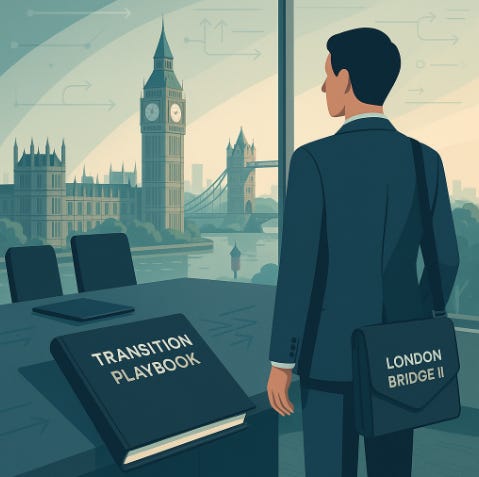
Most people experience just one major executive transition in their lifetime. I’ve now supported two regional President transitions, and while there were no crowns or state funerals, there was a codename: Operation London Bridge.
That’s what leadership called it (half-serious, half-sobering) as we built the strategic communications and change management plan to navigate the removal of an operating company President. The implications were real: investor confidence, leadership trust, team morale. The delivery had to be precise, quiet, and dignified.
At the time, I was working under the Chief of Staff, supporting in coordinating across Legal, HR, and Communications. Our new CHRO had just joined the company a few weeks earlier and was still calibrating. That left us with a clear mandate: stabilize the transition, control the narrative, and protect the business.
The Assignment
This transition wasn’t performance related. It was a strategic realignment. The business needed a different kind of leadership for its next chapter. So we developed a phased plan: stakeholder mapping, legal risk analysis, employee sentiment forecasting, and scenario planning for every imaginable outcome. Then I got on a plane to London to execute the plan in real time.
The Breakfast
That’s when the most surreal moment happened.
The outgoing President was invited to an offsite breakfast.
Pro tip: if you’re ever invited to breakfast by a billionaire, unprompted: proceed with caution.
The decision had been made. But the tone still mattered. There were no fireworks, but rather silver teapots, quiet civility, and a parting handshake. The conversation was tucked inside a quiet wood-paneled dining room in Mayfair. My work began immediately after.
We moved swiftly: coordinating cascading comms to leaders, preparing follow-up briefings, reinforcing alignment with HR and legal, and managing the message across four time zones. The President exited gracefully. The company moved forward.
What I learned within the inner circle:
There’s no training manual for moments like these. But here’s what stayed with me:
* Leadership transitions are emotional theater: Data alone doesn’t move people. You need sequencing, symbols, and psychological timing.
* If you don’t control the story, someone else will: We used a disciplined comms architecture: six talking points, three red lines, and managed a rumor mill.
* Composure is a strategic asset: In ambiguity, people mirror the calmest person in the room. That’s who I always chose to be.
Since then, I’ve supported other executive onboardings and offboardings, rewritten board communications during a business model pivot, and even built real-time dashboards to manage some transitions. But I’ll never forget that Monday in Mayfair.
The President landed well, with clarity and support. The organization found its footing after a period of transition.
And me? I learned that sometimes, the most important part of change isn’t what you say; it’s how steadily you say it.
The Sequel
A few quarters later, we had to run the play again.
Different leader. Different circumstances. But the stakes were just as high. This time, I didn’t have to build the plan from scratch: I simply pulled the playbook off the (now digital) shelf. Roles were clearer. Messaging was tighter. The comms cascade landed in under 72 hours.
We called it Operation London Bridge II.
And guess what? It worked, again.
If you found this helpful, follow me for more reflections on organizational transformation, cross-functional strategy, and the future of work.
This Substack is reader-supported. To receive new posts and support my work, consider becoming a free or paid subscriber.