Friday marked 60 days since President Trump informed Congress that military operations had begun in Iran. The deadline is critical, under the 1973 War Powers Act, after 60 days the president must seek authorization for the use of force or terminate military activity. Alternatively, he could seek a 30 day extension.
Instead of doing either, the administration has advanced a novel theory, first posed by the Secretary of Defense Pete Hegseth last week - that the 60 day clock had been paused as a result of the cease fire.
It is an interpretation of the law that most legal scholars suggest does not hold water given that the law clearly describes three circumstances under which the clock can be paused and a cease fire is not among them. The law says the clock pauses if congress (a) declares war (b) passes an Authorization for the Use of Military Force (AUMF) or (c) agrees to extend the deadline after receipt of an official request from the president; none of which has occurred.
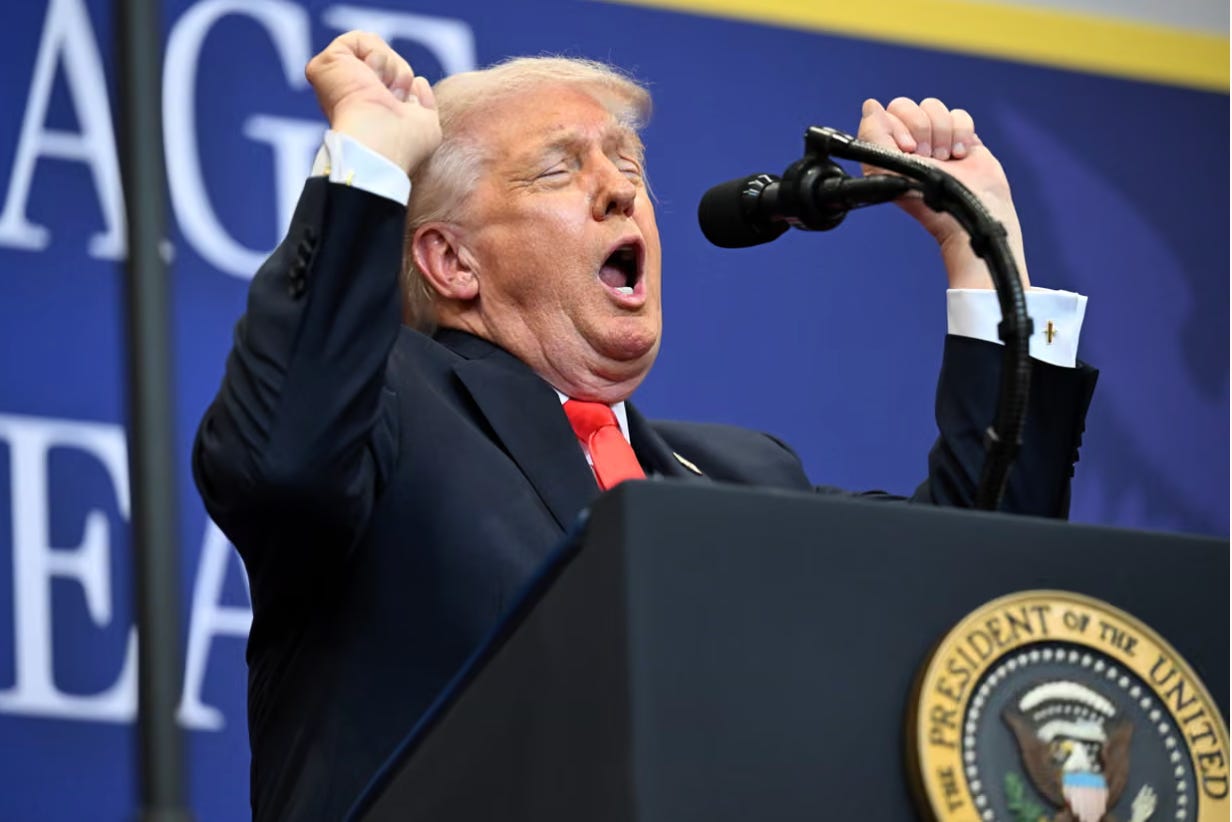
Instead, last Friday the President sent a letter to congressional leaders arguing that the deadline no longer applies because “the hostilities that began on February 28, 2026, have terminated.” The letter arrived just as the President, speaking to retirees in Florida saying exactly the opposite.
You know we’re in a war because I think you would agree we cannot let lunatics have a nuclear weapon. Do you agree?”
Trump is not alone in this, he is being enabled by Republican leaders in Congress, beginning with John Thune and Mike Johnson, both of who have said there is no reason for the president to seek authorization at this point.
In trying to defend his unwillingness to hold the administration to the 60 day deadline Johnson said:
“I don’t think we have an active, kinetic military bombing, firing or anything like that. Right now, we are trying to broker a peace.” Then he added, “I would be very reluctant to get in front of the administration in the midst of these very sensitive negotiations, so we’ll have to see how that plays out.”
All of which begs the obvious question, if we are not at war, why are trying to broker a peace?
Already Republicans ranging from Senator’s Susan Collins (Maine) and John Curtis (Utah) to Josh Hawley (Missouri), Todd Young (Indiana) and Lisa Murkowski (Alaska) have expressed concern about this stance.
Collins, who is facing a tough reelection in a state which largely opposes the War, recently flipped her position voting in favor of a resolution to halt the war. Murkowski who drafted an AUMF, likewise said, “the president must have flexibility to respond to emergencies and imminent threats, and he does. But those are not ongoing military campaigns like we find ourselves currently mired in.”
Expect pressure to grow on these and other Republican members as they are home on break until May 11, in many cases, gearing up to run for re-election and facing a public that increasingly disapproves of this war. As CNN’s Harry Enten made clear, the data shows that they blame the president and Republicans for the impact the War is having on their lives, beginning with the skyrocketing cost of gas, groceries, and other goods; not to mention the over dozen U.S. soldiers who have been killed and the thousands of innocent civilians killed, injured or displaced as a result of this action.