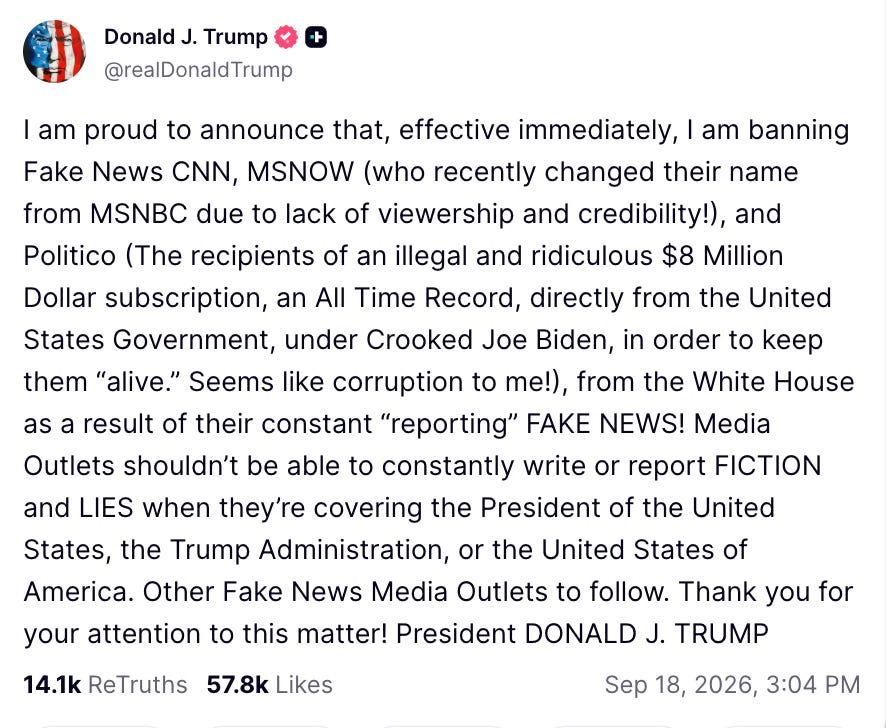
President Trump has been launching broadsides against the press since he was elected in 2016. During his first term, for instance, he revoked press credentials for CNN’s Jim Acosta and Playboy reporter Brian Karem. He also continued a practice he engaged in repeatedly on the campaign trail, referring to the news media as “fake news” and “enemy of the people,” while encouraging attendees at his rallies to boo the reporters assembled.
Since coming back into office in 2025, however, these attacks have intensified. In just the last two years he has overseen an administration which has:
* Excluded the Associated Press (AP) from the press pool because it refused to refer to the Gulf of Mexico as the Gulf of America.
* Fired the editor, publisher and a reporter from Stars and Stripes for reporting on poor conditions on USS Abraham.
* Banned members of the Pentagon press pool unless they sign an oath promising to only report authorized news.
* Continued to blame the media for suppressing the administration’s accomplishments and highlighting its missteps
* Rescinded Justice Department policies that protected journalists’ phone records from government searches, making it easier to investigate leaks.
* Used regulatory powers to investigate and attempt to intimidate broadcast networks critical of the president, including encouraging the suspension of comedian Jimmy Kimmel’s late-night show on ABC.
* Filed lawsuits against outlets whose coverage the president opposed
* Threatened to revoke TV broadcast licenses.
* Raided the homes of reporters such as Hannah Natanson from the Washington Post; a raid conducted under the direction of FBI Director Kash Patel as part of a national security leak investigation.
* Subpoenaed New York Times journalists and their family members after the outlet published articles revealing that an Air Force One jet gifted by Qatar was unsafe.
The latest in this litany was among the most startling - Trump’s announcement that the White House was banning CNN, MS NOW, and Politico, as well as revoking the press credentials of its reporters as a result of unfavorable coverage.
Several outlets are reporting that Trump made the decision at the prodding of his controversial close aide Natalie Harp, after she showed him negative media coverage. The ban also appears to have been a surprise to many of the presidents other aides, including his Chief of Staff, Susie Wiles, who was out of the White House when the announcement was made.
As a result, the impacted outlets joined together and filed a lawsuit in the U.S. District Court for the District of Columbia arguing the ban constitutes view point discrimination and retaliation in violation of their First Amendment right to free press; as well as a violation of their Fifth Amendment right to Due process because the decision was made without notice, standards, or a chance to appeal.
The outlets are requesting that the Court issue a Temporary Restraining Order (TRO) blocking the ban and restoring their access. In a joint statement they wrote:
“Left unchallenged, this threatens press freedom and the public’s right to independent journalism free from government interference. The government does not decide what the press reports or publishes.”
The case will be heard by U.S. District Judge Timothy Kelly, a Trump appointee who in 2018 ordered the president to return the credentials of CNN’s Acosta. The attorney who represented Acosta, Theodore "Ted" Boutrous Jr., is also representing the news outlets in the current case. The judge is expected to rule on the TRO on Wednesday after a hearing today.
The ban was met not only with this lawsuit, but a show of solidarity by the media writ-large. Just yesterday the TV networks who are part of the White House pool - ABC, CBS, NBC, and Fox - took the unprecedented collective step of acting in concert to suspend pool video coverage of Trump until the impacted media outlets credentials are restored.
Several legal scholars, including Fox News legal analyst Jonathan Turley, have predicted the ban will not survive legal scrutiny. There is no certainty on this because while the courts have ruled the government cannot arbitrarily ban journalists or revoke their press credentials based on the content of their reporting or their viewpoints, there are exceptions.
First, on the major legal points working in the media’s favor.
* Judge Kelly who is hearing the case previously ruled against the Trump administration in a case with similar hallmarks (i.e., the 2018 case involving CNN’s Jim Acosta).
* In the 1977 case Sherrill v. Knightthe D.C. Circuit Court of Appeals ruled that the White House press area is a “nonpublic First Amendment forum” as a result, access cannot be denied arbitrarily, and the government must provide explicit, compelling reasons (such as legitimate national security threats) to deny a pass. This case set the precedent that once the White House is open to the press generally, it cannot exclude specific journalists or outlets based on “viewpoint discrimination” (i.e., ban them simply because the administration dislikes their coverage).
* Federal courts have also ruled that the White House has to abide by the Fifth Amendment right to “due process” before banning a journalist or media outlet. This means, among other things, giving the media advance notice, clearly stating the grounds in writing, and allowing time to appeal. We saw this in CNN v. Trump (2018), as well as two years later in Karem v Trump (2020).
Despite this, recent court rulings have distinguished between general press facilities and highly restricted presidential areas. The so-called ‘restricted spaces’ exception was referenced most recently by the D.C. Circuit Court of Appeals in 2025. When issuing a preliminary ruling in the AP case, the Court held that highly restricted presidential spaces are not open First Amendment forums. As a result, the White House has the discretion to determine who is admitted for any reason, viewpoint or otherwise.
The so-called ‘restricted spaces’ exception may help explain why, when attempting to defend the administration, Vice President JD Vance said the action was not a restriction on free speech but rather a denial of "special access." While Vance appeared to be trying to place the facts in the current case within the Courts exception, he was immediately contradicted by Trump who once again called the action a "ban” and dismissed the notion it was merely a diminishment of “special access.”