Why cave and why now?
These are the questions many people are asking about the Democratic shutdown that was (or is soon to have been). After all, just one week ago Democrats were riding high for the first time in a long time after an election night that even Steve Bannon described as an “absolute disaster” for Republicans.
Democrats across the country are livid at the 8 “Folders” and their decision to cross the aisle and work with the GOP to reopen the government has re-opened a long simmering wound in the Democratic Party; even though a history of shutdowns tells us that (a) not much more was going to be achieved and (b) shutdowns seldom result in policy victories.
What shutdowns can achieve is a framing victory that sets the pro-shutdown party up well for the next election. In short, you lose the battle, but can win the war.
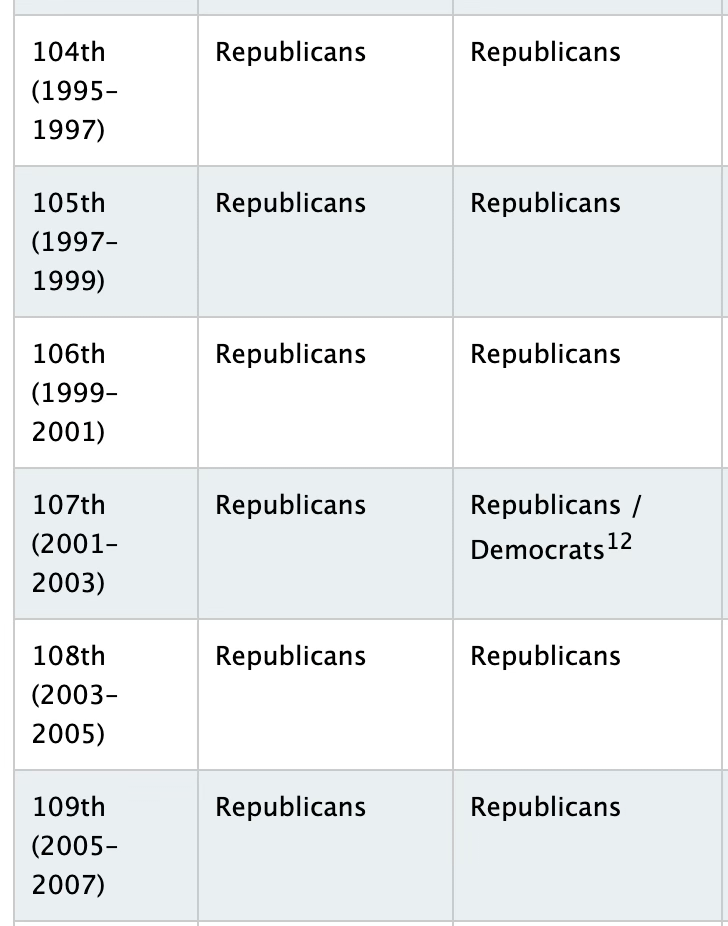
This is what Republicans did in 1995 and 1996 with their back to back shutdowns; they lost the battle of achieving a balanced budget, but won the war because they went on to control Congress for a decade (see table below, left column is party control of the House and right, Senate, 1995-2007). These wins were in large part a result of the Republicans ability to message that they were the party of fiscal and budgetary responsibility.
From any perspective, the Democrats have done the same as it pertains to being seen as the party of affordability, the party concerned about health care costs and the cost of living for average Americans.
They have been helped along the way by the reality of who Donald Trump is and where he has focused his energy and time while in office. Consider that in just the last week, in addition to the stunning election results, polls have showed that Americans are giving Trump historically low numbers when it comes to the economy.
A recent Bloomberg/Harris poll, for instance, shows Trump is 18 points underwater on the economy, with 59% of Americans saying they disapprove of how he is handling the economy and just 41% saying they approve. In the same poll, only 1/3 of Americans said they think the economy is on the right track.
These devastating numbers are backed up by the RealClearPolitics polling average which shows Trump’s approval on the economy overall at -14%.
Couple that with the fact in the last few days, two critical members of Trumps economic team, Scott Bessent and Kevin Hassett, both acknowledged parts of the eco are in recession and preliminary numbers from the University of Michigan’s measure of consumer sentiment finds that it is the second lowest on record.
In the face of all of this, the administration did NOT focus on the economy, instead they spent days fighting to ensure 42 m food insecure Americans, including 16m children, 8m elderly Americans and 1m Veterans do NOT receive SNAP benefits. All the while the president was hosting a lavish Great Gatsby themed party, hosting foreign leaders, tearing down the East Wing of the White House to build a gold-plated ballroom, describing the affordability crisis as a con-job and a hoax, and attempting to push additional cut taxes for the ultra wealthy and large corporations.
As frustrated as Democrats are - and they have reason to be - they did succeed in underscoring who Republicans are for. Could they have held out longer to make this case? Yes, although the odds of achieving a different policy end were nil, but that was never really the point.
Despite this, anger at the ‘Folders’ is real. Part of it stems from the fact that the fact that the shutdown, coupled with what happened on Tuesday, raised expectations of a policy win. Historically, however, that was not how this was ever going to end and the Folders, recognizing that from the beginning and being members of a party that is ‘pro-’ government, not surprisingly, pulled the plug, insulated as they all are from the ballot box for at least one or more cycles.
One lesson for the next party who engages in this tactic is they need to articulate an end strategy early on, they also need to prepare their supporters for end and be united in it when it comes, as it inevitably will. That didn’t happen in this case and as a result, leadership is paying the price. We are already hearing calls for Chuck Schumer to be replaced (whether fair or not). Rep. Ro Khanna (D-Calif.) was just one of several Democrats to express anger in this regard: “Senator Schumer is no longer effective and should be replaced. If you can’t lead the fight to stop healthcare premiums from skyrocketing for Americans, what will you fight for?”