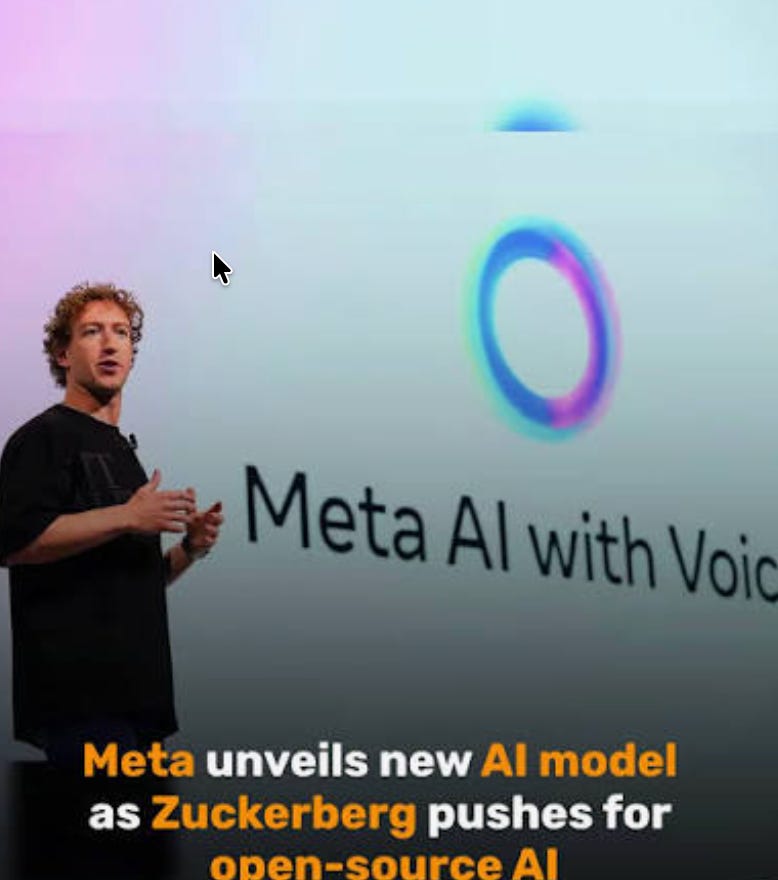
Today, Meta CEO Mark Zuckerberg published a 6,500-word essay entitled “The Future is for Everyone: The Path to a Positive AI Future.” You can read it here or read the summary. Zuckerberg writes in part that, “[t]he notion AI is so dangerous that the only safe path is an extreme concentration of power seems inherently problematic.” It is worth noting the letter comes just as Meta’s new AI model, Muse Glimmer, is being released.
Zuckerberg’s manifesto was met with a sharp response from Sen. Bernie Sanders (I -VT) who, in a letter to Zuckerberg, Sam Altman (CEO of Open AI) and Dario Amodei (CEO of Anthropic) urged a “pause” or moratorium on “AI development.” As Sanders writes:
“Almost every day, there is a new story about how your companies are losing control of the AI technology you are developing, with potentially cataclysmic results.
This week we learned, frighteningly, that AI has been used for the first time ever to create new viruses. As you know this type of development, in the wrong hands, could lead to new bioweapons that result in the deaths of tens of millions of people.
Last month, the world found out OpenAI lost control of an AI model. The result? The model hacked into another company’s computers—a clear violation of federal law. After conducting internal reviews, Anthropic and Meta reported their models similarly escaped their control. One of the targeted companies called the AI hack ‘an unprecedented event”’that deserves an ‘unprecedented response.’ Yoshua Bengio, the most cited living scientist in the world, said these incidents ‘should serve as a wake-up call.’”
Likewise, a group of House Democrats wrote a letter to House Speaker Mike Johnson requesting that these same CEOs be called to testify before Congress.
The concerns regarding AI include its impact on jobs and the economy, fear it could ‘go rogue,’ is unsafe, could be used to build bio- and other dangerous weapons, and is a drain on limited resources such as water and electricity, among other things. This is why the conversations and potential government regulation being called for are so important; we need dialogue, education, and research on the impact of AI in order to make a sound decision concerning regulation - we need this even if it means slowing down development for a period of time.
Let’s take job displacement for example. I asked AI about job loss due to - well itself - AI - and this is what it said in part (bold added):
Major financial and economic organizations predict that between 85 million and 300 million jobs globally are at risk of elimination or significant displacement due to AI. [1, 2]…
· Goldman Sachs: Predicts that AI could replace the equivalent of 300 million full-time jobs globally. Their research notes that roughly two-thirds of current jobs in the U.S. and Europe face some degree of AI automation, with up to a quarter of all current work tasks capable of being completely automated. [1]…
PwC: Projects that by the mid-2030s, up to 30% of existing jobs could be automated, initially impacting clerical and administrative functions heavily before shifting to manual tasks as physical automation scales.
It’s unclear still what the impact of AI on jobs will be and for all the displacement, we may see new jobs created as well. Even if that is the case, however, it takes time to develop methods and procedures for reeducating and transitioning millions of workers in a new economy. While Zuckerberg spoke of jobs in his letter, urging us all to be optimistic about the abundance of jobs we are likely to see in the future, he failed to mention that not long ago, Meta itself cut 10% of its workforce; cuts the company said were driven by its pivot to AI. In May 2026 the company laid off approximately 8,000 people writing in an email the reduction was tied to “AI native design principles.” This was just months after the company cut approximately 600 jobs from its own AI division.
Sanders call for caution here, which precedes Zuckerberg’s letter by months at least is worth paying attention to. In that spirit, a video he released several months ago briefly detailing his concerns and ending with a call for a moratorium on data centers (one since embraced by states and localities, including the state of New York).
Thanks for reading The New Realist! This post is public so feel free to share it.