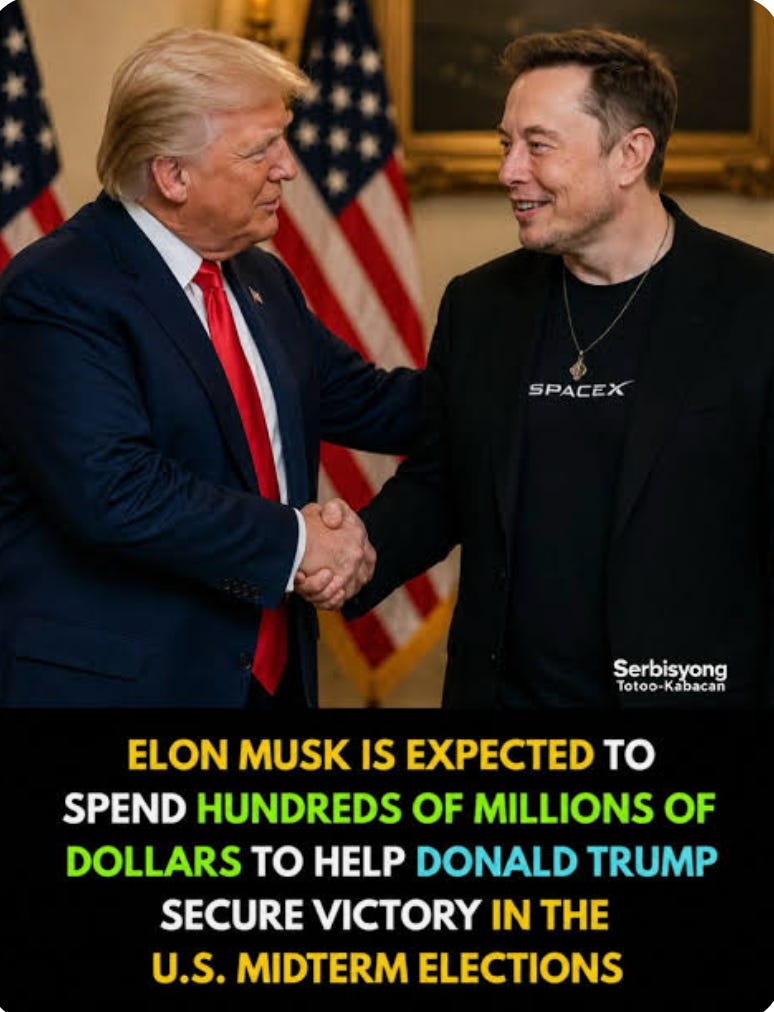
The numbers are astounding.
The wealthiest person in the world and, arguably the wealthiest individual to ever walk the earth, has broken all records when it comes to spending in an election.
According to a report in the New York Timestoday, Elon Musk has spent $366 million on this midterm cycle, far exceeding the $290 million he spent to help Republicans and President Trump in 2024. While this is less than a drop in the bucket for Musk (.037% of his estimated $1 Trillion net worth), it makes him the single largest donor of this or any other election cycle.
This is not just a case of pay-for-play, political influence, or access-buying. It is, to Senator Bernie Sanders (Independent -Vermont) point, the clearest sign to date that we are living in the midst of an emerging oligarchy.
In late September, Sanders spoke at Riverside Church in New York arguing that “oligarchy is ascending, working families are struggling to stay alive and democracy is in retreat.”
At the time, Sanders noted that Musk was “spending some $200 million more to help Republicans keep control over the Congress” in the midterm. Little did Senator Sanders know at the time, but the actual amount of spending by Musk is nearly double that.
Nevertheless, Sanders is correct to say that what we are witnessing in the U.S. today is the very definition of an oligarchy. After all what is an oligarchy but a form of government in which a very minuscule number of extremely wealthy people, such as Musk, exert an inordinate amount of economic, political, social, governmental, and technological, power.
The Times revelation regarding Musk’s spending comes just a few days after a new poll found that “most young people” in the United States feel the “system is tilted toward Billionaires.” Among other things the researchers found that:
* In terms of who holds power in Washington D.C., young Americans rank voters dead last and Billionaires first
* The Concern about money in politics is widespread and bipartisan.
* 83% of young Americans describe money in politics as a big problem (58% say it is “very big”), and just 2% say it is not a problem at all
* most young Americans believe Congress and the states should be able to reasonably regulate and limit money in campaigns and elections.
* Many see money as a threat to elections.
Despite the focus in the Times piece on Musk, the problem is much bigger than any one individual or party. It is widespread, it permeates both parties and all aspects of our politics. It is also not enough to cast aspersions towards groups, parties, or individuals who play by the rules and follow the law. The problem is not them, but rather the law itself.
To quote Michael Kinsley, “the scandal isn’t what’s illegal; the scandal is what’s legal.” That is what needs to be changed, the laws, the system and rules of the game by which we conduct our political lives.
This starts with overturning the Supreme Court’s decision in Citizens United v. Federal Election Commission (FEC) (2010) which reinforced the major finding in Buckley v Valeo (1976) that money spent in campaigns to influence voters is ‘free speech.’
The result was not unlike what we saw in the heyday of the conservative court in the late 19th and early 20th Centuries when the Justices consistently struck down most efforts by states and the federal government to regulate the economy. The major difference is instead of striking down attempts to regulate the economy, they have been busy striking down attempts to regulate campaign spending.
We saw this most recently just a few months ago when by a vote of 6-3, the Court struck down federal limits on how much parties can spend in conjunction with candidates (National Republican Senatorial Committee v. FEC(2026)).
There are solutions. The non-profit, American Promise, which sponsored the poll referenced previously is, for example, working to overturn these Court rulings by amending the Constitution to ensure that Congress and the States, are able to “reasonably” regulate and limit “contributions and spending in campaigns, elections, or ballot measures.” To date they report that 25 states “have already called on Congress to propose an amendment solution.”
Amendments are, however, notoriously difficult to pass. How difficult? The last time an amendment was ratified was in 1992. That amendment, #27, was written and proposed, 200 years earlier; and its’ author was none other than James Madison. As Justice Antonin Scalia once quipped, ‘it ought to be hard, but not that hard.’
With that in mind, there are additional remedies or partial solutions that can be considered in the interim. In the short term, voters casting ballots in November should do so with the understanding that whoever they elect to the Senate will be asked to confirm new justices to the lower federal bench and potentially the Supreme Court. Whoever they choose is likely to have a say in whether efforts by Congress and state legislatures to regulate money in politics are deemed constitutional or not.
The New Realist is a reader-supported publication. To receive new posts and support my work, consider becoming a free or paid subscriber.