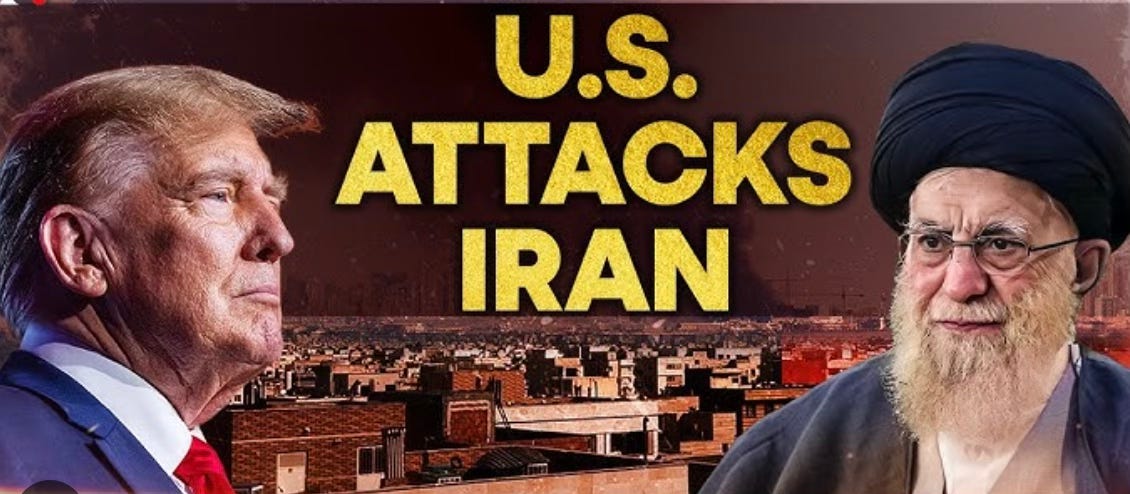
We are now living in a country in which less than two months apart the U.S. President has sent American troops into foreign nations to remove and kill their leaders.
It is not just that the Trump administration has taken these actions, it is how.
The invasions of Venezuela (January 3) and Iran (February 28) demonstrate a marked change in how the U.S. goes to war - and yes, when you invade another country and remove their leader, especially when that country presents no imminent threat, it IS a war. In both cases, preemptive wars of choice.
From the time he first burst on the political scene, Trump has been a vocal critic of the U.S.’s 2003 invasion of Iraq. It has been a central pillar of his “America First” foreign policy. It is a war which he described it as “the single biggest mistake made in the history of our country.”
Yet contrast how the Bush administration went to War in Iraq with what the president has done over the last few months. Regardless of your view of the War in Iraq, the Bush administration conducted itself in accordance with the rules based order as established and agreed upon in the modern era. In the run-up to the Iraq War, they defined the principles at stake, worked with international organizations and law (U.N., etc.), built a broad coalition of forty-some odd allies from around the world, consulted with Congress, Congressional leadership, and the American people, and explained both their rationale and objectives (flawed as they were).
None of that has been done in these recent cases. Instead, the world’s leading democracy has, through its actions and deeds, now set a precedent which is welcome by the autocrats of the world: the rules based order is of little concern or consequence. Intervention into a foreign nation - whether a quick hit, more extended incursion, removal or killing of another country’s leader, or any other type of intervention - all of that takes just one thing, military power and might. If you have the power to act, you can do so regardless of the post-WWII system of laws, norms, and institutions designed in the late 20th Century to precent or at least diminish conflict and the use of force.
The impacts of how the Trump administration has approached Venezuela and Iran are many and long term. By way of just a few short-term examples: how can the U.S. speak out against Russia’s invasion of Ukraine? How can we help negotiate an end to the Russia/Ukraine War? How can the U.S. criticize Putin for invading Ukraine? What if Putin chooses to kill V. Zelensky or vice-versa, Ukraine decapitates Russia’s leadership, what then? Likewise, on what grounds can we lead the Western world in challenging a potential Chinese takeover of Taiwan?
What can be done about this at home? Very little. Congress does, under Article I, section 8, have the sole power to declare War. That wasn’t done in this case as they were not consulted. They will come back to Washington D.C. this week and debate will begin on a War Powers Resolution. As important as it is for all members of Congress to go on the record and let the American people know where they stand on this War, even if it passes both the House and the Senate, it will be vetoed by Trump and in a GOP-led congress, they will have the votes to override that veto. Apart from that, Congress can only act to restrict funding for the War should the President ask for more, but that is doubtful in the short term.
What is left is for the American public to speak out, most importantly at the ballot box. Voting in the primaries begins tomorrow in Texas and North Carolina and then extends across the nation in the coming weeks. U.S. voters seldom take foreign policy into account in any concerted way at the ballot box (unless the nation is at War for an extended period of time and there is a loss of U.S. life). It is still too early to know if that will be different this year and much of that depends on what happens in the ground in Iran and the Middle East given the U.S. has now started a War without articulating clear objectives or goals, and without a plan as to how best to achieve them.