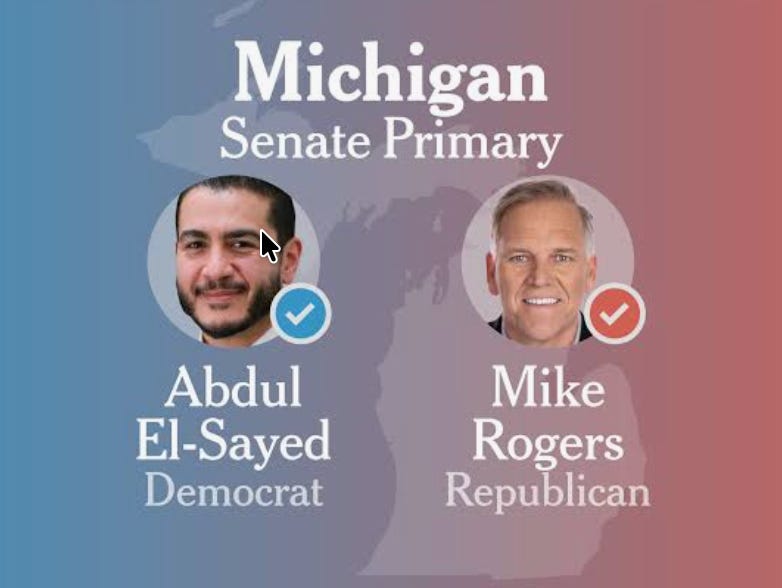
Thoughts on Dr. Abdul El-Sayed’s narrow victory (<15k votes) over Representative Haley Stevens in the Democratic primary in Michigan
* The polls were way off, Realclearpolitics average of polls, for instance, had El-Sayed up +10, Emerson had him up +15, etc. The truth is, polling primaries is very difficult in part because turn out tends to be much lower than in general elections.
* The polls raised expectations of a blow-out that did not occur, but that should not take away from the fact this is a big win for El-Sayed and progressives overall. If last year anyone suggested a progressive could beat a strong, well-funded, and widely supported Rep. Stevens in Michigan few would have bet on it.
* El-Sayed was one of just three wins for progressives in Michigan last night, the others were District #7 where William Lawrence won and will now face off against Republican Rep. Tom Barrett and District #13 where Donavan McKinney defeated incumbent Rep. Shri Thanedar.
* Up to this point, the establishment Democrats have been able to say that progressives can only win in blue states like NY and Colorado. El-Sayed’s victory in purple Michigan gives lie to this argument. Of course, now he has to prove he can win the general election versus Republican Mike Rogers, which will not be an easy task.
* That said, establishment/moderates scored big victories not just last night but throughout this primary election season as well. In the much watched rematch between Cori Bush and Democratic Rep. Wesley Bell in Missouri District #1, for instance, the more moderate Bell came out ahead of Bush once again.
* Democratic turnout in Michigan was much higher than Republican turnout, suggesting as we have seen in the specials and primaries so far - Democrats are enthusiastic and engaged, something that should bode well for the party’s nominees in November.
* Not only do we have our nominees in Michigan, but we know what we are likely to hear for the next 3 months from both.
>El-Sayed will paint Rogers as a Washington insider, a corporate sell-out who is beholden to the big special interests he made millions from after leaving office, a carpet bagger who resides in Florida, someone who is ideologically conflicted as he moves between the Neo-cons and MAGA wings of the party, and an individual who, if elected, would use his time in office to do Trump’s bidding. Don’t forget, he was in line to serve as Trump’s FBI Director during his second term, but lost out to K. Patel.
>Rogers will argue that El-Sayed is an “extremist” and an “anti-American” radical, he will focus on painting him as a Democratic Socialist and argue that he supports the most objectionable parts of the DSA’s platform, including - the abolition of ICE, de-funding the police, etc. He will try to call attention to his own background in security and intelligence by claiming El-Sayed will make Michigan less safe and less affordable and that he is beholden to voices of the far left wing, such as Hasan Piker. He will also avoid talking about national issues and try to make the race as local as possible.
* During his victory speech this morning, El-Sayed challenged Rogers to 5 televised debates. So far, Rogers has not responded.
Crib Notes on Senate Races to Watch this Election Cycle
* 33 U.S. Senate seats are up for election this November, including the Michigan seat.
* Republicans currently hold a 53–457 majority in the Senate (this includes the 2 independents who caucus with the Democrats).
* On November 3, Democrats need to gain a NET of 4 seats to win the majority, Republicans can lose no more than 2 seats to retain the majority.
* In addition to Michigan, the Cook Political Report has listed just 3 seats as toss up’s:
>Alaska - Sen. Dan Sullivan (R) vs/. Mary Peltola (D)
>Maine - Sen. Susan Collins (R) vs/. Troy Jackson (D)
>Ohio - Sen. Jon Husted (R) vs/. Sherrod Brown (D)
* While Michigan is an Open Seat, the other three toss up races all feature incumbent Republicans on the ballot.
* In addition to the 4 toss up races, Cook lists 4 races as leaning or likely Democrat (Georgia, Minnesota, New Hampshire, and North Carolina) and 4 races leaning or likely Republican (Iowa, Kansas, Nebraska, and Texas).