After telling Fox Business Network’s Maria Bartiromo today that the Iran war is “very close to over,” President Trump added the Iranian’s, “want to make a deal very badly.”
There is very little evidence of either. If the war is ‘very close to over,’ why did the Pentagon just announce it is sending thousand more American troops to the Middle East?
Likewise, why would the regime be more interested in striking a deal now than it was in late March when the Trump administration decided that there was no reason to continue negotiating and instead decided to mount a bombing campaign?
According to the President, the difference is that there is a “new regime in place.” As Trump has repeatedly claimed, Iran’s new leadership is
“less radical and much more reasonable… If you look already because the one regime was decimated, destroyed. They’re all dead. The next regime is mostly dead. And the third regime, we’re dealing with different people than anybody’s dealt with before. It’s a whole different group of people.”
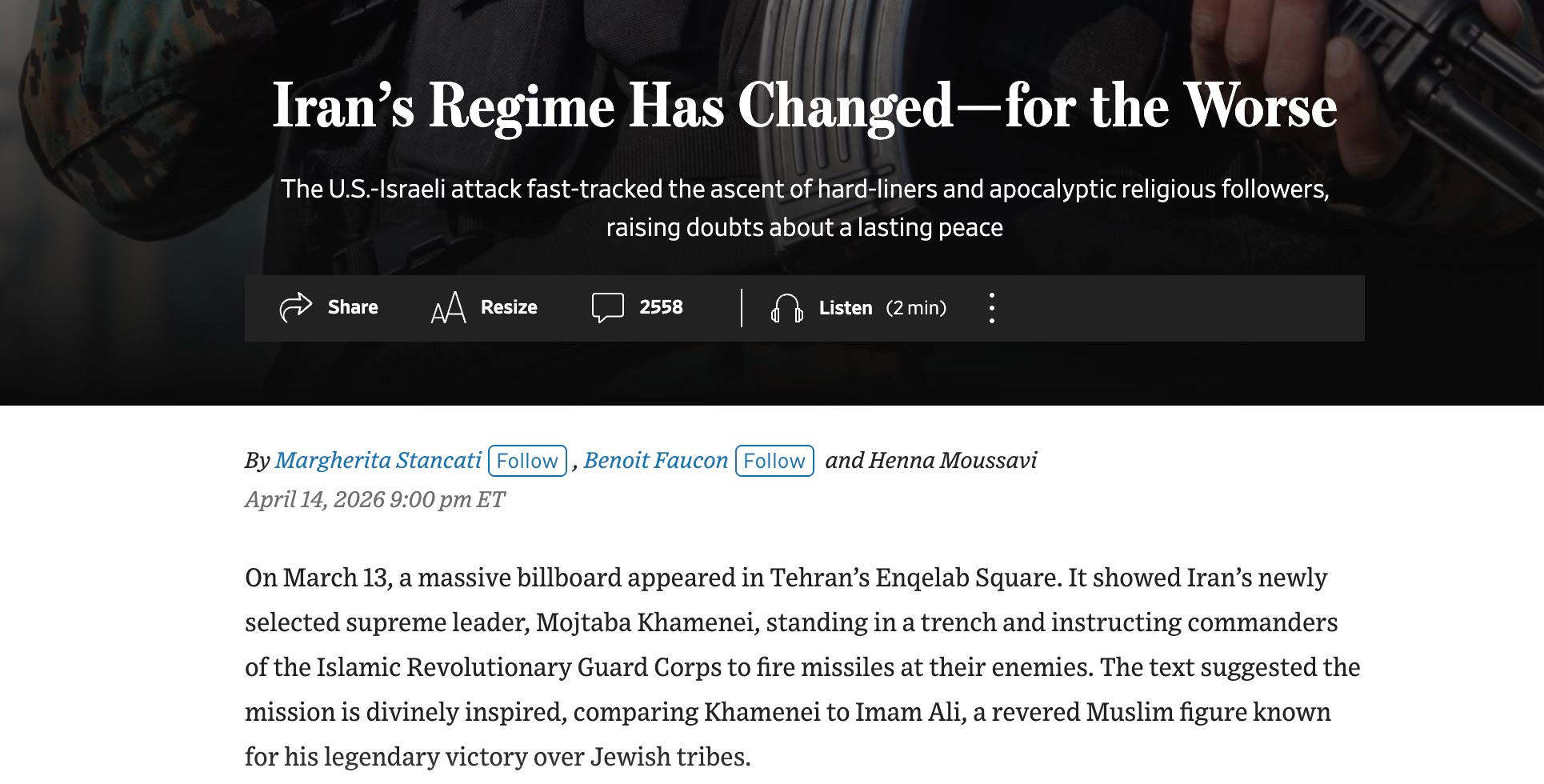
A piece in yesterday’s Wall Street Journal, however, tells a very different story about the “new regime.”
Among other things, the article gives insight into the backgrounds of the key individuals who make up the regime. After reading the article, even a novice would be hard pressed to describe these figures as far “less radical” and “much more reasonable” than their predecessors. Among them are:
(1) Mojtaba Khamenei, the new Ayatollah, who survived “the airstrike that killed his father and several other members of his family” and is reported by most experts to be even more hardline than his father.
(2) Mohammad Bagher Zolghadr, the new national security chief, who was not only a former member of the Revolutionary Guard but “the leader of a guerrilla group that killed an American petroleum engineer…” and someone who “was personally involved in the assassination of two policemen.”
(3) Ahmad Vahidi, the IRGC’s new commander in chief who “is accused of participating in the 1994 bombing of a Jewish community center in Buenos Aires that killed 85 people and injured hundreds.”
The article, by Margherita Staccato, Benoit Faucon, and Henna Moussavi, is well worth reading in full. Among other things, it raises questions about the veracity of Trump’s repeated assertions regarding the new regime; as well as whether his optimistic talk about a pending negotiated settlement and an imminent end to the war are anything more than wishful thinking.