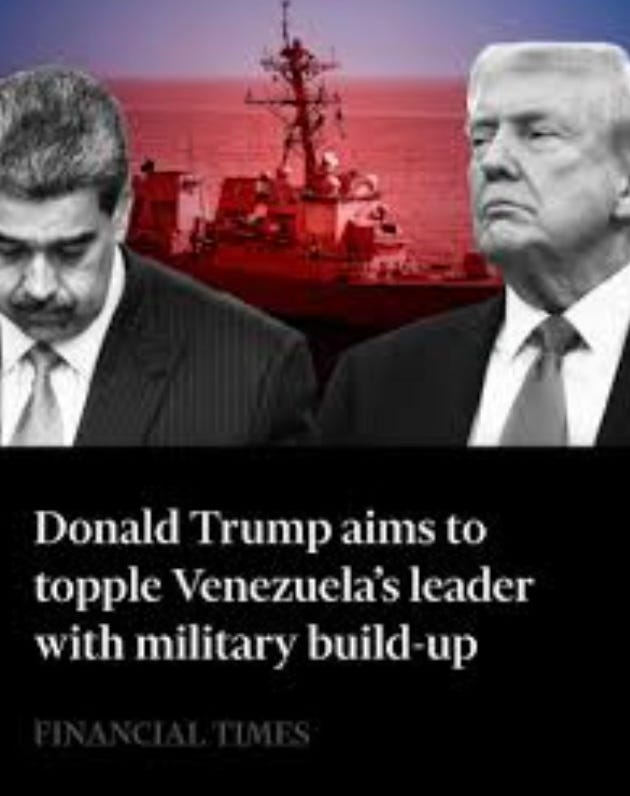
For two months, the US has been carrying out lethal strikes in international waters on small Venezuelan boats in the Caribbean and Pacific Oceans. The strikes have hit numerous boats (all alleged to be carrying illicit drugs) and killed more than forty people (all alleged to be drug smugglers).
So far, however, the Trump administration has not put forth evidence to either the American public or Congress to support these claims.
As I noted here weeks ago, the legality (both under domestic and international law) and the strategy of these strikes are questionable. Nevertheless, when asked this week whether he needs to go to Congress to get authorization for the continued use of lethal force, President Trump said he may, but probably does not need to; moreover he warned land strikes could be next:
“The land is going to be next... And we may go to the Senate; we may go to the Congress and tell them about it, but I can’t imagine they’d have any problem with it.”
In my last post on this topic, I discussed why this policy is questionable legally, constitutionally, morally, and strategically. Today, the focus is on the politics of it - none of which make much sense given Trump’s commitment to MAGA.
It is well documented that human rights, civil and political rights, worsened under the rule of Hugo Chavez and his successor, Nicolas Maduro. The question is not whether Venezuelans are suffering, but what is the goal of the Trump administration and is this approach the most sound way to achieve it? Are they hoping to overturn the Maduro government? Are they hoping to create unrest in the country and its neighbors to achieve regime change?
The US has a long and sordid history of regime change and it is not hard to point to many examples where the policy has failed dismally - look no further than Iraq. Ironically, Trump has long said he was against the Iraq War. Moreover, he criticized many of his opponents in the 2016 election for supporting it, which makes this approach to Venezuela - which sounds eerily like the Bush approach to Iraq - that much more perplexing.
Second, what happened to ‘America first’? President Trump ran promising to keep the country out of endless wars, yet now he is suggesting we may see boots on the ground in Venezuela? He ran promising to ‘make America great again,’ beginning first with the economy, yet as our own government remains shutdown and prices are climbing, he is spending more time on issues overseas, in the Middle East, Asia, South and Latin America, than he is on the troubles plaguing the U.S.
Third, not only does this approach toe Venezuela fly in the face of his long-standing criticism of endless wars generally and Iraq specifically, but it stands in opposition to the views of many in his base. Consider Sen. Rand Paul (R-KY) who has spoken out against the policy for several reasons, including the fact that about a quarter of the time our information regarding who is on those boats is faulty. This is one reason why, in a country governed by the rule of law, we don’t shoot first and ask questions later. Instead, everyone is assumed innocent until proven guilty, including drug traffickers. That is why, as Paul noted, instead of shooting first, the US should continue its long standing practice of having the coast guard stop and board the ship, if there are illicit drugs on board they can then be handled legally.
Fourth, if the US continues to attack boats from other nations in international waters and puts boots on the ground in an effort to remove Maduro, can we really continue to cry foul at Russian President Putin for going into Ukraine and attempting to remove President Zelenskyy? Can we really take on China if it decides to invade Taiwan?
I spoke with Bloomberg’s Joe Mathieu and Tyler Kendall on Balance of Power about these and other difficult issues raised by Venezuelan boat attacks.