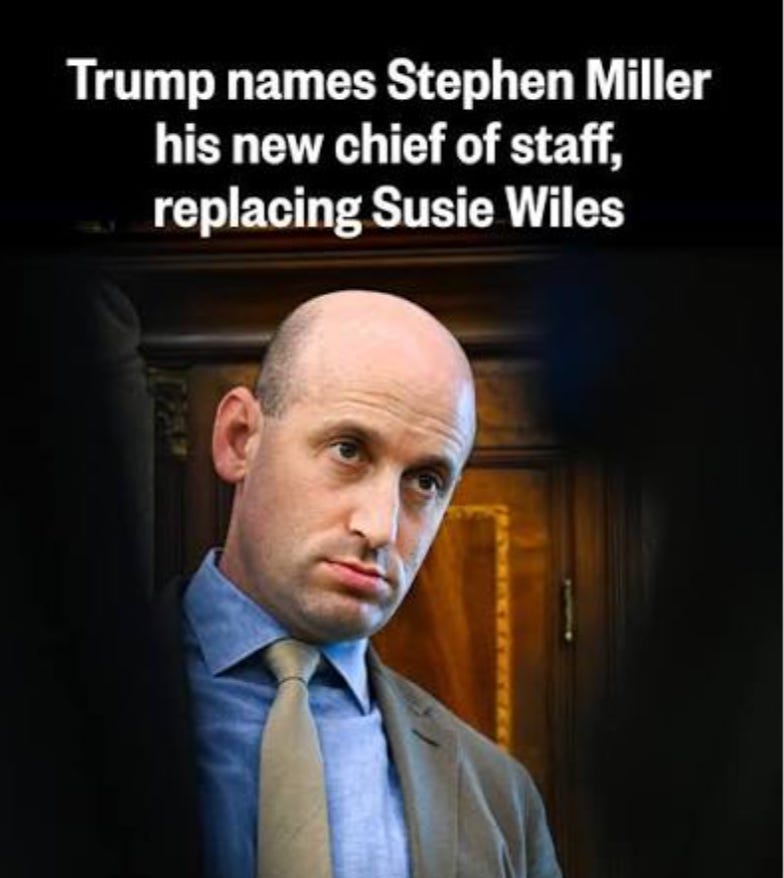
Miller’s appointment is a middle finger to voters
White House staff shakeups after midterm losses are nothing new.
George W. Bush made staff changes after the 2006 election when Republicans lost 30 seats in the House and 6 in the Senate. Four years later, Barack Obama did the same when Democrats lost 63 seats in the House and 6 in the Senate.
Unlike what we saw yesterday in the wake of the Republican’s midterm wipe out (39 seats in the House and 7 in the Senate so far), however, the staffing changes Bush and Obama made were responsive to the message sent by voters.
In the case of the 2006“thumping,” as Bush called it, voters were angry about the Iraq War and the administration’s handling of it. As a result, the day after the election, the president announced that he was replacing Defense Secretary Don Rumsfeld with Bob Gates.
Likewise, because the 2010 “shellacking” was seen as a sign that voters were frustrated by the slow rate of economic recovery and the failure of Democrats to govern and communicate better, Obama made several staff changes. This includes, replacing interim Chief of Staff Pete Rouse (who took over for Rahm Emanuel who had left just before the election) with William Daley and Press Secretary Robert Gibbs with Jay Carney, among others.
Whether or not you agree these steps were effective, Bush and Obama’s staff shakeups were at least rationally related to the electoral outcome and responsive to the messages coming from voters.
The same cannot be said of Trump’s decision to replace Chief of Staff Susie Wiles with Stephen Miller, the architect of one of Trump’s most unpopular policies. It is, after all, Miller, who has been the primary driver of the most controversial aspects of Trump’s hardline approach to immigration and border security, including:
* Travel bans targeting several Muslim-majority countries
* The “zero-tolerance” family separation policy at the southern border
* Significant reductions in annual refugee admissions ceilings
* Expansive mass deportation campaigns
* Increased daily ICE arrest quotas
* Efforts to restrict legal immigration, penalize immigrants using public benefits, and challenge birthright citizenship
In short, the very aspects of the president’s immigration policy that a majority of voters oppose. According to the AP Voter Poll, “6 in 10 voters said the Trump administration’s actions on immigration enforcement have ‘gone too far’” and object to how ICE has managed its responsibilities.
This is particularly true of Latino voters who helped propel Trump back into the White House in 2024. Data by UnidosUS shows that more than a quarter of Latino voters in the Midterm cited immigration reform and ICE enforcement as one of the top three issues that impacted their vote, 68% said they oppose the $240 billion provided to ICE and 76% favor ICE reforms. Moreover, 9 out of 10, including 88% of Hispanic Republicans, favor a more balanced, common sense approach to immigration than pursued by the Trump administration.
Trump’s appointment of Miller is anything but responsive. It is the opposite, but hard to find an antonym that suffices. Unresponsive, obtuse and indifferent are in the ballpark, but too mild, because this is something more. It is a middle finger to voters, a sign that the president is not only thumbing his nose at the electorate, but doubling down and preparing for a fight.
Those who have followed Miller know that is exactly what Trump is getting with his new Chief. A political opportunist who will do whatever is needed to goad Democrats into overreaching on investigations, impeachment and the like. The goal? To put his boss back in the position where he is most comfortable, that of a victim who is fighting the ‘system.’ It’s hard to do that when you and your party are in power, so the last two years have been hard for the president. The same thing happened in his first term, he is at his best when he has someone or something to campaign against, but what he isn’t so good at is governing. It’s no wonder he suffered big losses in his first midterm (41 House seats) and again in his effort to be re-elected in 2020.
Now that Democrats are set to take control of Congress and with Miller in charge, he is getting what he needs - an opposition party in power that he can both fight against and blame for the governing failures to come during the remainder of his term.
We got wind of this strategy even before he appointed Miller. The day after the election when the stock market experienced a steep drop (the Dow fell 1,833 points, the S&P 500 dropped 4.36%, and the Nasdaq plunged 5.52%) Trump wrote on Truth Social that the crash occurred, "because the Dumocrats had a big Tuesday" and told voters "you only have yourselves to blame.”
The New Realist is a reader-supported publication. To receive new posts and support my work, consider becoming a free or paid subscriber.