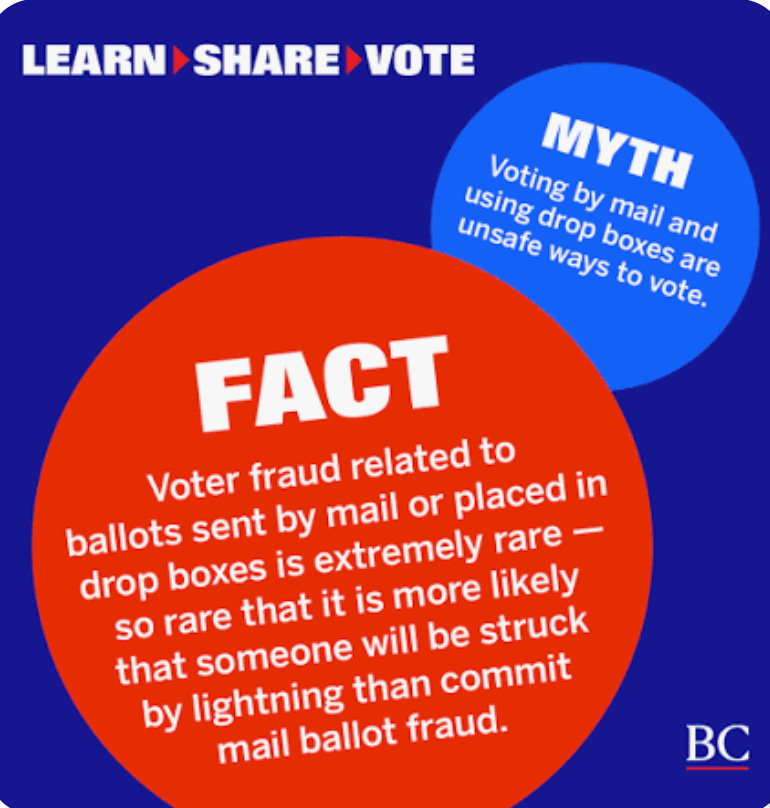
A person is more likely to be struck by lightning than commit mail-in voter fraud. This was the finding of a study by the Brennan Center for Justice. An earlier study described the rate of voter fraud as “infinitesimal.” While last year, the Brookings Institution released a study showing mail voting fraud is so rare that it accounts for “only 0.000043% of total mail ballots cast” or “about four cases out of every 10 million mail votes.”
Despite this, on March 31, President Trump signed Executive Order (E.O.) #14399 “Ensuring Citizenship Verification and Integrity in Federal Elections,” which imposes restrictions on mail-in balloting.
And this week, in a 6-3 unsigned opinion, the Supreme Court ruled that it was too soon to consider if the 23 state’s challenging the order had been harmed because the order itself hasn’t been carried out yet. As a result, they have not suffered the type of injury necessary to go forward with the their lawsuit.
With mail-in ballots going out next week, the three dissenters argued that the result would be “chaos” in the “November elections.” This is not the first time the Supreme Court has handed down a decision close to an election that could foment confusion at the ballot box, they did the same earlier this year when they ruled to strike down Section 2 of the Voting Rights Act.
As the BC, Brookings and almost every other study has shown, there is little if any evidence of fraud in mail in voting in the U.S. Moreover, voting by mail is so common that in 2024 30% of ballots were sent by mail. Among the 1/3 of Americans who vote by mail is President Trump, who requested a mail in ballot at the end of July and submitted it in the Florida primaries just over a week ago.
Since returning to office in 2025, Trump has been looking for ways to exert control over elections - this includes flirting with putting ICE Agents and national guardsmen/women at polling sites, mid-decade redistricting, threatening with withhold state funding to states that do not abide by certain Trump approved voting rules, gutting the Cybersecurity and Infrastructure Security Agency (CISA), dismantling the Office of the Director of National Intelligence’s (DNI) Foreign Malign Influence Center, sending the DNI to Georgia to oversee seizure of voting records, sowing seeds of doubt in election results, and more. The March EO, efforts to take control of the United States Postal Service (USPS) Board of Governors and force through rule changes that forbid the postal service from delivering ballots to anyone not on the approved voter list is just another in a long line of attempts by this president to take control of US elections.
For anyone who lived through January 6, there is no question what Trump is capable of doing when he loses an election. Nor is there any question that November is shaping up to be a bad election for him and his party, which looks increasingly likely to lose the House and potentially the Senate. If either of these things happen, Americans will once again be at the mercy of the Courts to stop Trump’s efforts to challenge the results - exactly as occurred in the months following the 2020 election and J6. This is why the way in which the Supreme Court handles rulings, such as the one regarding Trump’s EO on ‘voter integrity’ matters so much.
It is also why it is important that we state clearly that all the research shows fraud in mail-in balloting is extremely rare; voting by mail is safe; and any efforts to limit it are not aimed at curbing fraud, but rather designed to achieve another goal.