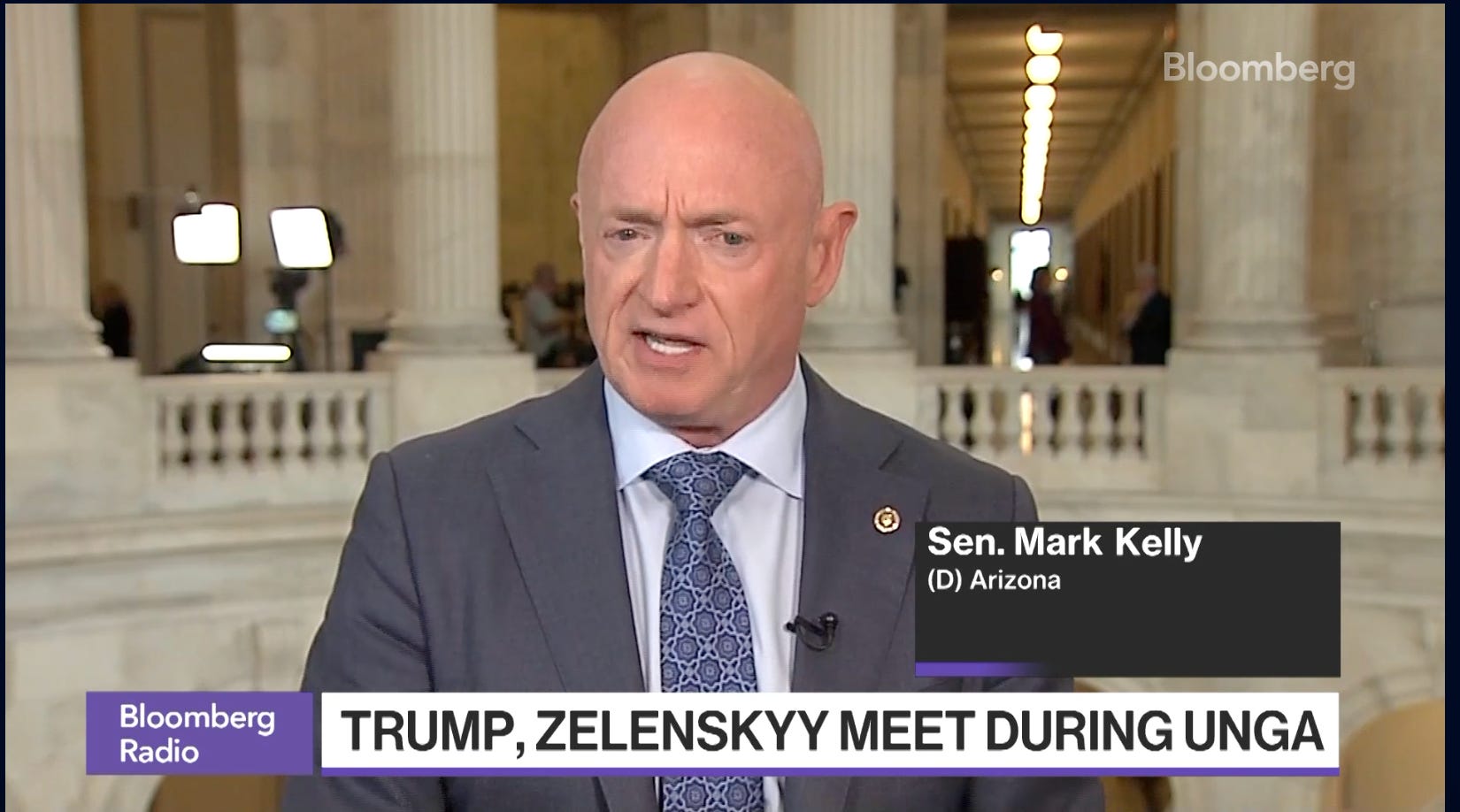
Yesterday, Senator Mark Kelly (D-AZ) spoke with Joe Mathieu and Kailey Leinz on Bloomberg’s “Balance of Power” about a bill he introduced to protect American workers at risk of being replaced by AI.
Speaking on the Senate floor about the “Make AI Work for Americans Act,” Kelly explained that the goal of the legislation is to ensure “workers aren’t left behind” and “Big Tech pays their fair share” by paying into a fund for workers displaced by AI. Specifically the bill calls for the establishment of an “AI Horizon Fund” financed by technology companies that are reaping the benefits of AI models. The fund would be used for training, transitioning and benefitting workers experiencing job loss and displacement due to automation.
“The alarms are sounding,” Kelly concluded. “The signals are clear. No one else is coming to the rescue. Mr. President, it has to be us.”
The data supports this, over the last few months Americans have increasingly sounded the alarm about AI and its potential impact on the labor force. In August, for instance, a Pew Research Center poll found that more than 7/10 Americans believe AI will result in fewer jobs in the U.S. - a double digit increase from 2024. Likewise, a NBC New poll earlier this month reported that 70% of Americans are concerned about AI taking jobs; concern is even greater amongst younger Americans, aged 18-29. Similarly, Gallup said the number of U.S. workers fearing new technology will make their jobs obsolete has increased to a historic 27%.
Kelly has yet to announce cosponsors for the bill, but it will be interesting to see whether he is able to cobble together a bipartisan set of cosponsors like he did last year when he worked with Senators Jim Banks (R-IN) and Todd Young (R-IN) on a bill entitled “Artificial Intelligence Data Authorization and Transparency Act (AI DATA).”
One group that Kelly reported have been supportive of his proposal are tech leaders and executives. In some ways, this may be surprising considering that the proposed legislation calls for additional taxes on their companies. On the other hand, for over ten years these same tech leaders have been sounding the alarm as it pertains to the impact of this new technology on jobs and several have supported calls for robust policies that address the displacement. Among the most popular ideas they have flirted with is Universal Basic Income (UBI). Among its earliest proponents going back several years are Dario Amodei, CEO Anthropic, Sam Altman, CEO Open AI, Marc Benioff, CEO Salesforce, Jack Dorsey, former CEO Twitter, Demis Hassabis, CEO Google DeepMind, Elon Musk, CEO xAI, SpaceX, Tesla, and Mark Zuckerberg, CEO Meta.
As Amodei noted not long ago:
“Some new and stranger thing will be needed, and that it’s something no one today has done a good job of envisioning. It could be as simple as a large universal basic income for everyone.”
Some, such as Altman, have called for and poured millions into studying UBI, only to “fall out of love” with the idea later on. Others, such as Hassabis, have continued to call for something ”like universal high income, or some way of distributing all the additional productivity that AI will produce in the economy.”
UBI is generally defined as “a cash transfer given to all members of a community on a recurrent basis regardless of income level and with no strings attached.” As Rebecca Hasdell notes, most versions of this increasingly popular policy share four characteristics, the programs are (a) Universal (paid to every one regardless of need) (b) Unconditional (involve no set conditions) (c) Periodic (as opposed to a one-off grant) and involve (d) Cash payments to an individual (versus a household).
By comparison, Kelly’s ‘fund’ proposal is much skinnier, more limited and arguably manageable. Instead of a periodic, universal and unconditional cash transfer - he is calling on those ‘winning’ the AI race to help fund those being left or pushed out.
These are not the only proposals of this kind and while still a long way off, they are welcome if only because they underscore how far we have come on this issue. It was just a decade ago that a colleague and I published an article in which we called on the government and elected officials to “help American workers prepare for a future in which the labor force is going to be forever changed by accelerating technological developments.” At the time, almost no candidates were talking about what they would do to assist workers in danger of losing jobs to automation; instead they continued to promise to return jobs to the U.S. and bring about a “manufacturing renaissance.”
The New Realist is a reader-supported publication. To receive new posts and support my work, consider becoming a free or paid subscriber.