I am including a couple of clips from over the last several days of interviews on Bloomberg regarding the U.S. intervention into Venezuela, along with a few key points below.
First, There is no legal or constitutional justification for the Trump administration’s actions in Venezuela. They are forbidden by the U.S. Constitution, law, the U.N. Charter (to which we are a party) and international law.
Under Article I section 8 clause 11 and Article II sections II of the Constitution, only Congress can declare war and, in the case of Venezuela, Congress was not informed in advance, nor did it consent. This was not a law enforcement operation; it was an invasion of a sovereign nation to seize its head of state and take control of its assets. That is an “act of war” that requires prior congressional approval.
Also, under the Constitution and laws of the U.S., any treaty the US signs are obligations of national law. The US ratified the UN Charter in 1945 and Article II, section 4 of that document is clear – countries must not use “the threat or use of force against the territorial integrity or political independence of any State.”
Likewise, this was a violation of one of the first and most important principles of international law which requires that all countries respect their neighbors borders and sovereignty.
Second, none of the above will matter in the short term, however, unless Congress reasserts its constitutional authority as a co-equal branch of government and holds the president and the administration accountable for its actions in Venezuela.
That is unlikely, at least in the short term, for several reasons, including:
* The Track Record of the 119th: As Carl Hulse writes, “during the first year of the second Trump administration... Republican leaders in both chambers largely declined to check a president unconstrained by law or custom.” There are no signs that as they return to Washington in the new year that this has changed.
* Statements by Republican Leaders: On the question of the whether the President needed prior authorization from Congress to go into Venezuela over the weekend, Mike Johnson (R), Speaker of the House, said “This is an operation that did not require prior consent of Congress [or] prior authorization of Congress.” Likewise, Senate Majority Leader John Thune (R): “I was comfortable with the notification I had. They didn’t tell me ahead of time, but I think there’s a reason why, like I said before, notification of Congress in the hands of really critical and hypersensitive missions to me, seems ill-advised anyway.”
Third, what can change this trajectory? In the short term, only one thing – Trump voters. Particularly those from red states and districts. These voters would need to contact their members and make clear that they do not support the administrations actions in Venezuela. That they voted for Trump based on his promise to focus on the U.S., to Make America Great Again, to address the economy, the cost of healthcare and groceries, affordability, technological advancements that are threatening our jobs, and the like - not to take over and run another country. They agreed with him when he called out President George W. Bush for getting the nation involved in the War in Iraq. They believed him when he said over three election cycles that he was “not going to start... [but] stop wars.”
In the absence of that, Congress will continue to do what it has been doing since Trump re-entered office in 2025, accept his exertions of Executive Authority without question or pushback.
At least until the midterms and, only in that case, if enough voters decide that they want to elect members of Congress who are willing to check Trump.
Fourth, timing matters. The midterm is not until November and the 120th Congress will not be sworn in until early January 2027.
In the interim, the president and top administration officials have made it clear that the U.S. takeover of Venezuela is not an anomaly and indeed may just be the first of many.
Here’s what the President said about other countries in the administration’s crosshairs in the last few days:
Colombia: “Colombia is very sick, too. Run by a sick man who likes making cocaine and selling it to the United States, and he’s [Colombian President Gustavo Petro] not going to be doing it very long.”
Mexico: “You have to do something with Mexico... We’re going to have to do something. We’d love Mexico to do it, they’re capable of doing it, but unfortunately the cartels are very strong in Mexico.”
Cuba: “Cuba is ready to fall. Cuba looks like it’s ready to fall. I don’t know if they’re going to hold out.”
Greenland: “We need Greenland, from the standpoint of national security.”
Iran: “If they start killing people [protestors] like they have in the past, I thinkthey’re going to get hit very hard by the United States.”
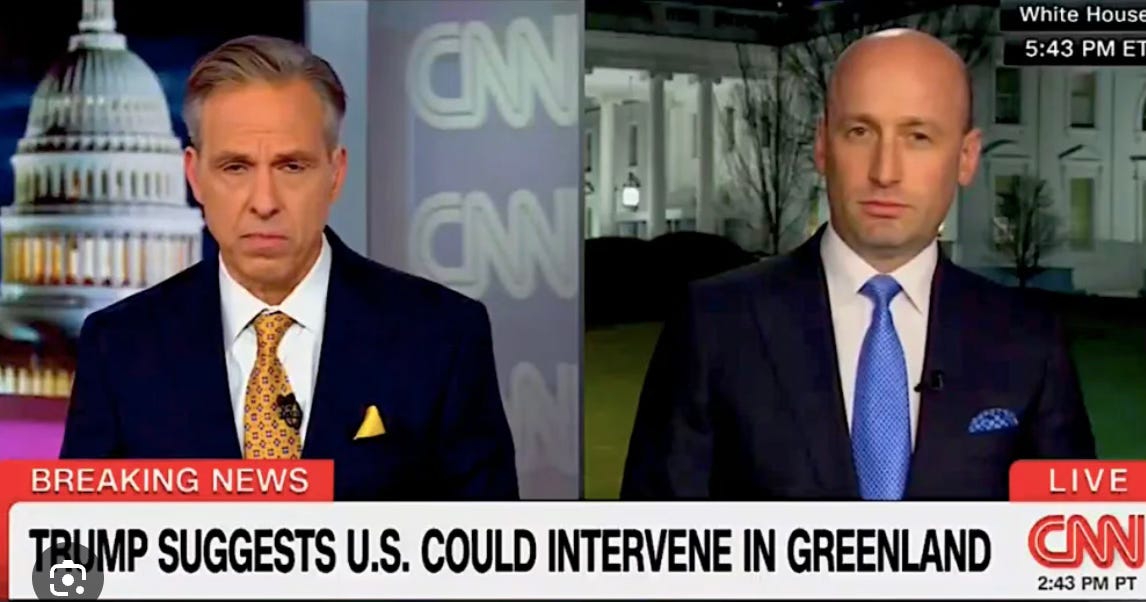
More ominous, his top aide Stephen Miller, who told CNN’s Jake Tapper on Monday night that Greenland rightfully belonged to the US and that the Trump administration could seize the territory if it wanted.
“Nobody’s going to fight the United States militarily over the future of Greenland...We live in a world, in the real world... that is governed by strength, that is governed by force, that is governed by power. These are the iron laws of the world since the beginning of time.”
This followed a post by his wife, Katie Miller, who in the hours after the U.S. went into Venezuela posted an altered image of the Danish territory on her X feed along with a single word: “SOON”.