Many members of the GOP are breathing a sigh of relief, high-fiving each other behind the scenes and quietly thanking the Supreme Court for doing something they couldn’t, stopping the president from pursuing a wildly unpopular tariff agenda.
Despite Trump’s decades long commitment to tariffs, his repeated declarations of ‘tariffs’ as his “favorite word” and his tendency to rely on them as a tool in economic and foreign policy, they remain unpopular with most of the American public. A recent New York Times/Siena poll showed that a majority of Americans and 58% of independent voters oppose his tariffs. Likewise, a Fox News survey in late January found more than 6/10 registered voters disapprove of Trump’s handling of tariffs, making trade one of his weakest issues.
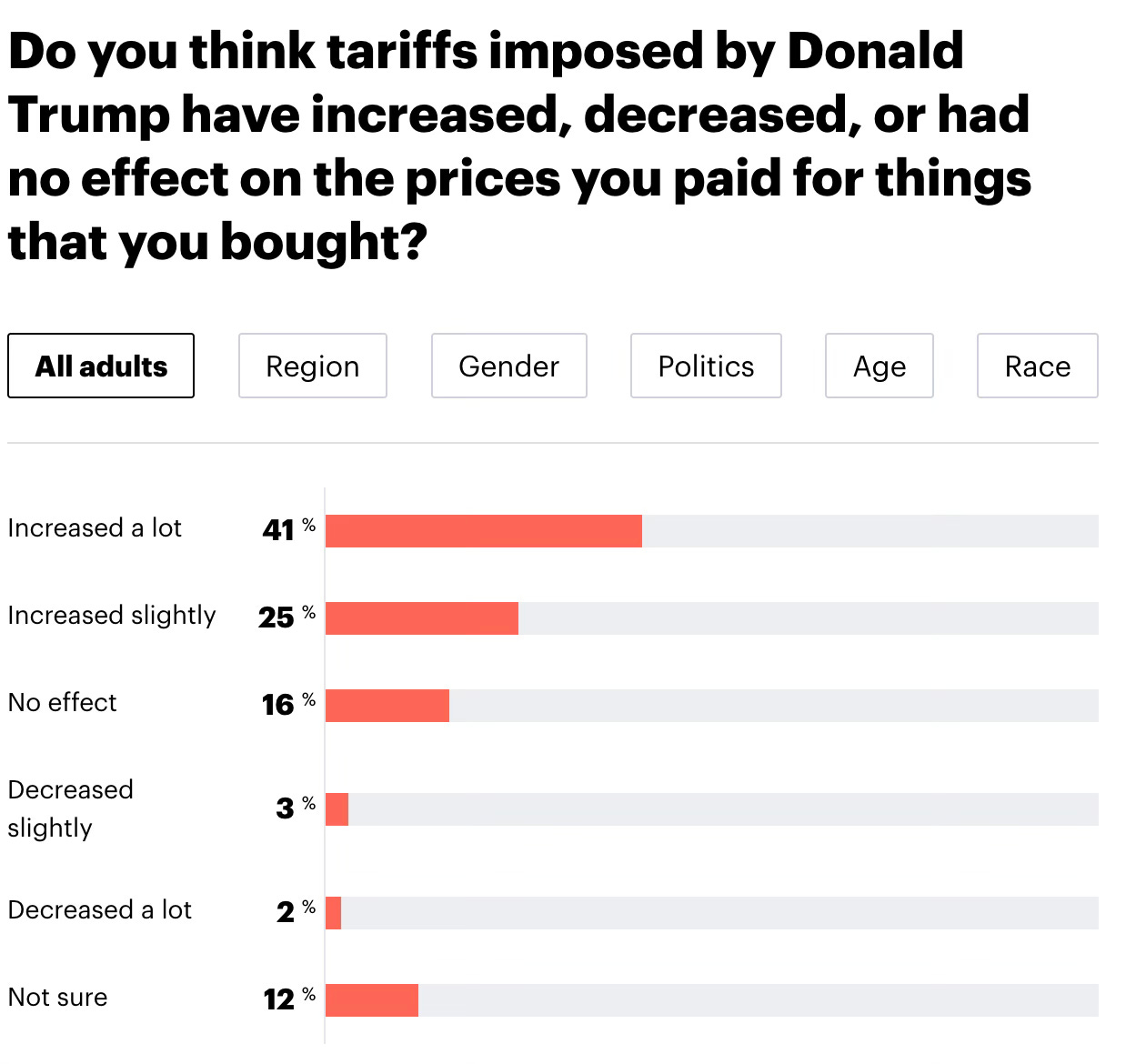
In an April 2025 survey, 76% of Americans said they believe tariffs will increase costs. In the wake of the Court’s Friday decision, a YouGov poll found that a majority of Americans strongly or somewhat approve of the ruling (60%). The same poll found this is because 66% of respondents believe that Trump’s tariffs have increased prices by a lot or slightly; by contrast, only 5% of Americans said Trump’s tariffs have lowered prices.
This is why in the wake of the ruling, a small but vocal group of Congressional Republicans praised the decision, including Sen’s. Mitch McConnell (KY), Chuck Grassley (IA), Rand Paul (KY), Jon Curtis (UT), Susan Collins (ME), as well as Rep’s Mike Turner (OH) and Kevin Kiley (CA). While others, particularly those from swing states and districts have not made public statements, they are quietly relieved because unlike the President, who went to Georgia the day before the ruling and said that he had “solved” the affordability crisis and that “tariffs” have played a major role in helping him do that, they know this sentiment is not shared by most of their constituents.
Except for those at the top of this K-shaped economy, most Americans are feeling the pinch, struggling to pay insurance, health care, child care, for groceries, gas, everyday goods and the like. We know this because despite what the president has said, according to the latest RealCearPolitics average of polls, he is 15 points under water on his handling of the economy - with 56% of Americans disapproving and just 40% approving. Numbers like these don’t bode well for Republicans on the ballot in November and they know it.
As a result, they are hoping to put as much distance between themselves, their party, and tariffs as they can. Nevertheless, the President seems determined not to allow that to happen. Just hours after the Court issued its finding in Learning Resources, Inc. v. Trump stating that the president’s use the International Emergency Economic Powers Act (IEEPA) to impose sweeping global tariffs was unconstitutional, Trump announced he would instead use Section 122 of the Trade Act of 1974 to impose new tariffs.
Initially, the President said he would raise tariffs 10% but this morning he took to Truth Social to announce he is raising this to 15%
These tariffs are set to take effect on 12:01 am Tuesday, February 24, the same day Trump is going to Congress to deliver his State of the Union address. Under the statute, these tariffs are limited to 150 days unless Congress votes to extend them. Given the political environment that seems unlikely, but it does set up quite an interesting tableau on Tuesday night.
The New Realist is a reader-supported publication. To receive new posts and support my work, consider becoming a free or paid subscriber.