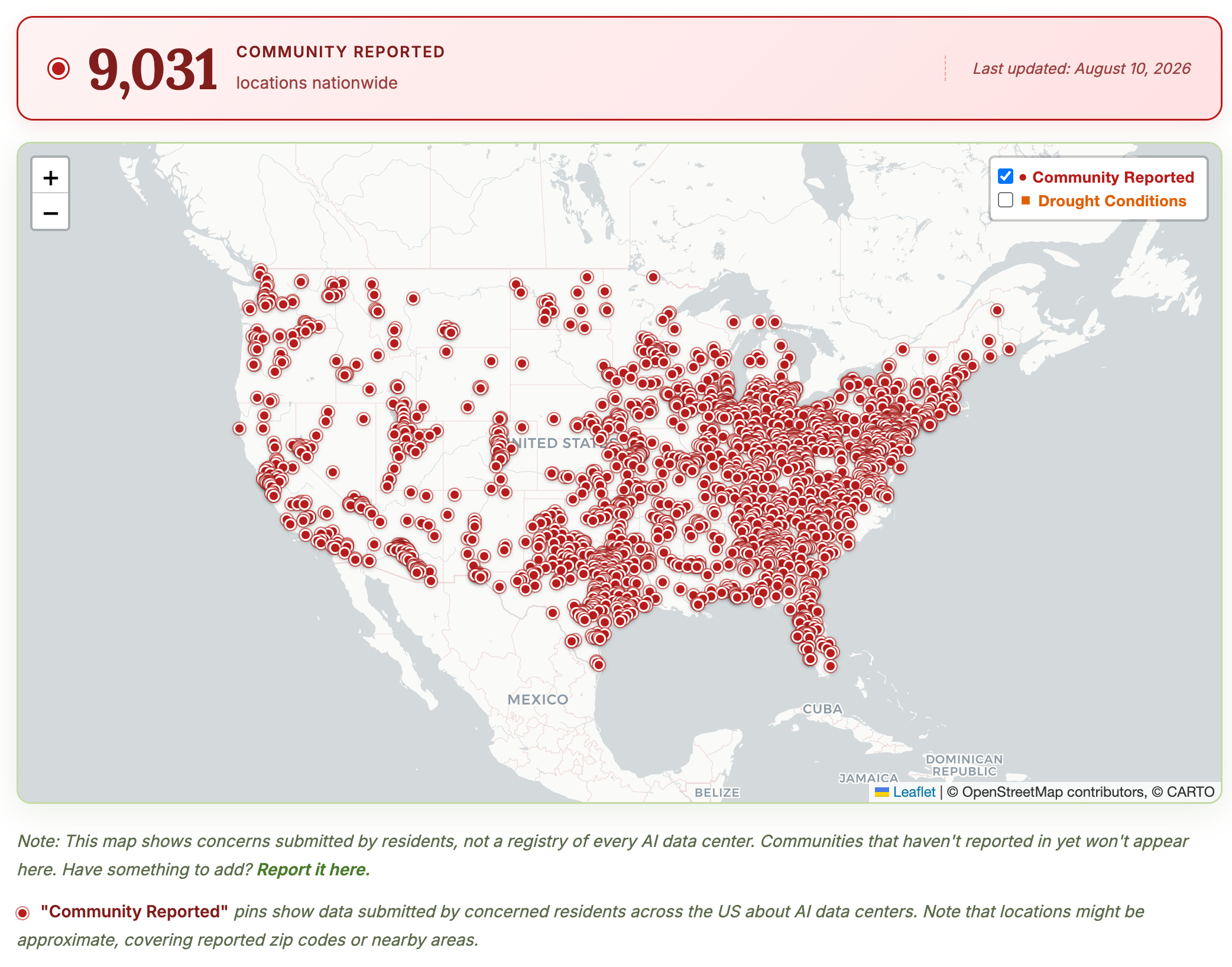
The map below is c/o Erin Brockovich’s AI Data Center Reporting web site. It displays the more than 9,000 locations across the country where people have emailed to express concern about data centers in their communities.
We discussed the wide-ranging politics of AI data centers on Bloomberg today. It is an issue that has quickly become one of the most concerning to people across the country, regardless of party.
This is in part because it is a proxy for anger people feel about the disruptive role of technology, tech companies, and tech titans in our lives. But that is only part of the story. Other parts are reflected in the talking points I put together in advance of this conversation and which I hope provide additional context about this issue.
* How does the public feel? A recent Gallup poll found 71% of Americans oppose constructing AI data centers in their local areas. As Gallup notes, of those 71% “nearly half, 48%, who are strongly opposed…. these results, from a March 2-18 Gallup survey, represent the first time Gallup has asked about data center construction, a topic that has met fierce opposition from local residents in many parts of the country.”
* What is driving opposition? Opposition to data centers is driven by an enormous number of factors, including concern they may be a massive drain on local resources from water and energy to the electrical grid, that they could result in rising electricity bills, create environmental and noise pollution, and diminish the quality of lives for people in the local area, among many other factors
* How much has been invested in building and by who? The 5 largest “hyperscalers” driving cloud and AI infrastructure are Amazon, Microsoft, Google, Meta, and Oracle; from 2025 to this year they are on track to spend approximately $1T on AI infrastructure
* Case 1 - The Stratos Project: There have been several cases of communities rising up recently to oppose construction. Here is but one of many examples - this one in opposition to the construction of a data center on the shores of the Great Salt Lake in Utah. Here is an excerpt from one report published about the Stratos Project that appeared in Truthhoutin late May.
“Plans for a celebrity-backed “hyperscale” data center in rural Utah, so massive that it would consume more than double the state’s current electricity use, have generated an intense public and political backlash…
The project, brought by “Shark Tank” TV personality Kevin O’Leary, would span 40,000 acres, demand 9 gigawatts of power once completed, and raise the state’s carbon emissions by 64 percent, according to estimates.
… News of the proposed data complex, dubbed the Stratos Project, became public in April after the three commissioners of Box Elder County, the mostly agricultural community that would host it, approved the project. They pointed to the project’s approval by more powerful state agencies and asserted that stopping it was out of their hands, while refusing to hear comments from more than 1,000 people who showed up to share their concerns. Utah Governor Spencer Cox, a Republican, has since walked back some of his full-throated support.”
* Case 2 - Meta’s Hyperion: Another case that has drawn widespread attention is Meta’s $50B Hyperion AI data center in Richland Parish Louisiana. As reported in the New York Times, that deal was characterized by a lack of transparency, Nondisclosure agreements (NDAs) that were signed with 77% of state senators, massive tax breaks, power and grid agreements, and so forth. This is not unique to this case. Across the country citizens have been largely left out of the process, much of which has been conducted quietly, in secret, and behind closed doors.
* Where is the Trump administration on this? In July 2025, President Trump signed Executive Order (EO) 14318 titled “Accelerating Federal Permitting of Data Center Infrastructure.” At the same time, the U.S. Department of Energy (DOE) announced it was opening federal lands to build large AI data centers. And just a few weeks ago, the DOE said it would redevelop parts of a Cold War-era uranium enrichment facility in Paducah, Ky., to host a large new A.I. data center campus.
* What is the response at the state and local level? In mid-July, NY Governor Kathy Hochul enacted the nation’s first statewide one-year moratorium on new hyperscale data centers. Less than a month later, Texas followed suit. At the local level, some reports are that there are now more than500 data center bans in towns and counties across the US. As Tech Brew reports, “the bans have been growing exponentially—the number jumped from 300 in late June to over 500 in July.”
The New Realist is a reader-supported publication. To receive new posts and support my work, consider becoming a free or paid subscriber.