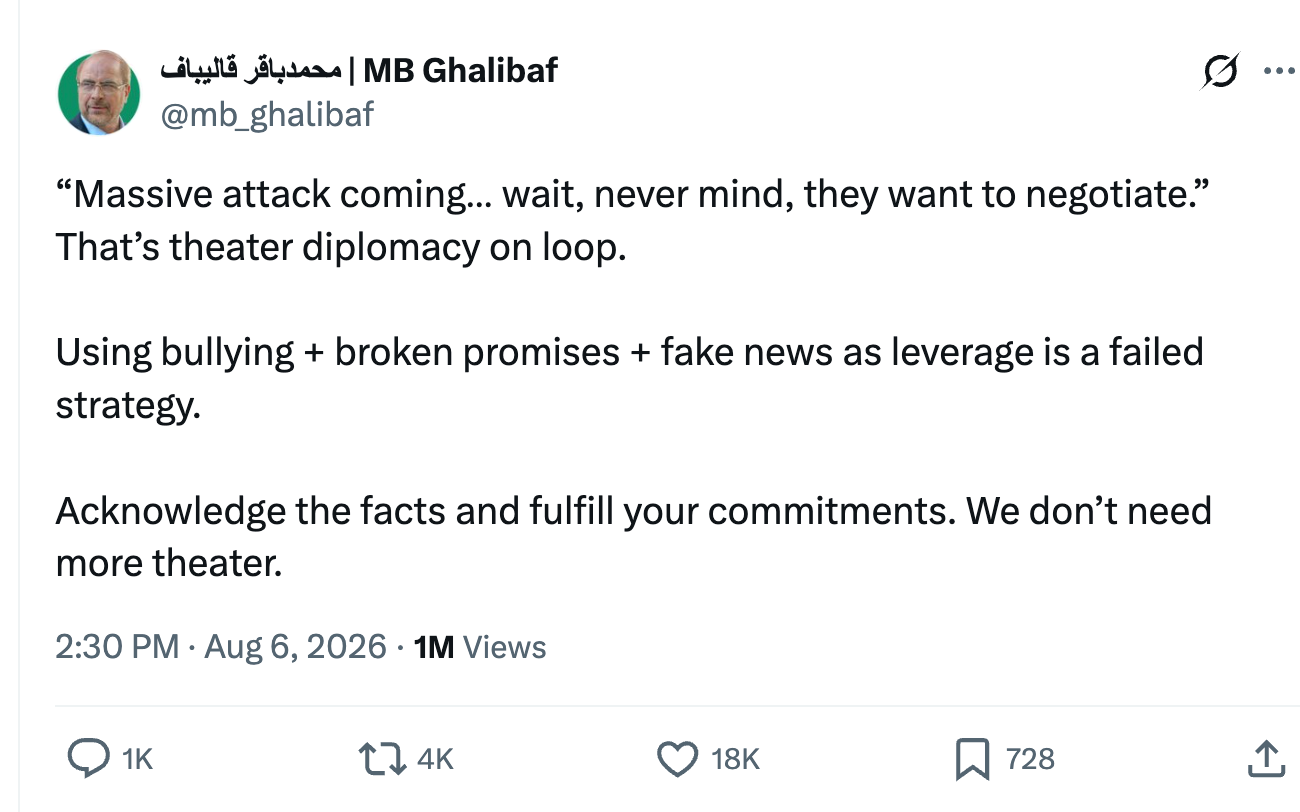
Iran’s parliament speaker and chief negotiator, Mohammad Bagher Ghalibaf went on X yesterday to accuse President Trump of “theater diplomacy.”
Ghalibaf’s post came not long after Trump once again called off strikes, arguing that “the perimeters of a deal” had already been agreed to; something there is no evidence of and something that Tehran continues to push back on.
As of early June, CNN reported that Trump had said we were close to a deal at least 38 times - as of today the number is now closer to 45. The most recent time was yesterday when he said the war “is going very well!” and will end “pretty soon.”
For all the president’s statements about a ‘deal,’ the only negotiations that seem to be moving forward are between Iran and Oman. The two countries have, by some accounts, reached a preliminary deal to partially re-open the Strait of Hormuz. This would seem to be welcome news, but we have few details and the US stance on the agreement, our involvement in the negotiations, and so forth remain painfully unclear. Whatever the deal entails, there is no question Iran will come out of it stronger than they were before the war when the Strait operated as an open, international waterway. Most reports suggest that at the very least, the deal will leave Iran with much more control of Hormuz than it had prior to late February.
Trump’s continued threats to ‘bomb’ Iran into submission are also falling flat because numerous reports show that we have a munitions shortage, particularly when it comes to precision and defensive weapons. A shortage the president has not only denied but responded to by accusing the journalists who have reported it of committing ‘treason.’ This munitions shortage, confirmed by many sources, is another in a long line of reasons Tehran is empowered. If the U.S. follows through with Trump’s threats to escalate the war, Iran will strike back and with a shortage of defensive weapons we will be left unable to defend ourselves, our service members, our allies and our interests in the region. We could escalate using dumber weapons but that would entail our military aircraft and service members getting closer to Iran and increase the possibility of a ground war, something there is little appetite for in the U.S. and something that we have little prospect of winning against a nation of 93m people that is three time larger than Iraq.
Our best bet now is to accept the Omani/Iranian deal as the best of several bad options, give Iran some sanctions relief if necessary, get the Strait reopened as far as possible, and get the oil and other goods flowing. In the meantime, the focus should be investing in other means to move oil and goods that leave us less dependent on the Strait and serious nuclear talks with Iran; in addition to addressing our munitions shortage, as well as our frayed alliances around the world.
With the Iran War, Trump has gotten himself into a quagmire of precisely the kind he said he abhorred and would avoid. Trump spoke in the past about the need to end the war to avoid “economic catastrophe” - that remains true. He also needs to end the war to avoid weakening the U.S. on the world stage any further.