In 1996 Congress passed, and President Bill Clinton signed into law, the Line Item Veto Act. The act, which passed with bipartisan support, codified the power of the president to strip pork and wasteful spending from legislation passed by congress.
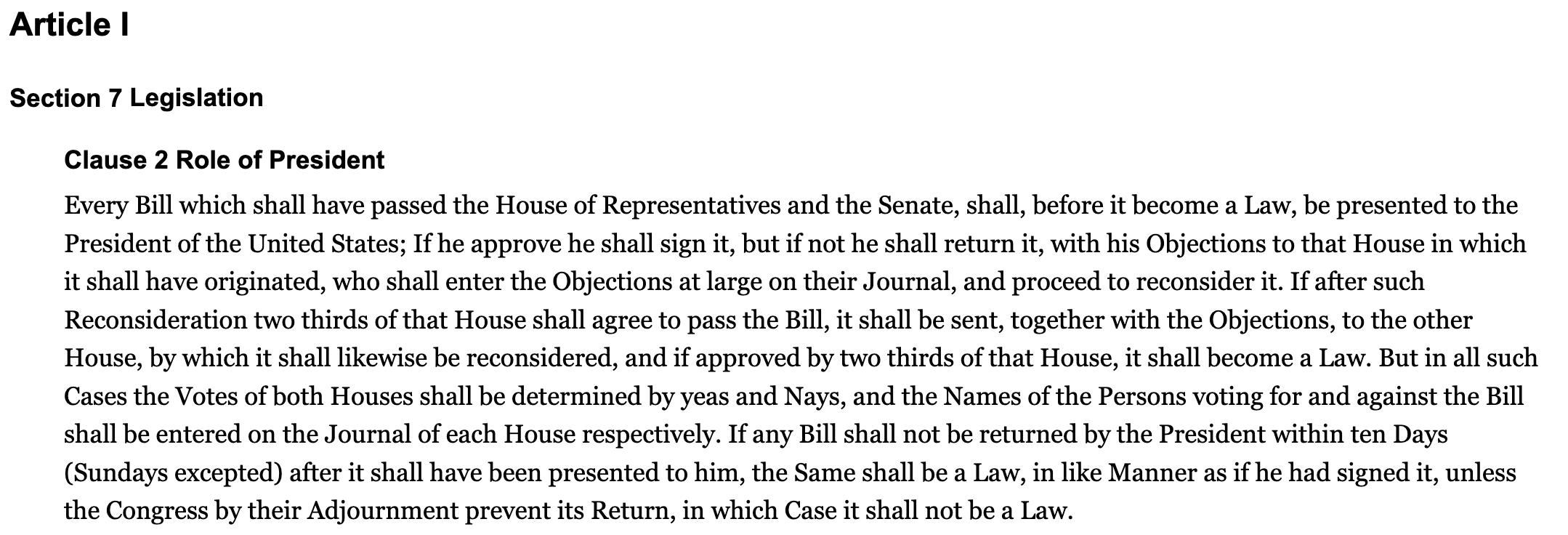
Two years later, in Clinton v City of New York, the Supreme Court ruled 6-3 the act was unconstitutional because it violated the Presentment Clause found in Article I , Section 7 of the Constitution. The Court interpreted the clause to give the president the power to approve or reject a bill passed by Congress, not the ability to amend it by ‘crossing out’ certain portions, before signing the rest into law. As a result, the Court ruled the act was a violation of separation of powers.
Today, following former Senator Lindsey Graham’s funeral, Ukrainian President Volodymyr Zelensky will meet with Senators on Capitol Hill to advocate for a bill the Senator favored that gives the president the power to impose tougher sanctions on Russia. The bill, which has been renamed the ‘Lindsey O. Graham Sanctioning Russia and Iran Act of 2026,’ has 62 co-sponsors, 22 of whom are Democrats, and is expected to pass by a wide-margin.
The bill is not, however, without controversy. Among Democrats who oppose it, one of the primary concerns is that the bill is a Trojan Horse. For a time, Trump resisted Graham’s pressure to introduce secondary sanctions on those countries who purchase Russian oil and gas. Graham, and the bills supporters, were able to sweeten the deal by insuring the language in the bill allows the president expansive tariff authority.
As Rep. Gregory Meeks (D-N.Y.), noted, the bill is so broad and vague that the president may be able to abuse it and potentially increase tariffs on other partners and allies. Likewise, Sen. Ron Wyden (D-Oreg.) and Rep. Richard Neal (D-Mass.) wrote that “it is extremely dangerous to give Trump massive new tariff powers, particularly after we’ve seen the disastrous impacts of his corrupt, chaotic, and inflationary tariff spree.”
There are other valid concerns about the legislation, including the fact the bill is unprecedented to the extent it marks the first time Congress has authorized the use of tariffs as a geopolitical weapon to punish secondary countries (India, China, etc.) rather than as a means to address trade issues.
In the 1990s, Congress tried to cede a substantial part of their power to legislate to the president. If the Court hadn’t intervened , the president would likely retain this power.
If Congress today outsources a substantial part of its responsibility for trade and tariffs to the president, it is not clear the Court will intervene in the same way. They may, after all, not long ago they curbed his power to impose tariffs in Learning Resources, Inc. v. Trump. This 6-3 decision, however, should be a reminder to lawmakers about how critical it is that legislation is carefully written and tailored to insure that in trying to support Ukraine, and in remembrance of a colleague, they do not end up stoking a more significant constitutional crisis.
Thanks for reading The New Realist! This post is public so feel free to share it.