Just as President Trump's temporary 10% tariffs expired at 12:01 a.m. today, they were replaced with new 10-12.5% duties. The new round of tariffs were imposed on more than 59 countries, plus the 27 nations that make up the European Union [EU]. Trump did this under Section 301 of the Trade Act of 1947, citing concerns about forced labor.
In reporting the news today, most outlets accurately noted that far from having real concerns about forced labor, this was in fact a “work-around” drummed up by the White House; a “sham” effort to end-run around the Supreme Court (which stripped him of his broad tariff authority earlier this year) and Congress (which under has the sole power to tax under Article I).
So far, the administration has not produced evidence of force labor practices in these nations, many of which are sensitive to these types of issues.
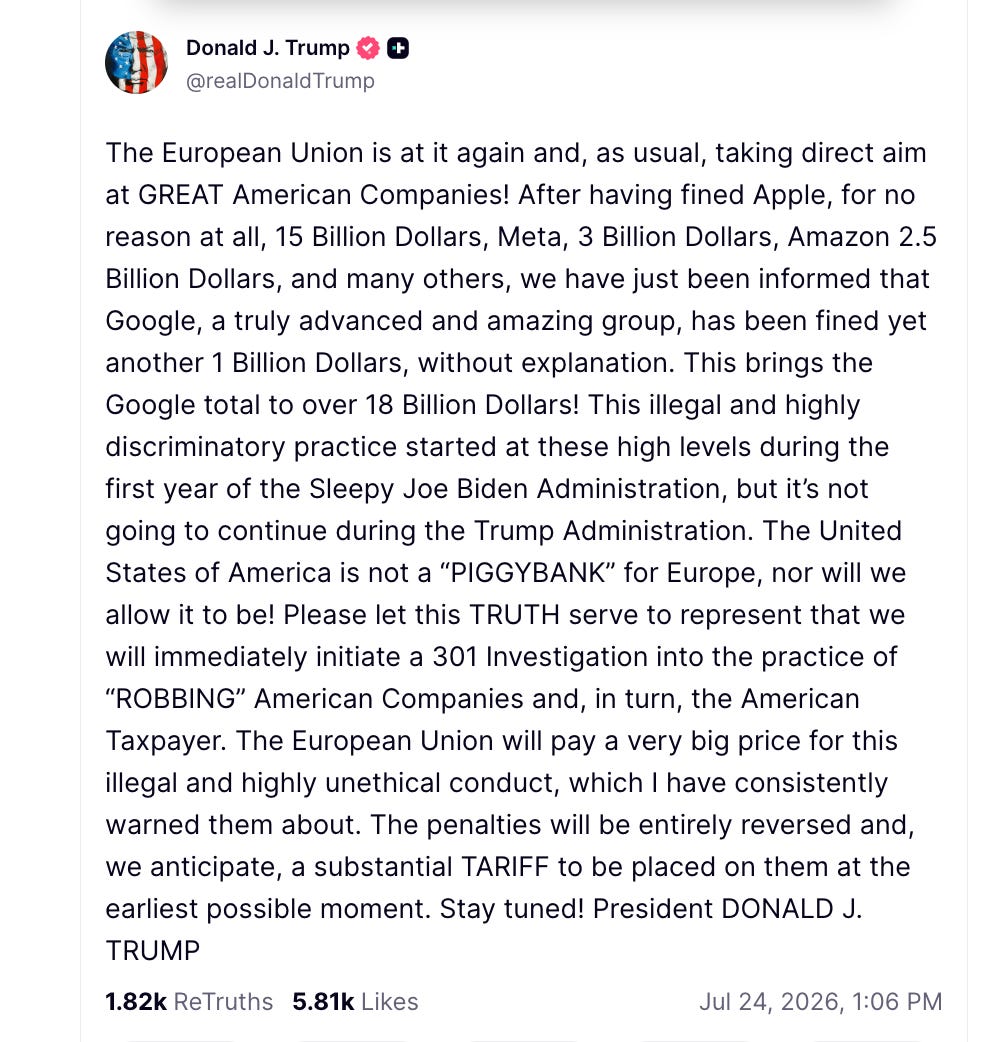
Just hours after the tariffs went into effect, Trump took to Truth Social and proposed another reason for imposing tariffs on the EU countries. Instead of focusing on forced labor, he announced a Section 301 investigation into the fines the EU imposed on U.S. tech-companies such as Apple, Meta, Amazon, Google. He argued that if they are not reversed, “substantial tariffs” will be placed on EU countries as soon as possible.
The fines he is referencing were imposed by the European Commission which is the primary antitrust enforcer of the EU. The penalties were levied under EU antirust rules and the Digital Markets Act (DMA). Google, for instance, was fined for favoring its own services over competitors in search results and the Google Play store.
Section 301 allows the U.S. to investigate unfair or discriminatory foreign trade practices and apply tariffs if they are evidenced. The fines Trump is referencing regarding these companies have nothing to do with unfair trade practices, they have to do with anti-trust.
In the meantime, we are still waiting to see evidence of forced labor in the supply chains of the almost 80 countries (including the EU) tariffed early this morning.
Anytime we talk about tariffs it is important to underscore that they are not paid by the countries in question, they are taxes imposed on Americans. Moreover, they are taxes Americans will be forced to pay at a time when large majorities are already frustrated by the higher cost of everything from gas to groceries.
The New Realist is a reader-supported publication. To receive new posts and support my work, consider becoming a free or paid subscriber.