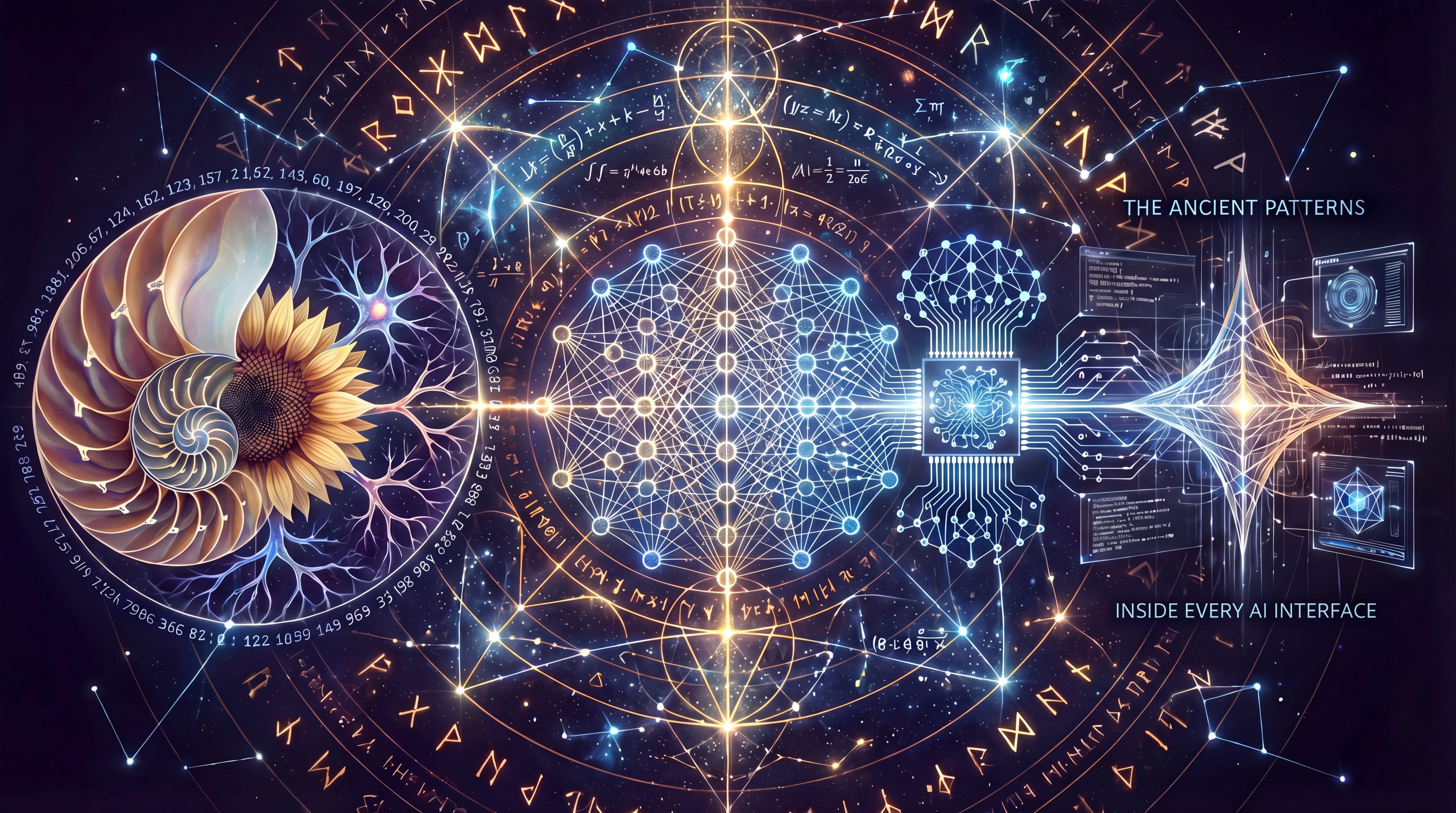
Let’s set the stage with a concept. We’ll call it the why chase. The why chase is the idea that if you chase any “why” deep enough - in science, task orientation, or simple childlike wonder - something strange happens. You not only drive your parents and teachers insane, but eventually, you leave the physical world behind entirely.
This observation is not new. Pythagoras noticed the concept of the why chase twenty-five centuries ago, though of course he termed it differently. In 1960, the physicist Eugene Wigner published a paper on the why chase, a paper with a title that still haunts the discipline to this very day: “The Unreasonable Effectiveness of Mathematics in the Natural Sciences”. His question was simple, but devastating: Why does mathematics - an abstract, non-physical system of truths - describe the physical world with such extraordinary precision? Why does reality obey rules it did not author? Wigner himself had no satisfying answer. His intent was simply to ask the question. He was chasing the “why”. We’re still chasing it today.
Roger Penrose, one of the most accomplished mathematical physicists alive, pushes the why chase even further. He proposes that reality operates across three irreducible worlds - the physical, the mental, and the mathematical - each somehow giving rise to the next in a cycle no one can fully explain. The physical world produces minds. Minds access mathematics. And mathematics governs the physical world. The loop closes, but the explanation does not.
Far from being fringe ideas, these principles sit at the foundation of modern physics. And while their implications for how we think about human intelligence are a matter of consistent study - we seem to be actively avoiding their application to any other type of mind.
The structure that physics did not create
Here is what Wigner’s question, and the why chase in general, looks like when you chase it through actual science.
Cicadas emerge on cycles of thirteen and seventeen years. Ask a biologist why, and the answer involves predator avoidance - prime-numbered cycles minimize overlap with predator reproductive schedules. Ask why thirteen and seventeen specifically, and the answer is: Because they are prime. Ask why the distribution of prime numbers is what it is, and you have left biology entirely. You are in the mathematics department, and no biological process can change what you find there.
This example comes from biologist and computer scientist Dr. Michael Levin, who has spent decades in the why chase, tracing the chain of “why” through biology until it breaks through the floor into mathematics. His observation applies across every science. Ask a physicist why particles behave as they do - why certain forces exist, why certain symmetries hold - and the chain of explanation terminates in mathematical structures. Every. Single. Time.
Groups, symmetries, constants. These mathematical facts constrain the physical world with absolute authority. The value of Euler’s number. The ratio of fundamental forces. The distribution of primes. Every one of these truths shapes physical reality, and not one of them can be changed by anything we do in physical reality.
Dr. Levin observes that if you swap out every physical constant at the Big Bang, and rearrange the initial conditions however you like, you will not change the value of e. You will not alter the distribution of prime numbers. These truths are not products of physics. Rather, physics is a product of them.
This deserves more weight than it usually receives. We humans are accustomed to only pursuing the why chase just far enough until we can live our lives, and then we ignore the rest. But with the advent of AI, further pursuit of “why” is very likely the most important thing we can be doing right now.
I’ll use another example from Dr. Levin, the master of “why”, to explain why (see what I did there?): Even in Newton’s entirely classical, pre-quantum universe - long before anyone invoked consciousness, complexity, or information theory to explain away the mysterious - the physical world was already governed by truths originating beyond the physical world. Strictly materialist worldviews were incomplete before quantum mechanics arrived, before neuroscience developed, before anyone ever asked whether AI could think. The foundation was always insufficient. Pure physicalism never had the explanatory range its adherents claimed, because the physical world has always been shaped by a layer of structure it did not generate and cannot reach.
The physical world has always been haunted by structure it did not create. Yet that shaky foundation is, and always has been, the most basic operational reality that every working physicist relies on. Comfort with the uncomfortable, in true human fashion.
What biology inherits without earning
Biology exploits this haunting with extraordinary efficiency. Wherever evolution builds a structure complex enough to intersect with mathematical truth, capabilities appear that were never selected for, never evolved, and never paid for computationally. Dr. Levin calls these “free lunches”. The evidence for this is everywhere, and it comes from multiple independent research programs.
The Fibonacci sequence - 1, 1, 2, 3, 5, 8, 13, 21 - appears in the spiral arrangement of sunflower seeds, the branching of trees, the geometry of pinecones and nautilus shells. No gene codes for the Fibonacci sequence. Evolution did not select for it. Biology simply built growth systems complex enough to intersect with a mathematical truth that was already there, and the pattern expressed itself. In 1952, Alan Turing - better known for cracking the Enigma code and founding computer science - published a paper showing that simple chemical reactions following mathematical rules could produce the stripes on a zebra, the spots on a leopard, the branching patterns of coral. Again: the patterns were not in the genes. They were in the mathematics the genes accessed.
Levin’s research pushes this principle into territory that challenges how we think about biological capability itself. He offers a thought experiment that illuminates the core insight: Imagine evolution optimizing for a particular triangular shape. Thousands of generations to fix the first angle. Thousands more for the second. But then the third angle simply arrives. in Euclidean geometry the three angles must sum to 180 degrees, so once two are fixed, the third is determined - completely for free. It is handed it over as a mathematical necessity, without any additional evolutionary cost. Biology earned two things and received the third as an inheritance from structure it did not create. Levin theorizes that some aspects of biological form and behavior are inherited from the structure of math/physics itself, rather than painstakingly encoded or evolved one detail at a time.
This concept extends to computation itself. When evolution produced a voltage-gated ion channel - a molecular structure that functions as a biological switch, performing the same role as a transistor in an electronic circuit - all of Boolean logic came with it. Every truth table, every logical operation, the computational universality that makes all digital technology possible. None of this was evolved. None of it was selected for. Biology built a switch. The entire architecture of computation was already waiting in the mathematical structure the switch accessed.
Levin’s laboratory has demonstrated this principle with remarkable directness. His team has shown that when cells from one organism are placed in a new context - a different environment, outside their original biological role - they exhibit structured, repeatable behaviors that those cells have never performed in their entire evolutionary history. Specific capabilities with defined boundaries, not random noise. The organism’s evolutionary lineage never encountered these contexts. Selection never optimized for these outcomes. Yet the behaviors are consiste…