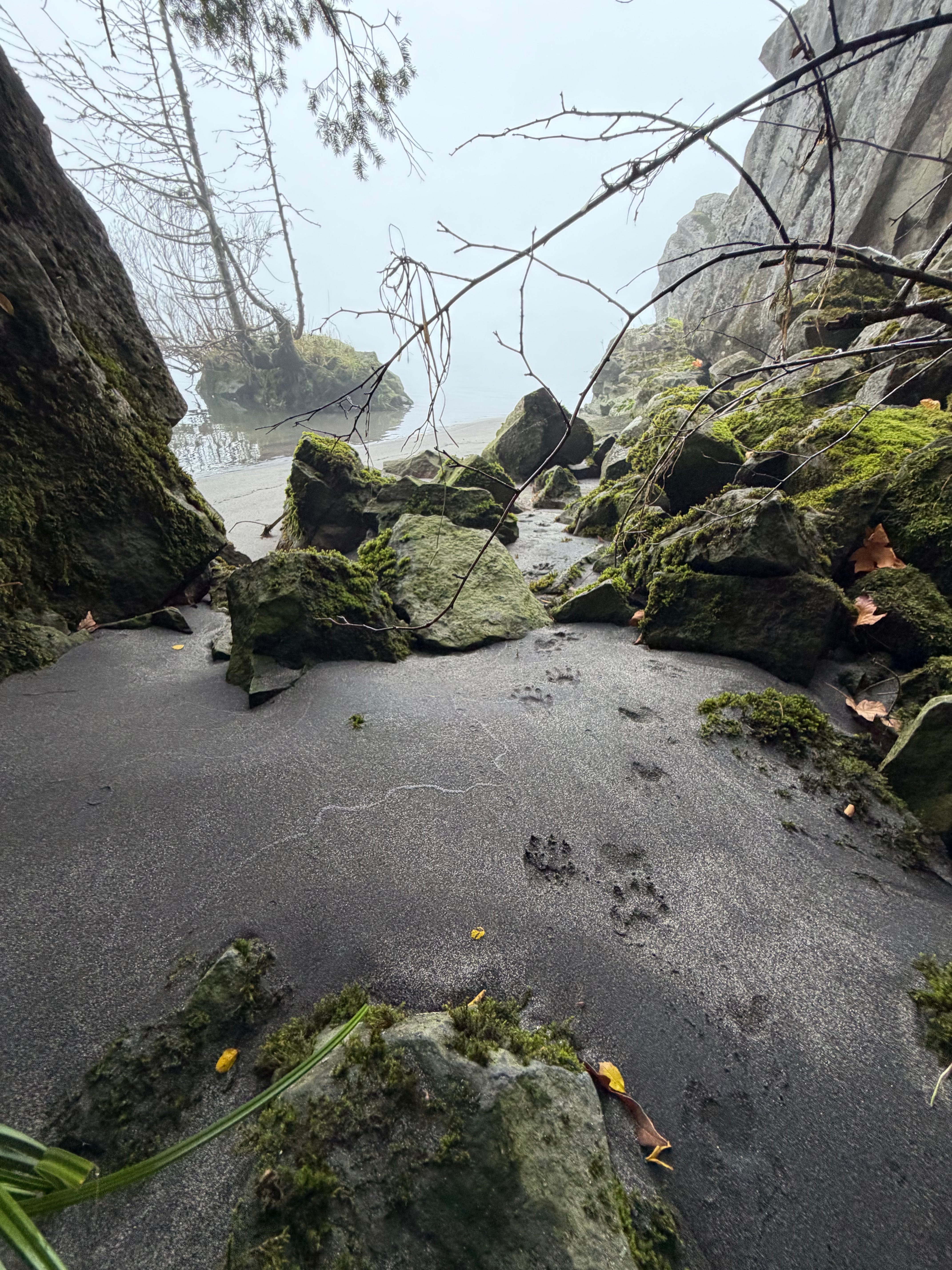
Recently I found myself taking a misty walk at dawn along the Columbia River (Wimahl in Chinook, Nchʼi-Wàna in Yakama), the second largest river in the contiguous United States — and one of the most industrialized rivers in the world.
Join me on this walk, where I discuss the ecological problems facing the Columbia — headlined by the dams. Guest appearances from the endangered Columbian white-tailed deer, beavers, and river otters.
If you’re new here, this is Biocentric, a newsletter about sustainability, greenwashing, and resistance, and I’m author and organizer Max Wilbert. If you want to follow, you can subscribe for free. Paid subscribers, in return for supporting this publication and the activism you see here, receive access to private posts, which contain behind-the-scenes reports and unreleased drafts. I can’t do this without support from readers, so thank you!
The Columbia River is no longer a free-flowing river. Dammed at fourteen places along the mainstem, there are more than 225 major dams in the watershed in total. Much of the river is essentially now a series of reservoirs.
Cheap and plentiful electricity from the dams powers chemical production, metal smelting and alloying, manufacturing, and, increasingly, data centers up and down the river. Barging made possible by the dams makes the river a highway for extractive industries: timber, grain, fossil fuels, and more. At a nuclear site in Washington State known as Hanford, more than 1 million gallons of high-level nuclear waste — and counting — has leaked out of old underground storage tanks and is slowly filtering through the soil into the river.
A barge moves logs up the Columbia River. Video by the author.
In the area where I filmed this video, the endangered Columbian white-tailed deer is hanging on to scraps of habitat, but is threatened mainly by habitat destruction and fragmentation from development (rural housing, urban sprawl, roads, highways, rail, industrial projects, and so on).
I conclude the video by talking about life as a process flowing with complexity greater than we can understand. It’s not enough to preserve a remnant of a remnant, which is all that the inadequate Endangered Species Act, which is currently under assault, manages to do. Whenever biodiversity and abundance and resilience is lost, the web of life is impoverished. This progressive impoverishment is the main problem the planet faces today.
A recent paper published in Nature, as shared by my friend Justin McAffee over at Collapse Curriculum, reaches a similar conclusion: “land-use change [read: habitat destruction, degradation, and fragmentation] may have major undetected impacts on the resilience of key ecological functions, hindering the capacity of natural ecosystems to absorb further reductions in functionality caused by ongoing perturbations.”
In other words, degraded landscapes can show a false resilience, like a person who has suffered a major injury or malady and is in state called “compensatory shock.” These people may appear almost healthy until their blood pressure collapses and they fall into a rapid spiral towards death. Similarly, degraded ecosystems are living on borrowed time. Their health is fundamentally compromised.
The Columbia River is a prime example of shifting baseline syndrome. The last of those who remember the river before the big dams were built are dying now. And with them die the memories, now becoming myth, of salmon and sturgeon and lampreys in their millions. But what humans have made, we can unmake.
The dams must fall, and the river must be freed.
I rely entirely on readers to share this content. If you appreciate what you read here, please share on social media, discussion forums, and in direct messages to friends. Thank you!
Biocentric is a liberated zone with zero AI-generated content.