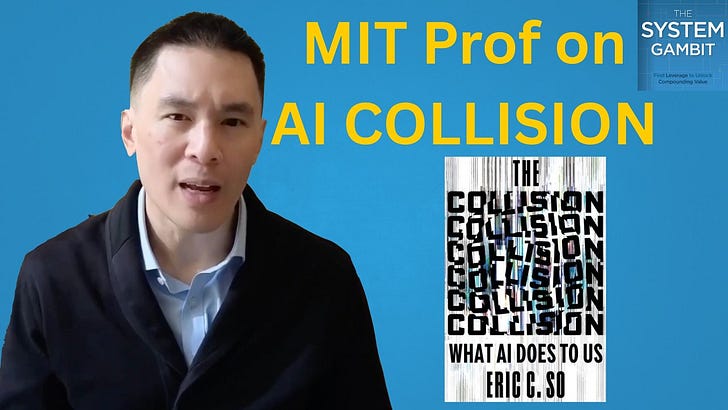
Every time you hand a task to AI, you make two decisions.The first is visible: get this done. The second is invisible: stop getting better at this.Most people only see the first one.
Today, practically all writing about AI asks what the technology will do next. Eric So, who teaches AI at MIT, asks a question with a longer shelf life: given what we already know about how humans think, learn, and compete, what happens when you place a machine that thinks into that environment?
His new book, The Collision: What AI Does to Us, makes almost no predictions about AI. It takes decades of established science about people and treats AI as a new variable in their environment. That choice is why the ideas hold up. Below are the models from our two hours together that stayed with me, especially the ones that run against intuition.
1. The Dream Team Fallacy
The intuition is simple. Take an elite human, add an elite machine, and you get the best of both. A doctor with AI should beat a doctor without it, and a strong analyst with a strong model should beat either one working alone.
The evidence says otherwise. Study after study finds that the combination often performs worse than the human alone or the machine alone. Eric’s explanation is that the two do not add together like ingredients in a recipe. They combine like chemicals in a reaction, where each one changes how the other behaves.
The main mechanism is anchoring. The picture people have in mind is two independent thinkers stress-testing each other. What happens in practice is that the machine speaks first, the human latches onto its answer, and the rest of the session is spent adjusting around it. The human stops contributing an independent view, which was the whole point of including the human.
The practical lesson: decide in advance which work goes to the human alone, which to the machine alone, and which to both. When you do combine them, form your own view before you look at the machine’s.
2. The Ratchet
Your brain is about 2 percent of your body mass and burns about 20 percent of your energy. Evolution built you to cut that cost whenever something offers to carry it, which makes a machine that thinks for you the most tempting offer your brain has ever received.
Now add competition. You do not need to see a colleague use AI. You only need to suspect it, and the suspicion pulls you in. Your use then pulls them in further. This is a prisoner’s dilemma, and the mechanism that keeps it moving is a ratchet: each turn is easy to make and very hard to reverse.
The subtle part is what the ratchet does to institutions. Eric described colleagues attending seminars on how to make their assignments “AI-proof.” Each redesign assumes every student will use AI, which quietly removes the option of doing the work unassisted. Once the system is redesigned around universal use, the choice to abstain no longer appears on the menu at all.
3. Capability Has No Shelf Life
Most organizations treat skill as inventory. You build it once, store it, and retrieve it when needed. Eric calls this assumption one of the most common and costly errors he sees in business.
The brain works differently. People who learned to juggle grew measurable brain matter in the regions responsible for hand-eye coordination within weeks, and within a few months of stopping, that growth receded. Skill is a state you maintain through use, and the brain reclaims what you stop using.
AI makes this dangerous because the output stays high while the capability underneath it drains. The essay still reads well and the code still runs, so the gauge reads full right up to the moment you need the skill and find it gone. Eric admitted on air that after thirty years of programming, he now mostly types instructions into an interface. He also named a loss he suspects but has not yet tested: thinking through a problem without a machine to argue with.
4. Work Is a Chain, and the Cheap Link Holds It Together
AI is good at tasks. Jobs are sequences of tasks. The pitch deck is one link, and presenting it, defending it under questioning, and adjusting it in the room are the links that follow. Outsource the first link and you weaken every link downstream, because the understanding you would have built while making the deck is the understanding you need when someone challenges it.
The same logic applies to junior roles. Many firms now use AI as a reason to hire fewer junior people, because their grunt work looks easy to automate. That grunt work is how senior people get made. A tennis academy that stopped junior players from hitting against the wall, because wall practice produces no trophies, would have no champions in ten years.
Rory Sutherland’s hotel doorman makes the same point from a different angle. A consultant sees a salary for opening a door and recommends cutting it. The consultant does not see the greeting, the help with luggage, the security, or the impression of quality that justified the room rate. The cost appears on a spreadsheet. The value was never written down.
5. The Skill-Biased Paradox
Economists call AI a skill-biased technology. Its benefits go mostly to people who already have expertise, because they know which questions to ask and can tell a good answer from a plausible one.
The paradox is in where that expertise came from. Eric built his through years of formative struggle before generative AI existed, and he doubts he would ask the same questions today if he had skipped that struggle. Today’s experts are the last generation trained without the shortcut. The tool amplifies exactly the expertise it makes harder to build, and that leaves every organization with an open question: where will the next generation of experts come from?
6. When Polish Is Free, Signals Collapse
A tailored cover letter used to tell an employer that a candidate cared enough to do the work. Now anyone can produce one in seconds, so it signals nothing. Eric pointed to research showing what employers do next: they fall back on older signals, such as which university you attended and whom you know.
The people who lose are the capable outsiders, whose effort was the only signal they had. Ramanujan reached Hardy through a cold letter full of mathematics. In today’s inbox, filled with polished messages that cost nothing to write, it is worth asking whether that letter would get read.
7. Guard or Cede
The useful question is which work AI should do, and the answer depends on who you are. Eric gives coding to AI because his value lives in the questions he asks as a researcher. A security engineer who did the same would be giving away the core of the job. Eric calls the parts of your work that define your value your signature thinking skills. Guard those, and let the machine have the rest.
One subtle point he added after finishing the book: even “harmless” uses carry a cost. Asking AI for a first outline or a brainstorm anchors your thinking before you have explored the problem yourself. The blank page is uncomfortable, and some of its value lies in that discomfort.
The System Gambit is a rigorous guide to the one strategic move that most investors and operators never make: