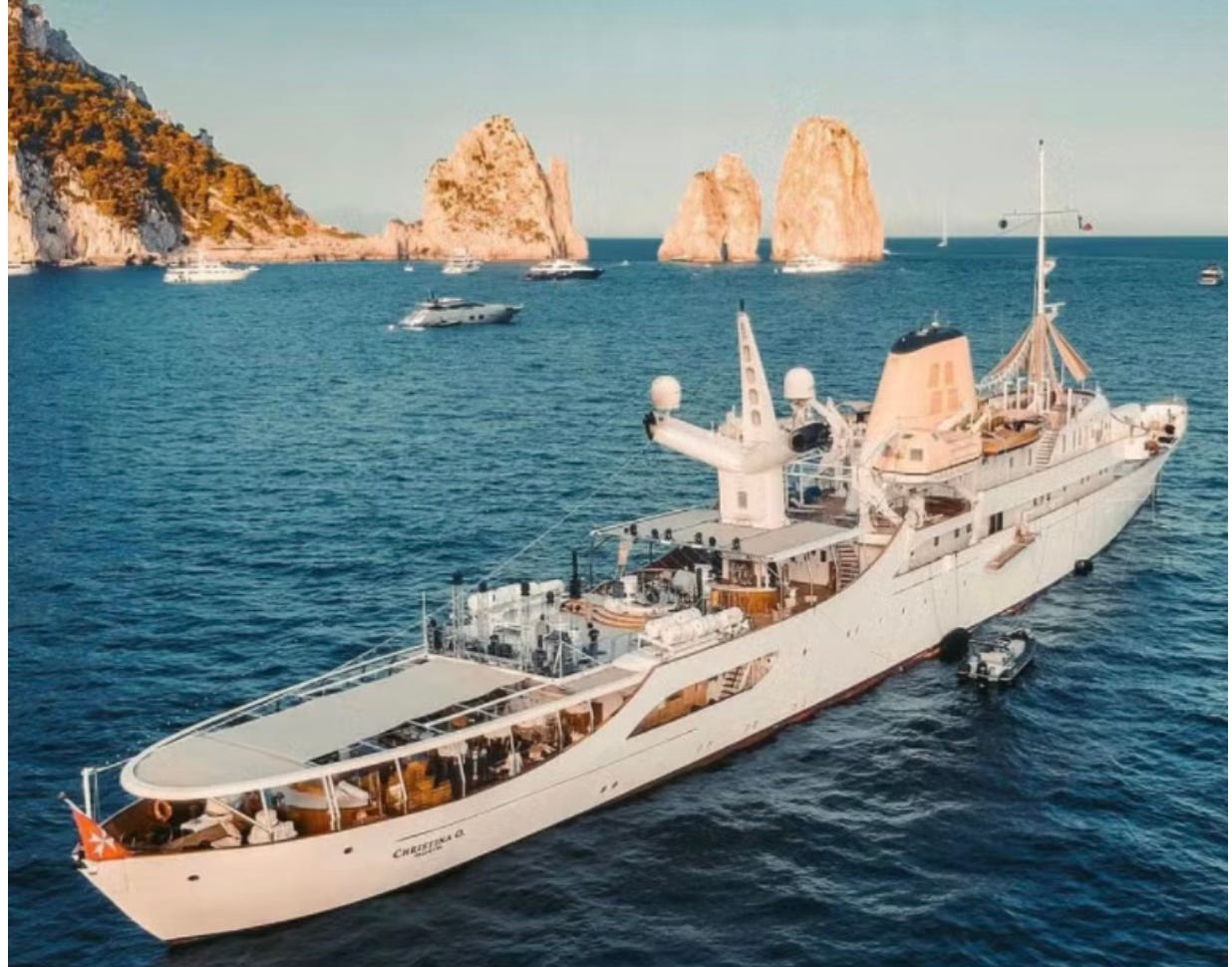
Prologo: La dimensione dell’impossibile
Novantanove metri di acciaio, teak e ambizione nel 1954 non erano semplicemente “grandi”. Erano un’anomalia. Erano una provocazione fisica alla scala umana del lusso.
Quando il Christina solcava il Mediterraneo, gli altri yacht sembravano tender da diporto. Era come portare un teatro dell’opera in mezzo al mare — e infatti, era esattamente quello che era.
Ma il vero genio non stava nelle dimensioni. Stava in ciò che quelle dimensioni permettevano.
I. Il laboratorio sociale: dove le gerarchie si dissolvevano
A terra, esistono protocolli. Sale separate per capi di Stato, tavoli riservati per industriali, zone blindate per teste coronate.
Sul Christina, tutto questo collassava.
Winston Churchill beveva ouzo con marinai greci.Maria Callas cantava mentre Greta Garbo fumava in silenzio nell’angolo.John Kennedy ascoltava aneddoti di guerra mentre Jackie prendeva il sole con gli altri ospiti.Frank Sinatra e Marilyn Monroe si mescolavano a magnati del petrolio.
Non era democrazia. Era un esperimento controllato di prossimità forzata.
Novantanove metri sono abbastanza grandi da ospitare il potere, ma abbastanza piccoli da impedire la fuga. A bordo, non esistevano uscite di sicurezza sociali. Dovevi restare, interagire, negoziare la tua presenza.
Il paradosso della distanza
Lo yacht era lontano dalla terraferma, quindi lontano da giornalisti, da cronache ufficiali, da verbali.
Ma proprio per questo diventava il luogo dove accadevano le cose vere:
* Gli accordi che non potevano essere firmati in un ufficio
* Le alleanze che non potevano essere fotografate
* Le conversazioni che non sarebbero mai finite in un memorandum
Era il backstage del XX secolo. E Onassis ne era il custode.
II. La corte galleggiante: Onassis come regista invisibile
Aristotele Onassis non era un armatore. Era un direttore di casting della storia.
Sapeva chi far salire a bordo, quando, e con chi. Ogni invito era una mossa. Ogni cena, una scacchiera.
La drammaturgia del bar della balena
Il leggendario Ari’s Bar — con i tavolini illuminati che mostravano la storia della navigazione, i famosi sgabelli ricoperti in pelle di balena, l’atmosfera da confessionale del potere — non era kitsch. Era teatro puro.
Quel bar diceva: “Qui le regole normali non valgono”.
E infatti:
* Churchill vi passava ore, bicchiere in mano, a raccontare la guerra con una franchezza che non avrebbe mai avuto a Downing Street. Tra il 1958 e il 1965 tornò otto volte — era l’unico ospite per cui Onassis cedeva la sua suite.
* JFK e Churchill si incontrarono per la prima volta proprio lì, nel 1958. Jackie scherzò che Churchill aveva scambiato Kennedy per un cameriere per via della sua giacca bianca da sera.
* Richard Burton ed Elizabeth Taylor vi trascorrevano serate davanti al camino del salone Lapis, trasformando ogni weekend in un dramma privato.
Non era ospitalità. Era regia.
Il potere di chi controlla lo spazio
Onassis aveva capito una cosa fondamentale: chi controlla l’ambiente, controlla la conversazione.
A terra, un capo di Stato può sempre andarsene, un magnate può sempre chiamare il suo ufficio, un’attrice può sempre ritirarsi in camerino.
Sul Christina, l’unica via d’uscita era il mare. E Onassis era il capitano.
III. Il ribaltamento dei rapporti di forza
Esiste un momento, a bordo di uno yacht, in cui il passeggero più potente del mondo si rende conto di una cosa:
Non è più lui a comandare.
Churchill, l’ospite ricorrente
Winston Churchill — l’uomo che aveva guidato un impero in guerra — saliva sul Christina e diventava... un ospite.
Non nel senso formale, ma in quello psicologico.
Dipendeva da Onassis per il tragitto, per la rotta, per il menu, per la compagnia. E in quella dipendenza simbolica si creava una relazione inedita: il magnate greco che offriva protezione (narrativa, scenica, sociale) al leone britannico.
Churchill non aveva bisogno dello yacht. Ma voleva quel mondo. Voleva quel senso di sospensione. Voleva quella libertà di essere semplicemente Winston, senza dover essere Churchill.
La biblioteca dello yacht porta ancora oggi il suo nome, in onore di quelle ore passate a leggere e dormire tra i libri, lontano dai riflettori.
Kennedy: il futuro presidente in prova
Quando John F. Kennedy salì sul Christina — ancora senatore, ancora in ascesa — non stava solo facendo una crociera.
Stava entrando in un’altra orbita sociale. Stava venendo osservato, valutato, presentato.
Nel 1959, durante il secondo incontro con Churchill (questa volta su richiesta dell’anziano statista), Kennedy parlò delle sue ambizioni presidenziali e del problema della sua fede cattolica. Churchill rispose: “Se questo è l’unico problema, puoi sempre cambiare religione e restare comunque un buon cristiano” — provocando una risata di Kennedy.
Onassis sapeva che quel giovane democratico americano poteva diventare qualcosa. E lo mise in scena. Lo fece interagire con industriali europei, con intellettuali, con vecchi lupi di mare della politica.
Il Christina non era neutrale. Era un filtro, un setaccio dove il potere futuro veniva testato sotto gli occhi del potere presente.
IV. La grande mondanità del mare: l’invenzione di un genere
Prima del Christina, il lusso nautico era una questione di eleganza britannica, di regate royal, di panfili sobri e silenziosi.
Dopo il Christina, il lusso nautico diventò teatro sociale.
L’estetica dell’eccesso intelligente
Onassis non costruì uno yacht discreto. Costruì uno yacht narrativo.
Ogni dettaglio era progettato per essere raccontato:
* I rubinetti placcati in oro (sì, erano veri)
* Le mosaici di Creta nei bagni — la vasca di Onassis ispirata a quella del mitico Minosse
* Il camino di Lapis Lazuli nel salone
* La piscina con mosaici minoici sul fondo che si trasformava in pista da ballo con un pannello mobile (meccanismo originale del 1956, funzionante ancora oggi)
Non era cattivo gusto. Era narrazione materiale. Ogni oggetto diceva: “Qui succede qualcosa di epico”.
E la stampa internazionale lo confermava. Ogni volta che il Christina attraccava, i fotografi erano già lì.
L’invenzione della “jet set aquatica”
Il Christina ha creato un’estetica che ancora oggi domina:
* Lo yacht come status symbol supremo
* Il Mediterraneo come palcoscenico estivo del potere
* La barca come luogo dove le cose accadono
Prima c’erano navi da crociera e panfili privati.Dopo, c’erano yacht come luoghi mitologici.
Sul Christina si celebrarono due dei ricevimenti di nozze più famosi del secolo: quello del Principe Ranieri e Grace Kelly, e quello di Onassis stesso con Jackie Kennedy nel 1968.
V. Gli attori inconsapevoli
La cosa più affascinante del Christina è che i suoi ospiti non sapevano di recitare.
Greta Garbo pensava di essere in vacanza. In realtà era parte di una coreografia più grande. Occupava la cabina Ithaca — quella di Christina Onassis — ogni volta che saliva a bordo.
Maria Callas credeva di essere lì per amore. In realtà era l’icona perfetta per completare il cast. Amava rilassarsi sul ponte poppiero, vicino alla piscina con i mosaici cretesi.
Jackie Kennedy pensava di fuggire dal lutto. In realtà stava entrando nel capitolo più fotografato della sua vita.
Onassis aveva capito che il vero potere non è far fare alle persone ciò che vuoi tu.
È creare un ambiente dove le persone fanno esattamente ciò che vuoi, credendo che sia stata una loro scelta.
Epilogo: Il teatro che continua
Alcuni yacht sono finiti nei musei. Altri sono stati smantellati.
Il Christina ha attraversato morti e rinascite.
Alla morte di Onassis nel 1975, lo yacht passò a sua figlia Christina e a Jackie Kennedy. Entrambe rifiutarono l’eredità. Il governo greco lo ribattezzò Argo e lo lasciò decadere fino agli anni ‘90.
Nel 1998 lo salvò John Paul Papanicolaou, amico della famiglia Onassis, che lo restaurò completamente tra il 1999 e il 2001 nei cantieri Viktor Lenac in Croazia. Gli restituì il nome Christina O — la “O” in tributo ad Onassis.
Oggi il Christina O naviga ancora. È disponibile per charter di lusso a circa 700.000-740.000 euro a settimana, può ospitare 34 ospiti in 18 cabine, e continua ad attirare chi vuole camminare sui ponti dove hanno camminato giganti.
L’Ari’s Bar è intatto. I mosaici minoici della piscina sono stati restaurati. Il salone Lapis Lazuli dove Jackie e Ari celebrarono il loro ricevimento è ancora lì. La biblioteca di Churchill conserva il suo nome.
Nel 2022 lo yacht è apparso in Triangle of Sadness, film vincitore della Palma d’Oro. Nel 2023 Rupert Murdoch lo ha noleggiato per una riunione di famiglia a Positano.
Il Christina O non è un relitto del passato.
È un teatro ancora in funzione, dove chi sale a bordo continua a recitare — spesso senza saperlo — la stessa scena che recitarono Churchill, Kennedy, Callas e tutti gli altri.
Perché la sua eredità non è negli oggetti. È nel modello.
Ha dimostrato che:
* Il lusso può essere un linguaggio politico
* Lo spazio può ribaltare i rapporti di forza
* Il mare può essere il set perfetto per riscrivere le gerarchie terrestri
Onassis non ha solo comprato uno yacht.
Ha inventato un genere: la mondanità galleggiante come forma di potere.
E per qualche decennio, su quei novantanove metri di teatro ambulante, il mondo ha recitato la sua parte migliore — senza sapere che qualcuno, dal ponte di comando, stava dirigendo ogni scena.
by Andrea Baracco
(English Follows)
Hai apprezzato questo articolo? Condividilo con chi potrebbe amarlo quanto te!
Se il Christina O ha inventato l’epoca d’oro dei superyacht, oggi quell’eredità di stile continua attraverso collaborazioni che portano il DNA dei più grandi marchi automobilistici sull’acqua. Scoprite come l’eleganza scultorea di Mercedes ha ridefinito il concetto di lusso moderno in mare.👇
Iscriviti a Yacht Lounge, è gratuito. Un click ti apre un mondo di racconti autentici, lontani dai soliti schemi.
Christina. The Theater Of Power.
Prologue: The Dimension of the Impossible
Ninety-nine meters of steel, teak, and ambition in 1954 weren’t simply “large.” They were an anomaly. A physical provocation to the human scale of luxury.
When the Christina sailed through the Mediterranean, other yachts looked like recreational tenders. It was like bringing an opera house to sea—and in fact, that’s exactly what it was.
But the true genius wasn’t in the dimensions. It was in what those dimensions allowed.
I. The Social Laboratory: Where Hierarchies Dissolved
On land, protocols exist. Separate rooms for heads of state, reserved tables for industrialists, secured zones for crowned heads.
On the Christina, all of this collapsed.
Winston Churchill drank ouzo with Greek sailors.Maria Callas sang while Greta Garbo smoked silently in the corner.John Kennedy listened to war anecdotes while Jackie sunbathed with other guests.Frank Sinatra and Marilyn Monroe mingled with oil magnates.
It wasn’t democracy. It was a controlled experiment in forced proximity.
Ninety-nine meters are large enough to host power, but small enough to prevent escape. On board, there were no social safety exits. You had to stay, interact, negotiate your presence.
The Paradox of Distance
The yacht was far from land, therefore far from journalists, official chronicles, minutes.
But precisely for this reason it became the place where real things happened:
* Deals that couldn’t be signed in an office
* Alliances that couldn’t be photographed
* Conversations that would never end up in a memorandum
It was the backstage of the 20th century. And Onassis was its keeper.
II. The Floating Court: Onassis as Invisible Director
Aristotle Onassis wasn’t a shipowner. He was a casting director of history.
He knew who to bring on board, when, and with whom. Every invitation was a move. Every dinner, a chessboard.
The Dramaturgy of the Whale Bar
The legendary Ari’s Bar—with its illuminated tables showing the history of navigation, the famous whale-leather covered stools, the atmosphere of a confessional of power—wasn’t kitsch. It was pure theater.
That bar said: “Normal rules don’t apply here.”
And indeed:
* Churchill spent hours there, glass in hand, recounting the war with a frankness he would never have had at Downing Street. Between 1958 and 1965 he returned eight times—he was the only guest for whom Onassis would yield his suite.
* JFK and Churchill met for the first time right there, in 1958. Jackie joked that Churchill had mistaken Kennedy for a waiter because of his white dinner jacket.
* Richard Burton and Elizabeth Taylor spent evenings in front of the Lapis lounge fireplace, turning every weekend into a private drama.
It wasn’t hospitality. It was direction.
The Power of Controlling Space
Onassis had understood something fundamental: whoever controls the environment, controls the conversation.
On land, a head of state can always leave, a magnate can always call his office, an actress can always retire to her dressing room.
On the Christina, the only way out was the sea. And Onassis was the captain.
III. The Reversal of Power Relations
There’s a moment, on board a yacht, when the world’s most powerful passenger realizes something:
He’s no longer in command.
Churchill, the Recurring Guest
Winston Churchill—the man who had led an empire through war—would board the Christina and become... a guest.
Not in the formal sense, but in the psychological one.
He depended on Onassis for the journey, the route, the menu, the company. And in that symbolic dependence, an unprecedented relationship was created: the Greek magnate offering protection (narrative, scenic, social) to the British lion.
Churchill didn’t need the yacht. But he wanted that world. He wanted that sense of suspension. He wanted that freedom to be simply Winston, without having to be Churchill.
The yacht’s library still bears his name today, in honor of those hours spent reading and sleeping among the books, away from the spotlight.
Kennedy: The Future President on Trial
When John F. Kennedy boarded the Christina —still a senator, still rising—he wasn’t just taking a cruise.
He was entering another social orbit. He was being observed, evaluated, presented.
In 1959, during the second meeting with Churchill (this time at the request of the elderly statesman), Kennedy spoke of his presidential ambitions and the problem of his Catholic faith. Churchill replied: “If that’s the only problem, you can always change your religion and still remain a good Christian”—provoking Kennedy’s laughter.
Onassis knew that young American Democrat could become something. And he staged him. He made him interact with European industrialists, intellectuals, old political sea wolves.
The Christina wasn’t neutral. It was a filter, a sieve where future power was tested under the eyes of present power.
IV. The Great Worldliness of the Sea: The Invention of a Genre
Before the Christina, nautical luxury was a matter of British elegance, royal regattas, sober and silent yachts.
After the Christina, nautical luxury became social theater.
The Aesthetics of Intelligent Excess
Onassis didn’t build a discreet yacht. He built a narrative yacht.
Every detail was designed to be recounted:
* Gold-plated faucets (yes, they were real)
* Cretan mosaics in the bathrooms—Onassis’s bathtub inspired by that of the mythical Minos
* The Lapis Lazuli fireplace in the lounge
* The pool with Minoan mosaics on the bottom that transformed into a dance floor with a mobile panel (original 1956 mechanism, still functioning today)
It wasn’t bad taste. It was material narration. Every object said: “Something epic happens here.”
And the international press confirmed it. Every time the Christina docked, photographers were already there.
The Invention of the “Aquatic Jet Set”
The Christina created an aesthetic that still dominates today:
* The yacht as the supreme status symbol
* The Mediterranean as the summer stage of power
* The boat as a place where things happen
Before there were cruise ships and private yachts.After, there were yachts as mythological places.
Two of the century’s most famous wedding receptions were celebrated on the Christina: that of Prince Rainier and Grace Kelly, and that of Onassis himself with Jackie Kennedy in 1968.
V. The Unwitting Actors
The most fascinating thing about the Christina is that its guests didn’t know they were acting.
Greta Garbo thought she was on vacation. In reality she was part of a larger choreography. She occupied the Ithaca cabin—Christina Onassis’s—every time she boarded.
Maria Callas believed she was there for love. In reality she was the perfect icon to complete the cast. She loved relaxing on the aft deck, near the pool with Cretan mosaics.
Jackie Kennedy thought she was escaping grief. In reality she was entering the most photographed chapter of her life.
Onassis had understood that true power isn’t making people do what you want.
It’s creating an environment where people do exactly what you want, believing it was their choice.
Epilogue: The Theater That Continues
Some yachts ended up in museums. Others were dismantled.
The Christina went through deaths and rebirths.
At Onassis’s death in 1975, the yacht passed to his daughter Christina and Jackie Kennedy. Both refused the inheritance. The Greek government renamed it Argo and let it decay until the 1990s.
In 1998 John Paul Papanicolaou, a friend of the Onassis family, saved it, completely restoring it between 1999 and 2001 at the Viktor Lenac shipyards in Croatia. He returned the name Christina O—the “O” in tribute to Onassis.
Today the Christina O still sails. It’s available for luxury charter at approximately 700,000-740,000 euros per week, can accommodate 34 guests in 18 cabins, and continues to attract those who want to walk on the decks where giants walked.
Ari’s Bar is intact. The Minoan mosaics of the pool have been restored. The Lapis Lazuli lounge where Jackie and Ari celebrated their reception is still there. Churchill’s library preserves his name.
In 2022 the yacht appeared in Triangle of Sadness, the Palme d’Or winning film. In 2023 Rupert Murdoch chartered it for a family reunion in Positano.
The Christina O is not a relic of the past.
It’s a theater still in operation, where those who board continue to act—often without knowing it—the same scene that Churchill, Kennedy, Callas and all the others acted.
Because its legacy isn’t in the objects. It’s in the model.
It demonstrated that:
* Luxury can be a political language
* Space can reverse power relations
* The sea can be the perfect set to rewrite terrestrial hierarchies
Onassis didn’t just buy a yacht.
He invented a genre: floating worldliness as a form of power.
And for a few decades, on those ninety-nine meters of traveling theater, the world performed its best part—without knowing that someone, from the bridge, was directing every scene.
by Andrea Baracco
Enjoyed this article? Share it with someone who would love it too!
While the Christina O invented the golden age of superyachts, today that legacy of style continues through collaborations that bring the DNA of the greatest automotive brands to the water. Discover how Mercedes’ sculptural elegance has redefined the concept of modern luxury at sea.👇
Subscribe to Yacht Lounge – it’s free. One click and you’ll discover a world of authentic stories, beyond the ordinary.
Podcast 🇺🇸 voice here 👉